Denemek ALTIN - Özgür
The Hubble Space Telescope Is Still Awesome
Scientific American
|May 2026
Hubble is going strong despite its decades in space and next-generation successors
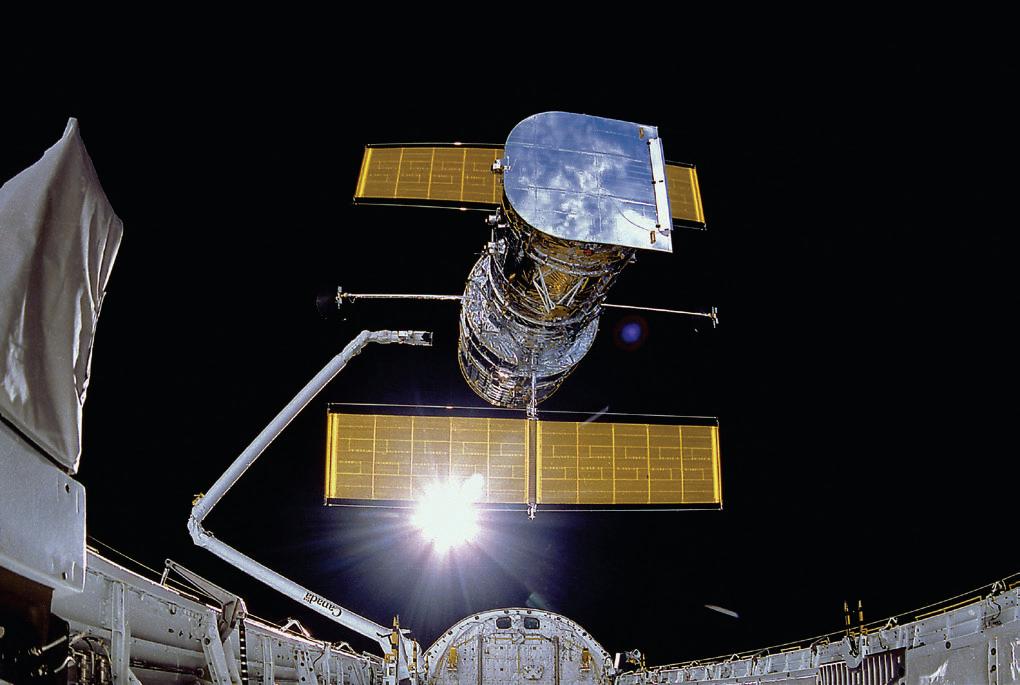
ON APRIL 24, 1990, HUMANITY LAUNCHED a scientific revolution.
I mean “launched” literally: on that date the space shuttle Discovery roared into the sky with the Hubble Space Telescope nestled in its cargo bay. The telescope was on a mission destined to forever change our view of the universe. Hubble wasn’t the largest telescope ever—its 2.4-meter mirror is actually considered small these days—but being above the atmosphere gave it superpowers. Our air boils and roils, blurring the views from ground-based instruments. It glows, too—dimly but enough to limit how faint an object astronomers can see. And our air absorbs most ultraviolet and infrared light—interesting wavelengths, cosmically speaking. Getting up, up and away from all that atmosphere made Hubble one of the most important telescopes ever built.
It revolutionized astronomy. Hubble saw objects fainter than had ever been observed before. The telescope homed in on the speed of universe expansion, watched weather changes on the outer planets and proved that every big galaxy has a supermassive black hole at its heart, just to name three amazing feats off the top of my head. The major breakthroughs and discoveries that came out of this magnificent satellite are so numerous, really, that even listing them here would be excessive (and a bit tedious, if incredible astronomical exploration could ever be tedious).
Yet despite these successes, I see a lot of chatter online (and even in the news) somewhat cavalierly dismissing Hubble, saying NASA’s James Webb Space Telescope (JWST) is Hubble’s “replacement.” That’s not just unfair; it’s wrong. JWST was never intended to supplant the Hubble telescope, and in fact it can't, given that it was designed for very different observations.

Bu hikaye Scientific American dergisinin May 2026 baskısından alınmıştır.
Binlerce özenle seçilmiş premium hikayeye ve 9.000'den fazla dergi ve gazeteye erişmek için Magzter GOLD'a abone olun.
Zaten abone misiniz? Oturum aç
Scientific American'den DAHA FAZLA HİKAYE

Scientific American
The Quiet Math Problem That Runs the Planet
How Diffie-Hellman key exchange secures everything from your text messages to government secrets

7 mins
May 2026

Scientific American
The Fog of Science
Did an adversary just invent a world-changing weapon, or are they making it up? DARPA is building an AI to instantly call their bluff
4 mins
May 2026
Scientific American
The Hubble Space Telescope Is Still Awesome
Hubble is going strong despite its decades in space and next-generation successors
4 mins
May 2026

Scientific American
Meet America's Native Bees
Scientists estimate there are about 4,000 species of native bees in the U.S.
5 mins
May 2026

Scientific American
The Chemistry of Desire
Inside the secretive laboratories where scientists build novel molecules to make luxury fragrance feel like pure emotion
5 mins
May 2026
Scientific American
Scanning the Stone
As ore gets harder to find, the mining industry is turning to subatomic-particle sensors to push deep underground
8 mins
May 2026

Scientific American
YOUR HEART IN FLAMES
Inflammation may be the true cause of cardiovascular diseaseand there's a drug to treat it
13 mins
May 2026

Scientific American
Ancient Lexicon
Stone Age art may reveal a 40,000-year-old precursor to writing
2 mins
May 2026

Scientific American
Thermal Breakthrough
A new super heat conductor challenges fundamental physics
2 mins
May 2026
Scientific American
How to Vacation in Space
Planned orbital hotels promise luxury, but can they deliver?
4 mins
May 2026
Listen
Translate
Change font size