
Magzter GOLD ile Sınırsız Olun
Sadece 9.000'den fazla dergi, gazete ve Premium hikayeye sınırsız erişim elde edin
Denemek ALTIN - Özgür
The Ethics of AI Art
Scientific American
|June 2026
When people understand AI-generated art’s underlying system and process, its moral implications become harder to accept
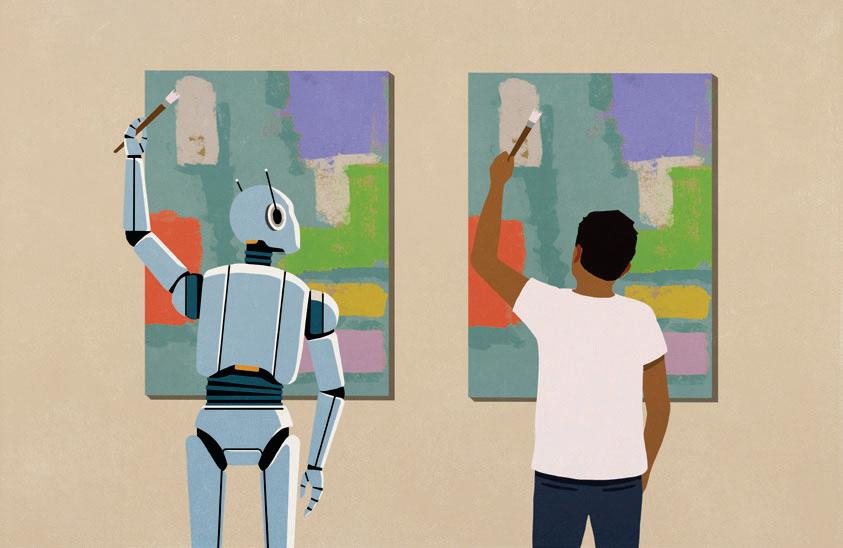
IN EARLY 2025 AUCTION HOUSE Christie’s in New York City sold an unusual collection of art pieces. Surreal portraits, photorealistic images and cartoon-inspired creations, all generated by artificial intelligence, raked in more than $700,000, beating sale estimates. The first-of-its-kind event also sparked a backlash. More than 6,000 artists protested that the AI models used to create these works had been trained on copyrighted images without creator consent. Although the auction house had argued that the works demonstrated “human agency in the age of AI,” critics saw the event as an example of an industry rushing to commercialize technology built on uncompensated creative labor.
Other artistic and professional communities have also been worried. A report released last November found that more than half of novelists surveyed in the U.K. thought AI could end their career. Many authors believed that their work had already been used without consent to train large language models and that AI was flooding the market with low-quality prose. Audiences seem to have complicated feelings about the technology, too. As one survey found, many Americans are okay with AI as a tool for creative professionals but not as a replacement for their work.
A viewer’s comfort with AI art, however, may depend on how much they know about the way it was made. I study neuroaesthetics, a field that combines neuroscience, psychology, and our perception of beauty and art. My colleagues and I have found that the more people learn about how AI’s back end works—the datasets, training process and prompting—the less comfortable they are with the moral considerations surrounding these creations and the value of AI-generated pieces.

Bu hikaye Scientific American dergisinin June 2026 baskısından alınmıştır.
Binlerce özenle seçilmiş premium hikayeye ve 9.000'den fazla dergi ve gazeteye erişmek için Magzter GOLD'a abone olun.
Zaten abone misiniz? Oturum aç
Scientific American'den DAHA FAZLA HİKAYE

Scientific American
War in Plain Sight
Near-real-time satellite coverage means militaries can no longer hide. So they are learning to lie better

4 mins
June 2026

Scientific American
A Bridge-Crossing Puzzle Led to New Math
Are you smarter than an 18th-century Prussian?
5 mins
June 2026
Scientific American
Nocturnal Navigation
These ants use a sophisticated lunar compass
2 mins
June 2026
Scientific American
Early Plates
Scientists found the oldest direct evidence for Earth’s tectonic motion
3 mins
June 2026

Scientific American
Mating Arm
Reproduction in octopuses is even weirder than you think
3 mins
June 2026

Scientific American
Battleship Science
Game-playing AI can show us how to do science better
2 mins
June 2026

Scientific American
WHAT’S A QUANTUM COMPUTER GOOD FOR, ANYWAY?
Quantum computing promises profound power in cryptography, materials design, telecommunications, and much more. But those dreams won’t become reality overnight—if ever
11 mins
June 2026

Scientific American
Atomic Snowflakes
Could each atom in the universe be unique?
2 mins
June 2026

Scientific American
The New Moon Race
The triumphant Artemis II mission marks a new era of lunar exploration and science. Here’s how it went down and what comes next
7 mins
June 2026

Scientific American
What’s Wrong with Quantum Mechanics
A 100-year-old theory might explain the confusion
6 mins
June 2026
Listen
Translate
Change font size