
Magzter GOLD ile Sınırsız Olun
Sadece 9.000'den fazla dergi, gazete ve Premium hikayeye sınırsız erişim elde edin
Denemek ALTIN - Özgür
New Ways to Keep Muscle as You Age
Scientific American
|June 2026
Ozempic, similar drugs and aging take off muscle. New therapies could retain it
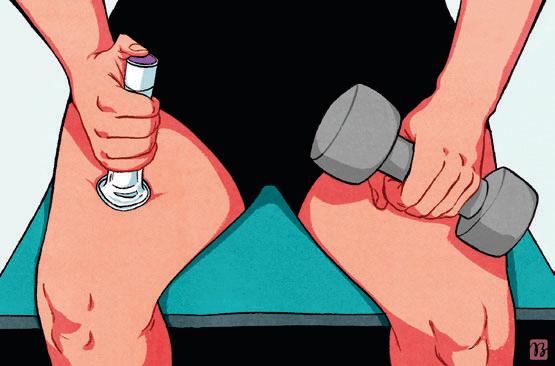
DRUGS SUCH AS WEGOVY and Ozempic can lead to profound weight loss, but fat isn’t the only thing that comes off. About 25 to 40 percent of the pounds shed through these treatments is lean body mass, and that includes muscle. This undesired effect has troubled older adults who are already worried about age-related muscle loss tied to falls and bone fractures. Preserving muscle matters for young adults as well: the more you have in your 30s, the more you will retain in your 60s. Losing any amount of muscle can amplify the risk of various health issues, such as declines in physical and metabolic function.
Every weight-loss intervention—including diets, bariatric surgery and glucagonlike peptide 1 (GLP-1) receptor agonist medicine such as Wegovy—melts muscle alongside fat to some degree. Now the widespread use of GLP-1 drugs is spurring scientists to work on experimental medications that could enable weight loss that barely affects muscle at all.
Muscle offers more than physical strength. These bands of fibrous tissue are important sites for storing and metabolizing glucose or for burning it for energy. A person’s muscle mass is also a strong predictor of their mobility later in life. Between our 20s and 80s we gradually lose around 30 percent of our muscle. Research suggests that GLP-1 drugs may speed up this process. Clinical trials on semaglutide (the GLP-1 sold as Wegovy and Ozempic, for example) and tirzepatide (sold as Zepbound and Mounjaro) estimate that within a few years of starting treatment, people may experience a loss of muscle mass equal to 20 years of age-related decline.

Bu hikaye Scientific American dergisinin June 2026 baskısından alınmıştır.
Binlerce özenle seçilmiş premium hikayeye ve 9.000'den fazla dergi ve gazeteye erişmek için Magzter GOLD'a abone olun.
Zaten abone misiniz? Oturum aç
Scientific American'den DAHA FAZLA HİKAYE

Scientific American
War in Plain Sight
Near-real-time satellite coverage means militaries can no longer hide. So they are learning to lie better

4 mins
June 2026

Scientific American
A Bridge-Crossing Puzzle Led to New Math
Are you smarter than an 18th-century Prussian?
5 mins
June 2026

Scientific American
Nocturnal Navigation
These ants use a sophisticated lunar compass
2 mins
June 2026
Scientific American
Early Plates
Scientists found the oldest direct evidence for Earth’s tectonic motion
3 mins
June 2026

Scientific American
Mating Arm
Reproduction in octopuses is even weirder than you think
3 mins
June 2026
Scientific American
Battleship Science
Game-playing AI can show us how to do science better
2 mins
June 2026

Scientific American
WHAT’S A QUANTUM COMPUTER GOOD FOR, ANYWAY?
Quantum computing promises profound power in cryptography, materials design, telecommunications, and much more. But those dreams won’t become reality overnight—if ever
11 mins
June 2026
Scientific American
Atomic Snowflakes
Could each atom in the universe be unique?
2 mins
June 2026

Scientific American
The New Moon Race
The triumphant Artemis II mission marks a new era of lunar exploration and science. Here’s how it went down and what comes next
7 mins
June 2026

Scientific American
What’s Wrong with Quantum Mechanics
A 100-year-old theory might explain the confusion
6 mins
June 2026
Listen
Translate
Change font size