Denemek ALTIN - Özgür
Humans Are Not So Special After All
Scientific American
|September 2025
Whales mourn, magpies exhibit self-awareness, and Venus flytraps make memories.
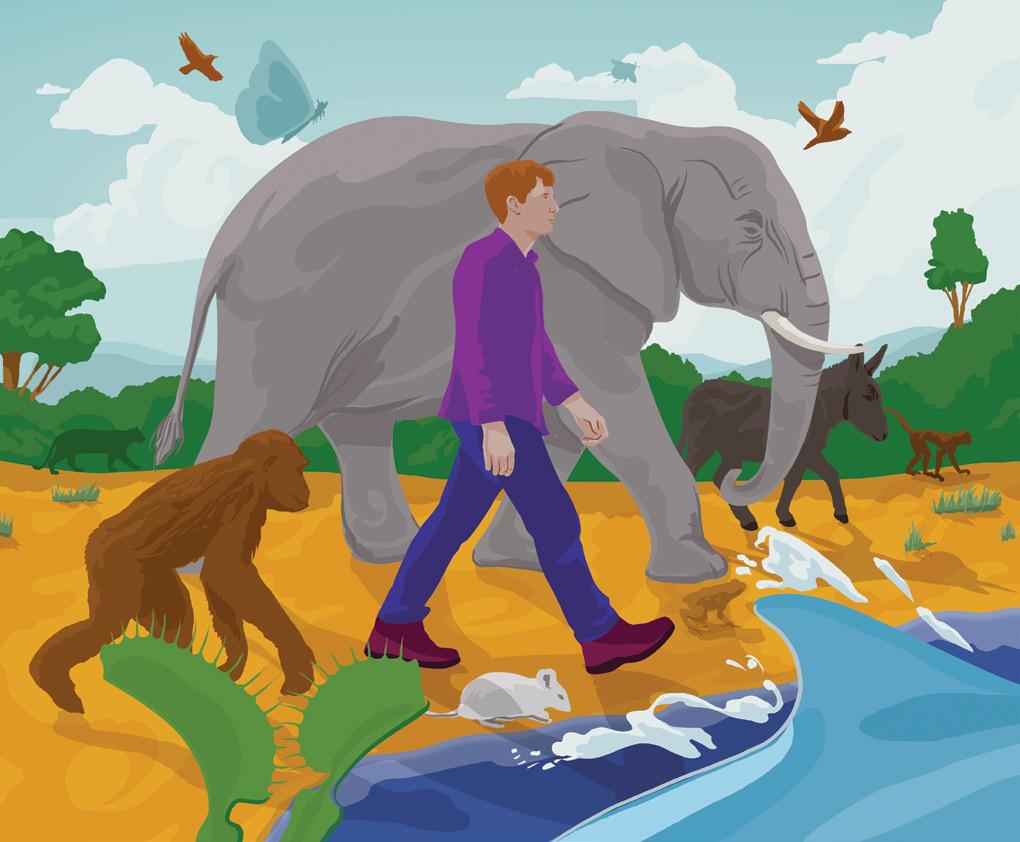
IT WAS THE TELEGRAM EXCHANGE that sparked an identity crisis for humankind. In 1960 a young Jane Goodall working in a remote forest in Tanzania observed a chimpanzee she named David Greybeard using blades of grass and twigs to fish nutritious termites out of their nest. The primatologist wrote to her mentor, Kenyan paleoanthropologist Louis Leakey, to tell him about her observation, which flew in the face of the conventional wisdom that held that only humans made tools.
For decades—centuries, even—scholars have attempted to draw a hard line between our kind and the other organisms with whom we share the planet. They have argued that only humans have culture—sets of learned behaviors, such as toolmaking, that are passed down from generation to generation. They have proposed that only humans think symbolically, using signs to represent objects or ideas. That our species alone is self-aware, capable of planning for the future and experiencing emotions such as joy and fear, love and grief. That only humans are conscious, possessed of an inner world of subjective experience.
For his part, Charles Darwin, writing in the late 1800s, opined that nonhuman animals have the same cognitive abilities and emotions that humans have and that any differences were a matter of degree and not kind. In the absence of any way to reliably read animal minds, however, scientists who studied animal behavior and cognition took the position that ascribing human thoughts, feelings and motivations to animals—anthropomorphism—was a cardinal sin. But in recent decades examples of other species demonstrating these capabilities have emerged from across the tree of life. The findings have spurred fresh thinking about what, exactly, distinguishes Homo sapiens, with our vaunted intellect, from every other species on Earth.

Bu hikaye Scientific American dergisinin September 2025 baskısından alınmıştır.
Binlerce özenle seçilmiş premium hikayeye ve 9.000'den fazla dergi ve gazeteye erişmek için Magzter GOLD'a abone olun.
Zaten abone misiniz? Oturum aç
Scientific American'den DAHA FAZLA HİKAYE
Scientific American
Flashes in the Night
Celestial transients shine furiously and briefly. Astronomers are just beginning to understand them.

13 mins
January 2026
Scientific American
The Imperiled Orcas of the Salish Sea
The southern resident killer whales are on the brink. Now the scientists who study them are, too
17 mins
January 2026
Scientific American
The Reptile Sexpocalypse
The sex of many turtles, crocodilians, and other reptiles is determined by the temperature at which their eggs incubate. Global warming could doom them
11 mins
January 2026

Scientific American
A Suite of Killers
Heart ailments, kidney diseases and type 2 diabetes actually may be part of just one condition. It's called CKM syndrome
10 mins
January 2026
Scientific American
A Good Night's Sleep
Psychological data and brain scans show all the ways sleep can improve our lives, our bodies and our relationships
1 mins
January 2026
Scientific American
Behind the Nobel
A 2025 winner reflects on the mysterious T cells that won him the prize
5 mins
January 2026
Scientific American
Cable Quakes
Fiber optics that connect the world can detect its earthquakes, too
2 mins
January 2026
Scientific American
Inside Asteroid Family Trees
Asteroid origins can be hard to trace
4 mins
January 2026
Scientific American
Think Again
Chimpanzees can weigh evidence and update their beliefs like humans do.
3 mins
January 2026

Scientific American
Cracking the World's Most Famous Code
Solving the CIA's Kryptos puzzle took three parts math and one part sleuthing
6 mins
January 2026
Listen
Translate
Change font size