Denemek ALTIN - Özgür
Gut Check
Scientific American
|September 2025
Microbes in the human intestines may absorb dangerous PFAS
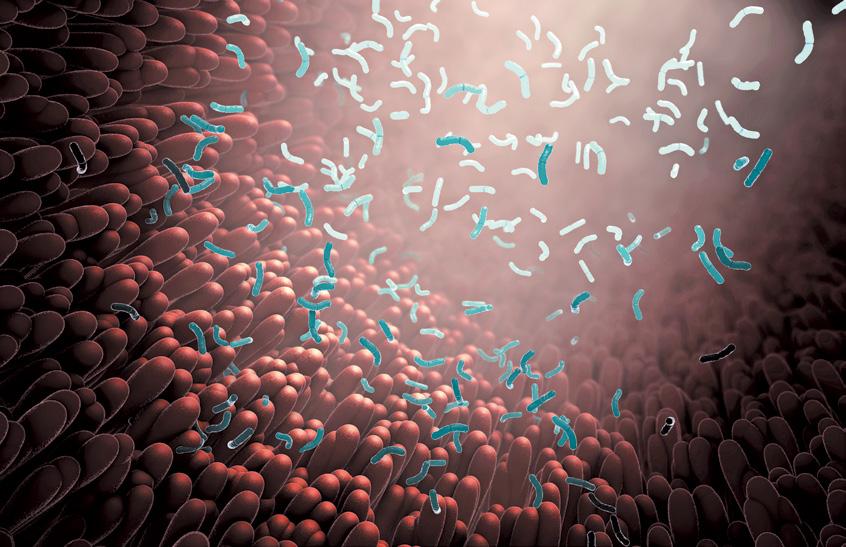
LURKING IN OUR NONSTICK PANS, our rain jackets and even our drinking water are toxic compounds known as perfluoroalkyl and polyfluoroalkyl substances (PFAS), also called “forever chemicals.” They can take hundreds of years to break down in the environment and are increasingly being detected in human blood and bodily tissues—where, research suggests, they can lead to several cancers and reproductive disorders, as well as thyroid disease and a weakened immune system. Scientists have been scrambling to find ways to remove PFAS from our surroundings before they reach human bodies. But one team may have found a way to tackle them afterward, too.
Bacteria commonly found in the human gut, such as Bacteroides uniformis and Odoribacter splanchnicus, could possibly be used to gather up PFAS and carry them out as waste, scientists suggest in a study published recently in Nature Microbiology.
“I think this research provides us a little glimmer of hope that it’s not all doom and gloom” when it comes to the PFAS problem, says study senior author Kiran Patil, a molecular biologist at the University of Cambridge. “Our bacteria—that have been our companions for thousands of years—may already be helping us do something about it.”

Bu hikaye Scientific American dergisinin September 2025 baskısından alınmıştır.
Binlerce özenle seçilmiş premium hikayeye ve 9.000'den fazla dergi ve gazeteye erişmek için Magzter GOLD'a abone olun.
Zaten abone misiniz? Oturum aç
Scientific American'den DAHA FAZLA HİKAYE
Scientific American
Flashes in the Night
Celestial transients shine furiously and briefly. Astronomers are just beginning to understand them.

13 mins
January 2026

Scientific American
The Imperiled Orcas of the Salish Sea
The southern resident killer whales are on the brink. Now the scientists who study them are, too
17 mins
January 2026
Scientific American
The Reptile Sexpocalypse
The sex of many turtles, crocodilians, and other reptiles is determined by the temperature at which their eggs incubate. Global warming could doom them
11 mins
January 2026

Scientific American
A Suite of Killers
Heart ailments, kidney diseases and type 2 diabetes actually may be part of just one condition. It's called CKM syndrome
10 mins
January 2026
Scientific American
A Good Night's Sleep
Psychological data and brain scans show all the ways sleep can improve our lives, our bodies and our relationships
1 mins
January 2026

Scientific American
Behind the Nobel
A 2025 winner reflects on the mysterious T cells that won him the prize
5 mins
January 2026
Scientific American
Cable Quakes
Fiber optics that connect the world can detect its earthquakes, too
2 mins
January 2026

Scientific American
Inside Asteroid Family Trees
Asteroid origins can be hard to trace
4 mins
January 2026
Scientific American
Think Again
Chimpanzees can weigh evidence and update their beliefs like humans do.
3 mins
January 2026

Scientific American
Cracking the World's Most Famous Code
Solving the CIA's Kryptos puzzle took three parts math and one part sleuthing
6 mins
January 2026
Listen
Translate
Change font size