Denemek ALTIN - Özgür
Fascinating Plumes
Scientific American
|December 2025
Saturn's moon Enceladus has complex, life-friendly chemistry
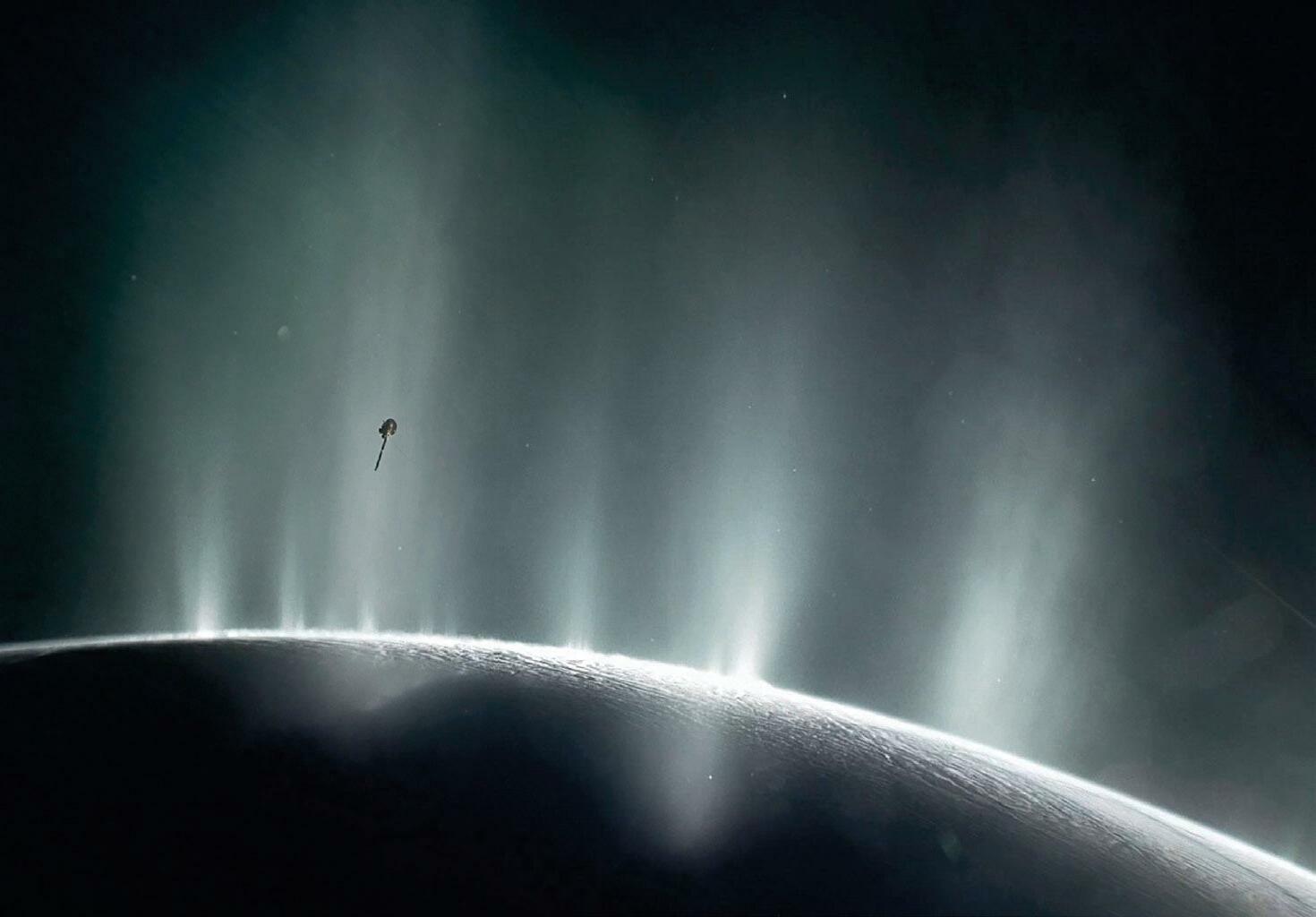
Artist's depiction of Cassini sampling plumes from the subsurface ocean of Saturn's icy moon Enceladus
ENCELADUS, a 500-kilometer-wide moon of Saturn, has been a top target in the hunt for extraterrestrial life for nearly two decades. In 2005, shortly after arriving in orbit around the ringed planet, the joint NASA-European Space Agency (ESA) Cassini mission found plumes of water spraying up from Enceladus's south pole—clinching evidence that the moon harbored a liquid-water ocean underneath its bright-white icy crust. Astrobiologists have become ever more enthralled by Enceladus as further studies of the plumes' ice grains have revealed multiple molecular building blocks of life blasting out from the hidden ocean.
Now scientists revisiting data from Cassini, which ended its mission to Saturn in 2017, have spied even more tantalizing ingredients in the plumes: suites of complex organic molecules that, on Earth, are involved in the chemistry associated with even bigger compounds considered essential for biology. The discovery, published in Nature Astronomy, bolsters the case for followup missions to search for signs of life within this enigmatic moon.
Its remoteness from Earth isn't the only thing that has let Enceladus keep so many secrets for so long. The Cassini orbiter wasn't really designed for deep scrutiny of a single, specific object in Saturn's system, says Nozair Khawaja, a planetary scientist at the Free University of Berlin, who led the Nature Astronomy study. Cassini launched nearly 30 years ago, back when Enceladus's subsurface ocean and south polar plumes were unknown. Repurposing its vintage kit for in-depth astrobiology was difficult—not least because of how hard the resulting data were to work with.

Bu hikaye Scientific American dergisinin December 2025 baskısından alınmıştır.
Binlerce özenle seçilmiş premium hikayeye ve 9.000'den fazla dergi ve gazeteye erişmek için Magzter GOLD'a abone olun.
Zaten abone misiniz? Oturum aç
Scientific American'den DAHA FAZLA HİKAYE
Scientific American
Flashes in the Night
Celestial transients shine furiously and briefly. Astronomers are just beginning to understand them.

13 mins
January 2026
Scientific American
The Imperiled Orcas of the Salish Sea
The southern resident killer whales are on the brink. Now the scientists who study them are, too
17 mins
January 2026
Scientific American
The Reptile Sexpocalypse
The sex of many turtles, crocodilians, and other reptiles is determined by the temperature at which their eggs incubate. Global warming could doom them
11 mins
January 2026

Scientific American
A Suite of Killers
Heart ailments, kidney diseases and type 2 diabetes actually may be part of just one condition. It's called CKM syndrome
10 mins
January 2026
Scientific American
A Good Night's Sleep
Psychological data and brain scans show all the ways sleep can improve our lives, our bodies and our relationships
1 mins
January 2026

Scientific American
Behind the Nobel
A 2025 winner reflects on the mysterious T cells that won him the prize
5 mins
January 2026
Scientific American
Cable Quakes
Fiber optics that connect the world can detect its earthquakes, too
2 mins
January 2026
Scientific American
Inside Asteroid Family Trees
Asteroid origins can be hard to trace
4 mins
January 2026
Scientific American
Think Again
Chimpanzees can weigh evidence and update their beliefs like humans do.
3 mins
January 2026
Scientific American
Cracking the World's Most Famous Code
Solving the CIA's Kryptos puzzle took three parts math and one part sleuthing
6 mins
January 2026
Listen
Translate
Change font size