Denemek ALTIN - Özgür
safety from numbers
Down To Earth
|February 16, 2023
Over-exploitation of some Himalayan towns due to huge influx of people and vehicles can be dealt with by developing more tourist spots and through targeted afforestation and solid waste management measures

THE INDIAN Himalayan region, with its rich biodiversity, glaciers, water resources and cultural diversity, attracts a large number of visitors from all over the world. According to government think tank niti Aayog, as of 2018, West Bengal sees the highest inflow of tourists, while the northwestern and central Himalayan states and Union Territories (UTs) of Jammu and Kashmir, Himachal Pradesh, Uttarakhand, Assam, Meghalaya, Sikkim and Tripura also record large numbers. Arunachal Pradesh, Manipur, Mizoram and Nagaland have a relatively lower inflow.
The Himalayan region offers conditions suitable for several activities, including recreation, adventure or religious pilgrimages. Tourism is also an important source of income and livelihood for people living in these states and UTs. Ensuring that these activities take place in a sustainable manner, from the grassroots to the top levels, is not a difficult but certainly a challenging task. Over the last year, the Union government has laid emphasis on promoting sustainable tourism in the Himalayan region. In June 2022, the Union Ministry of Tourism launched the National Strategy for Sustainable Tourism and Responsible Traveller Campaign in a summit organised in partnership with UN Environment Programme and the Responsible Tourism Society of India. The strategy document focuses on promotion of environmental, economic and socio-cultural sustainability; protection of biodiversity; capacity-building and governance among other aspects. There is also recognition on need for greater investment in green infrastructure with more efficient transport facilities, reduced air pollution, conservation of heritage sites and open spaces.
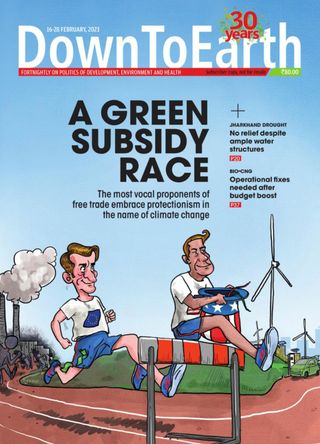

Bu hikaye Down To Earth dergisinin February 16, 2023 baskısından alınmıştır.
Binlerce özenle seçilmiş premium hikayeye ve 9.000'den fazla dergi ve gazeteye erişmek için Magzter GOLD'a abone olun.
Zaten abone misiniz? Oturum aç
Down To Earth'den DAHA FAZLA HİKAYE

Down To Earth
BEYOND COLLATERAL DAMAGE
Recent geopolitical conflicts are urging a reconsideration of what constitutes environmental harm in war and the limits of existing legal frameworks

3 mins
April 01, 2026

Down To Earth
Masterstroke
Residents of a small Kerala town reject an inadequate state-led development blueprint and create their own master plan that prioritises protection of historic water systems and urban commons
4 mins
April 01, 2026

Down To Earth
Rethinking E20
It is pertinent to explore potential of ethanol as high-value industrial feedstock
4 mins
April 01, 2026
Down To Earth
Food in the age of climate change
WHEN WE eat, we contribute to climate change. But food is also about livelihoods, about nutrition and about nature.
3 mins
April 01, 2026

Down To Earth
FADING WINTER
India's winters are warming, becoming shorter, shifting and spilling beyond their traditional bounds. The consequences are already evident in meltwater availability, forest-fire intensity and changes in flowering cycles and insect behaviour.
20 mins
April 01, 2026

Down To Earth
War on Iran strikes India's pharmaceuticals sector
Shortages of critical raw materials and rising input costs for the drug industry will have global consequences
4 mins
April 01, 2026

Down To Earth
POWER IN AN AGE OF INSECURITY
Energy transition is no longer solely about emission reduction but also about energy security
3 mins
April 01, 2026
Down To Earth
Re-discovery of fuelwood
THE WEST Asia conflict has made visible a multi-billion dollar energy market in India.
2 mins
April 01, 2026

Down To Earth
A CASE THAT RESHAPED INDIA'S ENVIRONMENT
The case of MC Mehta v Union of India stands as proof that a proactive judiciary can accelerate action even when the executive drags its feet
4 mins
April 01, 2026
Down To Earth
FOREVER DEPENDENT
India depends on global fertiliser supply chains for 70 per cent of its needs, leaving its food security exposed to geopolitical disruptions
6 mins
April 01, 2026
Translate
Change font size