Denemek ALTIN - Özgür
MISMEASURE OF A MOUNTAIN
Down To Earth
|January 16, 2026
Earthquakes in the Aravallis provide a cautionary tale

ABOUT 200 kilometres south of Delhi lies Bayana, a largely forgotten town in Rajasthan. Once famed for producing perhaps the world’s first and finest clear crystalline sugar, Bayana rivalled Agra and Delhi in wealth and grandeur. Its sugar owed its reputation to the town’s wells and their water. Then Bayana’s prestige waned. And eventually vanished altogether.
Environmental historians trace the town’s decline to a distant earthquake in 1505 and a gradual depletion of water. Bayana sits in the Bayana Basin, in the eastern part of the North Delhi Fold Belt, within an ancient chunk of the earth's crust known as the Aravalli Craton. The town rests atop undeformed sedimentary rocks formed from river-borne sand deposited in a shallow sea over millions of years. Over time, under high pressure and aided by pulses of immense heat from below, these sediments hardened into rocks between one to two billion years ago. What set in Bayana’s decline is perhaps one, or even two, earthquakes. Neither occurred beneath the town. The first one most likely struck Afghanistan. The Baburnama, the memoirs of the first Mughal emperor, records an earthquake that ruptured the ground at Paghman and Bektut, west of Kabul. It caused the river Kabul to swerve tens of metres away from its old course. Another earthquake, possibly a discrete one, occurred in Kumaon and the western Himalaya of Nepal. Paghman lies nearly 2,000 km away to the northwest and Kumaon-West Nepal's epicentre is at least 400 km north of Bayana, as the crow flies. Perched atop heat- and pressure-tempered sandstone-and-quartzite shoulders of the Aravallis, Bayana perished not because a quake struck below it, but because one struck far away.
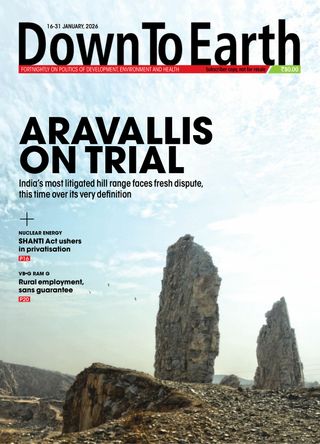

Bu hikaye Down To Earth dergisinin January 16, 2026 baskısından alınmıştır.
Binlerce özenle seçilmiş premium hikayeye ve 9.000'den fazla dergi ve gazeteye erişmek için Magzter GOLD'a abone olun.
Zaten abone misiniz? Oturum aç
Down To Earth'den DAHA FAZLA HİKAYE

Down To Earth
THE GREAT PIVOT
China's moves to transition to clean energy offer critical lessons to India

4 mins
March 01, 2026
Down To Earth
COAL V CORRIDOR
A proposal to mine coal along a corridor that links two tiger reserves in central India is a step away from getting final clearance. The move could affect movement and genetic diversity of tiger populations in the region
8 mins
March 01, 2026

Down To Earth
India's challenging AI predicament
Hobbled by lack of innovation and AI skills in its crucial technology sector, India is focusing on a ruinous plan to host data centres
4 mins
March 01, 2026
Down To Earth
China to implement zero tariffs across Africa
CHINA ON February 14 announced that it will implement zero tariffs for imports from all the 53 African nations it has diplomatic relations with, starting from May 1.
1 min
March 01, 2026
Down To Earth
Poverty, sans the threshold
MEASUREMENT OF poverty is a fundamental exercise, needed to direct development programmes.
2 mins
March 01, 2026
Down To Earth
A bridge across forever
For two decades, a Chhattisgarh village remains stuck in a loop of building temporary river crossings to access markets and sell forest produce
4 mins
March 01, 2026
Down To Earth
Liveable cities need a new model
CRY FOR my Delhi. This is my city—my family records many generations who have lived here.
3 mins
March 01, 2026

Down To Earth
Real impacts of the changing seasons
This refers to the article \"1,500 days, and an alarm for new climate\" (1-15 December, 2025).
1 mins
March 01, 2026

Down To Earth
‘It’s a systematic effort by US to dismantle climate policy’
The US, the world's largest historical emitter of greenhouse gases, has overturned its “endangerment finding”, the legal foundation for regulating emissions under the Clean Air Act since 2009.
4 mins
March 01, 2026
Down To Earth
Amazon turned carbon source in 2023 drought
EXTREME DROUGHT and a prolonged heatwave in 2023 pushed parts of the Amazon rainforest from acting as a carbon sink to becoming a carbon source for three months, according to a February 13 study published in the journal AGU Advances of the American Geophysical Union.
1 min
March 01, 2026
Listen
Translate
Change font size