Denemek ALTIN - Özgür
EASY TO SWITCH
Down To Earth
|December 01, 2022
Low-cost ethnoveterinary medicines can help curb the use of antibiotics in Indian dairy sector and combat the overlooked pandemic of antimicrobial resistance

SOME LIFESAVING solutions are so simple and obvious that they remain hidden in plain sight. This is particularly true for livestock disease treatments that have evolved over generations through experiences of communities, withstood the test of time, are embodied in local culture and practices and yet, the knowledge remains untapped in the absence of standardisation and scientific validation. More often than not, dairy farmers, and some field veterinarians, indiscriminately use antibiotics for treating even common infections in animals.
Researchers with Delhi-based Centre for Science and Environment (CSE) found evidence of such rampant misuse and overuse of antibiotics in 2020 and 2021, during consultations with dairy farmers and experts from various sectors such as animal husbandry, food safety, human health. They had observed that most dairy farmers skip the critical withdrawal period-a prescribed number of days during which the treated animal should be excluded from the milk supply chain to allow antibiotic residues to be excreted out of its body. In 2018, the Food Safety and Standards Authority of India (FSSAI) had also found antibiotic residues in milk samples.
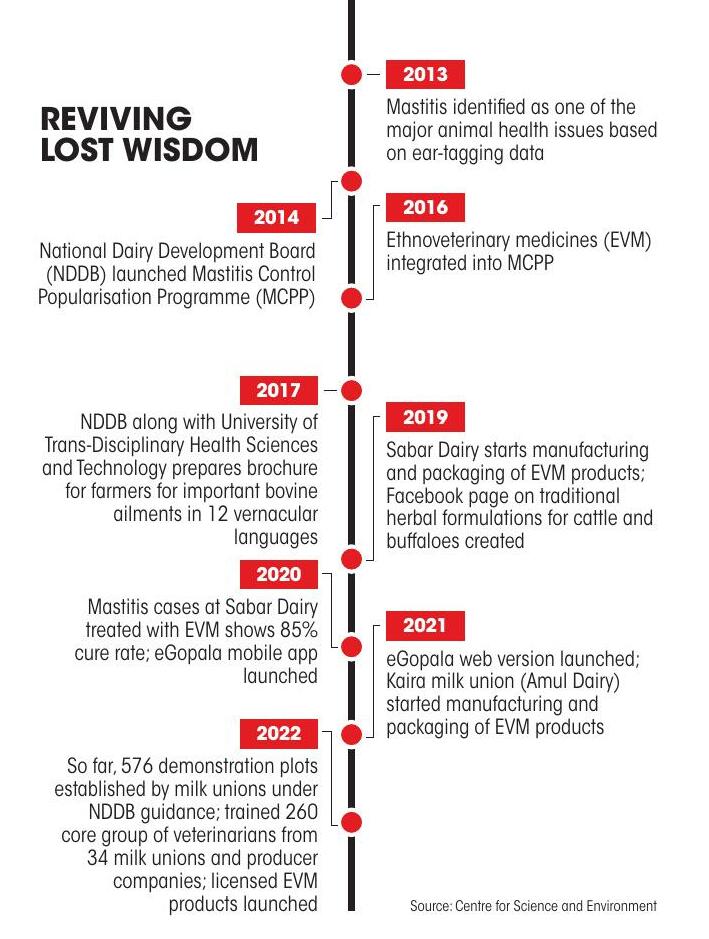
Such abuse of antibiotics not only adds to the treatment costs, but also increases the burden of antimicrobial resistance (AMR). Interaction between antibiotic residues and pathogens in various environmental matrices (soil and water) and in living organisms can lead to formation and spread of bacteria that are resistant to antibiotics. A comprehensive global study published in peer-reviewed journal The Lancet in January 2022, estimates that infections caused by these antibiotic-resistant bacteria played a part in the deaths of 4.95 million people in 2019 alone.

Bu hikaye Down To Earth dergisinin December 01, 2022 baskısından alınmıştır.
Binlerce özenle seçilmiş premium hikayeye ve 9.000'den fazla dergi ve gazeteye erişmek için Magzter GOLD'a abone olun.
Zaten abone misiniz? Oturum aç
Down To Earth'den DAHA FAZLA HİKAYE
Down To Earth
Popular distrust
THE WORLD seems to be going through a period of stasis despite facing an unfathomable polycrisis.

2 mins
February 01, 2026
Down To Earth
CONSERVE OR PERISH
Periyar Tiger Reserve has rewritten Indian conservation by turning poachers into protectors and conflict into coexistence
5 mins
February 01, 2026

Down To Earth
'Rivers need to run free'
From Tibet to West Bengal, the Brahmaputra is the pulse of communities and ecosystems along its course. But what are the risks the river faces through human interventions, particularly dams, discusses journalist, author and filmmaker SANJOY HAZARIKA in his new book, River Traveller.
4 mins
February 01, 2026

Down To Earth
India is facing up to its innovation lag
There are signs now that India is acknowledging the superior strides made by China in a frontier technology like Al
4 mins
February 01, 2026

Down To Earth
Competing concerns
What are the repercussions of the EU-Mercosur pact that have made European farmers protest against the free trade agreement?
4 mins
February 01, 2026

Down To Earth
From fryer to flight
Sustainable fuel made from used cooking oil can play a pivotal role in helping India achieve its aviation emission reduction goals. Measures to collect this oil must be revamped
4 mins
February 01, 2026

Down To Earth
ACCESS OPEN
An amendment to India's nodal forest conservation law opens up forests across India to commercial exploitation by the paper industry
6 mins
February 01, 2026
Down To Earth
DRINK FROM TAP CAN BE A REALITY
As cities across India struggle to supply safe piped water, Odisha offers a success story
2 mins
February 01, 2026

Down To Earth
GREAT DRYING
The Earth is hotter than at any point in the past 100,000 years, with 2023-25 becoming the warmest three-year period on record and also breaching the 1.5°C threshold for the first time. One fallout is dwindling freshwater.
22 mins
February 01, 2026

Down To Earth
Green redemption
Restoration of grasslands of Kerala's Pampadum Shola National Park, once dominated by invasive Australian wattles, see a return of streams and native species
1 mins
February 01, 2026
Translate
Change font size