
Magzter GOLD ile Sınırsız Olun
Sadece 9.000'den fazla dergi, gazete ve Premium hikayeye sınırsız erişim elde edin
Denemek ALTIN - Özgür
CEMENTING POSSIBILITIES
Down To Earth
|August 01, 2023
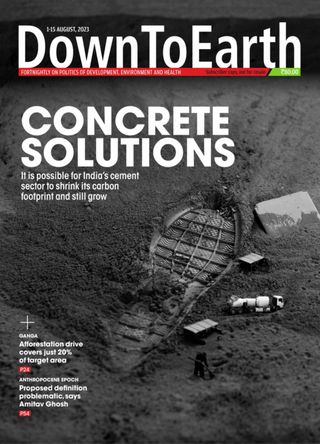
After water, cement is the most widely used material on the planet. It is also the second largest industrial emitter of carbon dioxide. Little wonder the sector is a priority target for decarbonisation to meet India' climate commitments. But the very nature of cement production makes elimination of carbon emissions a difficult, if not impossible, task. Here is a step-by-step strategy to turn this carbon-intensive industry into a carbon-lean one.

What water is to life, cement W is to the modern world. Since it was developed two centuries ago during an experiment by British bricklayer Joseph Aspdin, who heated a mix of limestone and clay to form a fine powder that hardened when exposed to water, cement has become the foundation of modern civilisation. Today it is the second most used material after water. Globally, a person uses 530 kg of cement on average in a year. The dependence on this robust and versatile construction material can be gauged from the fact that an individual in India consumes more than double the amount of cement than the staple food, rice-240 kg of cement in a year against 102 kg of rice.
The problem is that this staple of the modern life is also a major source of greenhouse gas (GHG) emissions. Production of 1 kg of cement releases almost an equal amount up to 0.8 kg-of carbon dioxide (CO₂). According to the International Energy Agency (IEA), the sector is considered to be the second largest industrial emitter in the world, and contributes about 7 per cent of CO₂ emissions globally. To put it in perspective, if the cement industry were a country it would be the third-largest emitter of CO,, after the US and China.

Bu hikaye Down To Earth dergisinin August 01, 2023 baskısından alınmıştır.
Binlerce özenle seçilmiş premium hikayeye ve 9.000'den fazla dergi ve gazeteye erişmek için Magzter GOLD'a abone olun.
Zaten abone misiniz? Oturum aç
Down To Earth'den DAHA FAZLA HİKAYE

Down To Earth
THINK TWICE BEFORE FELLING SAL TREES
Many trees considered to be affected by sal borer in the 1990s are still alive today

1 mins
February 16, 2026

Down To Earth
EDGE OF SURVIVAL
Caste divides deny marginalised communities land, resources and essential aid, leaving them more vulnerable to climate disasters
6 mins
February 16, 2026

Down To Earth
A WISH LIST?
Union Budget for 2026-27 conveys the impression of a roll-call of intentions and ambitious proposals, with little detail on their formulation
6 mins
February 16, 2026
Down To Earth
Break down the gender wall
THE RULING National Democratic Alliance (NDA) government has been heavily invested in the goal to make India a developed economy by 2047.
2 mins
February 16, 2026

Down To Earth
MENSTRUAL HEALTH, NOW A FUNDAMENTAL RIGHT
In a landmark judgement, the Supreme Court has recognised menstrual health and hygiene as a fundamental right under Article 21 of the Constitution of India, which guarantees the right to life and dignity.
8 mins
February 16, 2026

Down To Earth
Of devolution and new disasters
The 16th Finance Commission pushes for changes in view of new fiscal and climatic conditions
11 mins
February 16, 2026
Down To Earth
Rising risks of plastics
NEGATIVE IMPACTS on human health due to emissions linked to the plastic lifecycle could double by 2040, according to a study published in The Lancet Planetary Health in January.
1 min
February 16, 2026

Down To Earth
GAP BETWEEN EPIDEMICS NARROWING
A watershed-based and landscape-level approach is needed to address forest degradation
2 mins
February 16, 2026

Down To Earth
WAITING TO STRIKE
Sal heartwood borer is considered the biggest threat to forestry in India, especially to the sal tree, where it lives and breeds.
11 mins
February 16, 2026

Down To Earth
A SPRING DELIGHT
Mustard flowers are not meant only for the eyes. Invite them to your plate once in a while
3 mins
February 16, 2026
Translate
Change font size