Denemek ALTIN - Özgür
THE PLANETS
BBC Sky at Night Magazine
|August 2025
Our celestial neighbourhood in August
-
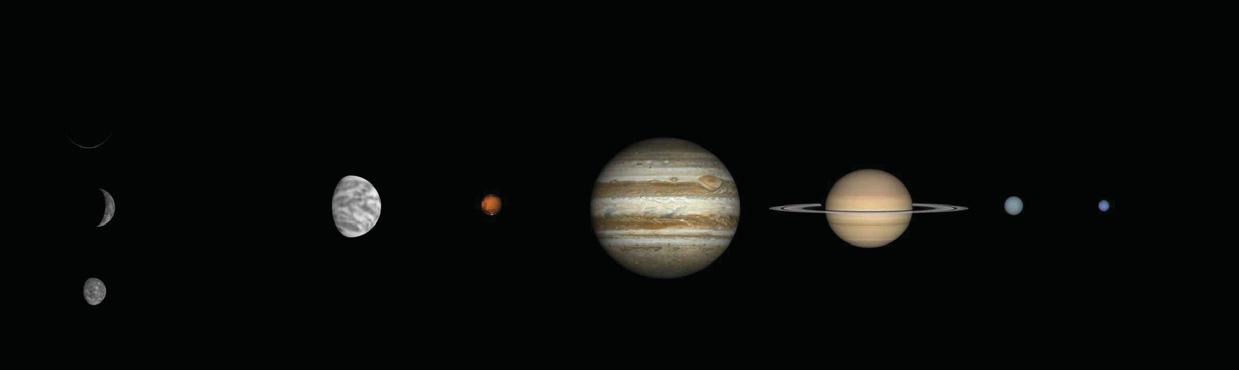
Uranus Best time to see: 31 August, 04:00 BST (03:00 UT) Altitude: 48° Location: Taurus Direction: Southeast Features: Colour, subtle atmospheric banding, moons Recommended equipment: 200mm or larger
It's surprising how rapidly darkness expands in August, which is perfect timing for viewing the planet Uranus, as by the end of the month it's able to reach a decent altitude above the southeast horizon before the onset of dawn.
On 1 August, morning twilight truncates the observing window at around 02:20 BST (01:20 UT), this distant world only achieving a peak altitude of around 16° on this date. For many years, Uranus has been in stellar limbo on the Aries–Taurus border. While not particularly difficult to track down, it has lacked bright guiding stars over this period – something that may have put off casual observation.
Having drifted further east at a painfully slow rate, the planet is now well and truly within Taurus and much more conveniently located immediately to the south of the Pleiades open cluster. On 31 August, the planet's eastern drift will have moved it into a position 4.5° south-southeast of the centre of the Pleiades.

Bu hikaye BBC Sky at Night Magazine dergisinin August 2025 baskısından alınmıştır.
Binlerce özenle seçilmiş premium hikayeye ve 9.000'den fazla dergi ve gazeteye erişmek için Magzter GOLD'a abone olun.
Zaten abone misiniz? Oturum aç
BBC Sky at Night Magazine'den DAHA FAZLA HİKAYE

BBC Sky at Night Magazine
Capture NLCs with a smartphone
Make this the summer that you nail a shot of beautiful night-shining clouds

3 mins
July 2026

BBC Sky at Night Magazine
ZWO Seestar S30 Pro smart telescope
ZWO Seestar S30 Pro smart telescope
4 mins
July 2026

BBC Sky at Night Magazine
The speed of light
The Universe has a speed limit - and it underpins everything we know about it. We explain the speed of light and its far-reaching implications for astronomy
2 mins
July 2026
BBC Sky at Night Magazine
COMETS AND ASTEROIDS
Can you spot dim, barely moving Pluto?
1 min
July 2026

BBC Sky at Night Magazine
THE SKY GUIDE CHALLENGE
What's the youngest Moon you can photograph? Try our ‘impossible’ challenge
2 mins
July 2026

BBC Sky at Night Magazine
Q&A WITH A SCIENCE COMMUNICATOR
As we find more planets in the habitable zones around other suns, we ask Neil deGrasse Tyson what would happen if we did meet intelligent alien life
3 mins
July 2026

BBC Sky at Night Magazine
Make an all-sky camera
How to set up an always-watching system to catch fleeting sky events
3 mins
July 2026

BBC Sky at Night Magazine
The Universe doesn't need a multiverse
The Universe doesn't need a multiverse The idea that there are many universes seems to solve our most stubborn cosmic mysteries. But, argues Brian Clegg, it's no substitute for hard evidence
2 mins
July 2026
BBC Sky at Night Magazine
Planets of mystery
Uranus and Neptune – visited just once, 40 years ago – are the least-known planets in our Solar System. Now 21st-century science has revealed they may not even be the ‘ice giants’ we thought. Joseph Phelan investigates
6 mins
July 2026
BBC Sky at Night Magazine
THE BIG THREE
The top sights to observe or image this month
4 mins
July 2026
Listen
Translate
Change font size