
Magzter GOLD ile Sınırsız Olun
Sadece 9.000'den fazla dergi, gazete ve Premium hikayeye sınırsız erişim elde edin
Denemek ALTIN - Özgür
Aliens on our doorstep
BBC Sky at Night Magazine
|February 2026
Could life be closer than we think? Ben Evans surveys the Solar System's likeliest hideouts - and what might live there

As far as we know, life in our Solar System emerged only here on Earth - the Sun's 'Goldilocks' planet - under conditions that were just right for liquid water to exist. Only here did life's ingredients take root. Only here did water, nutrients, an energy source, a clement atmosphere, survivable temperatures and pressures, and benign radiation fall happily into equilibrium.
Not long after its formation, the earliest life stirred. Multilayered 'microbial mats', fossilised 'stromatolites' – sediments created by photosynthetic organisms and precipitates from hydrothermal vents have been found that are at least 3.5 billion years old. Life, it seems, favoured Earth as enthusiastically as the fairytale Goldilocks favoured the baby bear's perfect porridge. But there are tantalising signs elsewhere in the Solar System that point to alien life having also taken root. Let's look at the most likely contenders.
Microbes on Mars
Our next-door planet, cinnamon-red Mars, is a desiccated, subfreezing, radiation-drenched place with a thin carbon dioxide atmosphere, no global magnetic field and surface pressures about 100 times weaker than Earth's.
Yet 3.7 billion years ago, Mars may have been quite different. Girdled by a thicker atmosphere, warmed by a moderate greenhouse effect and shielded from solar radiation by a stable magnetic field, it could have had higher surface temperatures - and even life.

Bu hikaye BBC Sky at Night Magazine dergisinin February 2026 baskısından alınmıştır.
Binlerce özenle seçilmiş premium hikayeye ve 9.000'den fazla dergi ve gazeteye erişmek için Magzter GOLD'a abone olun.
Zaten abone misiniz? Oturum aç
BBC Sky at Night Magazine'den DAHA FAZLA HİKAYE
BBC Sky at Night Magazine
The Giant Leap: Why Space is the Next Frontier in the Evolution of Life
“Earth is the cradle of humanity, but one cannot live in the cradle forever,” wrote Konstantin Tsiolkovsky in 1911.

1 mins
February 2026
BBC Sky at Night Magazine
Tele Vue Nagler Type-7 series eyepieces
These premium optics were inspired by Apollo - and deliver a giant leap to your views
4 mins
February 2026
BBC Sky at Night Magazine
Once Upon a Time in Space
While the Space Race of the Cold War years was ultimately a geopolitical contest between the USA and the Soviet Union, the rivalry sparked rapid innovation and inspired multiple generations to look skyward.
1 mins
February 2026
BBC Sky at Night Magazine
The Multiverse: When One Universe Isn't Enough
The concept of a 'multiverse' – the idea that our Universe may be just one of many – is widespread in science fiction and a common thread of online discussions.
1 mins
February 2026
BBC Sky at Night Magazine
Q&A WITH A GAMMA RAY SPECIALIST
In 2025, astronomers detected a blast from space that lasted seven hours. Now they're uncovering the strange processes behind the exceptional outburst
3 mins
February 2026
BBC Sky at Night Magazine
Astronomy Photographer of the Year
The world-leading astrophotography competition returns. Could your image take the top prize of £10,000?
2 mins
February 2026
BBC Sky at Night Magazine
MOONWATCH
February's top lunar feature to observe
2 mins
February 2026
BBC Sky at Night Magazine
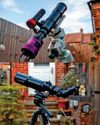
NOVAStar Scarlet A62Q 62mm f/8.4 quadruplet achromatic refractor
Well-built and capable, this beginner scope punches well above its bargain price
4 mins
February 2026
BBC Sky at Night Magazine
STAR OF THE MONTH
Rasalas, Leo the Lion's metal-rich crown
1 min
February 2026
BBC Sky at Night Magazine
Comet 24P/Schaumasse
Having reached perihelion on 8 January, comet 24P/ Schaumasse is now fading. Starting the month at a small-telescope-friendly mag. +10.5, it dims throughout February to below 12th magnitude.
1 min
February 2026
Listen
Translate
Change font size