Denemek ALTIN - Özgür
THE LOOMING NUCLEAR DANGER!
Geopolitics
|March 2023
The world is now without any armscontrol agreement with regard to nuclear weapons. The new START treaty, whose duration was extended up to 2026 by the two superpowers- USA and Russia, who between them have 90 percent of the world’s nuclear weapons, is now under suspension. Moscow has walked out of it because of what it says is the American-led war in Ukraine against Russia’s very survival.
-

The new START represented a 75 percent reduction in warheads since the end of the Cold War. Under it, both Russia and the United States agreed to limit the number of deployed warheads to no more than 1,550 by February 5, 2018. The treaty establishes that the number of warheads deployed on intercontinental ballistic missiles (ICBMs) and submarinelaunched ballistic missiles (SLBMs) is counted as the number of re-entry vehicles (RVs) on each missile. Heavy bombers are counted as one warhead against the total regardless of how many warheads they carry.
Number of launchers: The new START limits both parties to a maximum of 800 deployed and non-deployed ICBM and SLBM launchers. Of those 800, no more than 700 delivery systems may be deployed at any time. Neither party may convert ICBM or SLBM launchers into launchers for missile defence systems.
Accordingly, as of September 1, 2022, the US had 1,420 deployed warheads and 659 deployed strategic delivery systems, the US State Department had revealed. Russia had 1,549 deployed warheads attributed to 540 deployed strategic launchers. Combined, the two countries accounted for about 90 percent of the world’s nuclear weapons.
Importantly, within 45 days of new START’s entry into force, Russia and the United States were required to report the numbers of deployed warheads, and deployed and non-deployed missiles and delivery systems of strategic weapons. This information was compiled into a database, which is updated with changes every six months. Inspections are intended to verify the data that is exchanged between the two countries.
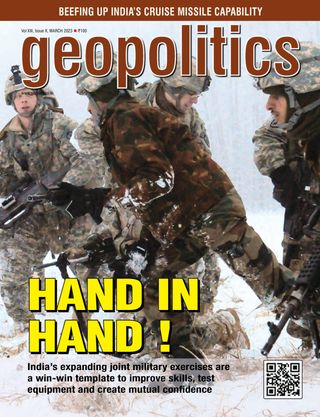

Bu hikaye Geopolitics dergisinin March 2023 baskısından alınmıştır.
Binlerce özenle seçilmiş premium hikayeye ve 9.000'den fazla dergi ve gazeteye erişmek için Magzter GOLD'a abone olun.
Zaten abone misiniz? Oturum aç
Geopolitics'den DAHA FAZLA HİKAYE

Geopolitics
Navy Advances Amphibious Carrier Evaluation
The Indian Navy has begun technical evaluations for its proposed Landing Helicopter Dock warship programme, widely viewed as a step toward developing a compact, drone-enabled aircraft-carrier capability.

1 min
May 2026

Geopolitics
Indigenous Engine Materials Near Completion
MIDHANI has reportedly completed nearly half of the specialised alloy development work required for India's proposed 120kN engine intended for the Advanced Medium Combat Aircraft programme, with around 80 per cent of the materials already certified.
1 mins
May 2026

Geopolitics
Sheshnag Swarms Transform Battlefield Dynamics
Bengaluru-based NewSpace Ben Hechnologies is preparing to Research Sheshnag-20 swarming loitering munition system for trials with the Indian Army following successful developmental testing.
1 min
May 2026
Geopolitics
MPATGM Nears Production Clearance Milestone
India's indigenous Man-Portable Anti-Tank Guided Missile programme has moved closer to final production approval following successful moving-target trials.
1 min
May 2026
Geopolitics
India Accelerates Future Combat Drones
India is accelerating the development of multiple manned-unmanned teaming programmes under the Combat Air Teaming System initiative as the country prepares for the next generation of network-centric aerial warfare.
1 min
May 2026
Geopolitics
THE IRON RENAISSANCE
India is committing ₹57,000 crore to overhaul its ageing Soviet-era tank fleet into a digital warfighting force. The transformation comes as China's Type 15 tanks loom on Himalayan ridgelines and Ukraine's battlefield lessons echo worldwide. The country's engineers are reimagining the very concept of the tank for a new era of combat. A Special Report
8 mins
May 2026

Geopolitics
THE ALGORITHMIC BATTLEFIELD IS THE FUTURE
As India is confronted with a critical strategic question of whether to prioritise indigenous development or to rely on foreign Artificial Intelligence technologies to guarantee sovereignty and security, JOSEPH P CHACKO analyses indigenous capabilities and the dependence versus self-reliance debate, as well as Al implementations in surveillance, threat detection, and decision support systems within the Indian defence framework.
14 mins
May 2026
Geopolitics
Rafale Partnership Structure Faces Overhaul
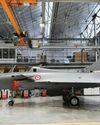
India is reportedly examining a major restructuring of the Dassault Reliance Aerospace Limited (DRAL) venture, with discussions underway regarding the induction of a new private-sector partner to strengthen Rafale-related manufacturing and maintenance operations in the country.
1 mins
May 2026

Geopolitics
INDIA'S DEFENCE VISION-2047: CLARITY BEFORE CAPABILITY
While the outlined roadmap for the Indian defence forces to emerge as the best in the world by the time the country celebrates 100 years of independence is timely, argues that one should not rush into creating theatre commands before becoming self-reliant in defence manufacturing.
6 mins
May 2026

Geopolitics
Indigenous Blast Capabilities Expand Rapidly
Sagar Defence Engineering has secured an explosives manufacturing licence, marking a major milestone in the company's expansion into indigenous defence production and reinforcing India's broader push towards strategic self-reliance in military technologies.
1 min
May 2026
Translate
Change font size