Denemek ALTIN - Özgür
Lessons for India as importance grows of electronic warfare in modern conflicts
The Sunday Guardian
|April 13, 2025
In the evolving realm of modern warfare, the contours of conflict have expanded far beyond the traditional domains of land, air, and sea.
Today, the electromagnetic spectrum has emerged as a decisive battlefield, where the ability to control, disrupt, or protect communications and surveillance systems can determine the outcome of military engagements. Electronic Warfare (EW), once seen as a support function, has now become a strategic force multiplier in contemporary conflicts, offering unparalleled advantages in intelligence, deterrence, and operational effectiveness. For India, facing a complex and volatile security environment, the Indian Army's growing focus on developing and deploying robust EW capabilities is not only timely but essential.
Electronic warfare involves the use of electromagnetic energy to detect, intercept, disrupt, and protect communication, radar, and navigation systems. It is broadly categorized into three domains: Electronic Support (ES), which involves detecting and analyzing enemy emissions; Electronic Attack (EA), which entails jamming or deceiving enemy systems; and Electronic Protection (EP), aimed at safeguarding friendly systems from similar threats. In an era of highly networked battlefields, EW enables forces to control the electromagnetic spectrum and deny the adversary critical information and coordination capabilities.
Recent conflicts around the world emphasize the growing prominence of EW. The ongoing Russia-Ukraine war offers a vivid example. Russian forces have deployed advanced EW systems such as the Krasukha-4 and Leer-3 to jam GPS signals, disrupt drone operations, and interfere with Ukrainian communications. On the other hand, Ukraine, with the support of NATO allies, has used portable jammers and spectrum-monitoring equipment to neutralize Russian UAVs and hinder battlefield coordination. The effectiveness of EW in this conflict has highlighted how disabling an enemy's communications and sensors can be as impactful as traditional kinetic strikes.

Bu hikaye The Sunday Guardian dergisinin April 13, 2025 baskısından alınmıştır.
Binlerce özenle seçilmiş premium hikayeye ve 9.000'den fazla dergi ve gazeteye erişmek için Magzter GOLD'a abone olun.
Zaten abone misiniz? Oturum aç
The Sunday Guardian'den DAHA FAZLA HİKAYE

The Sunday Guardian
PIYUSH GOYAL'S BRUSSELS VISIT A STEP TOWARDS FTA
Union Minister of Commerce and Industry, Piyush Goyal, concluded his two-day visit to Brussels a decisive step forward in the India-EU Free Trade Agreement (FTA) negotiations.

2 mins
January 11, 2026

The Sunday Guardian
Andaman and Nicobar arc: India's strategic anchor in the Indian Ocean Region and Indo-Pacific
The Andaman and Nicobar Command, India’s only operational tri-service command, is uniquely placed to monitor the critical waterways of the Bay of Bengal and adjoining seas. Within this island chain, the bases at Car Nicobar and Great Nicobar are of extraordinary importance.
4 mins
January 11, 2026
The Sunday Guardian
INDIA REVAMPS CRISIS COMMUNICATIONS TO CORRECT SINDOOR LAPSES
Reform effort has unfolded in multiple layers, ranging from administrative restructuring of human resources to deployment of advanced technology platforms for real-time narrative awareness.
4 mins
January 11, 2026
The Sunday Guardian
China’s mega dams threaten water security of downstream nations
China’s vast South-to-North Water Diversion Project (SN-WDP), the largest hydraulic engineering venture ever attempted, along with its relentless dam construction across the Tibetan Plateau, is reshaping Asia's rivers with consequences that stretch far beyond its borders.
3 mins
January 11, 2026

The Sunday Guardian
INDIA REMAINS AMONG FASTEST GROWING ECONOMIES, SAYS UN
India’s economy is expected to remain one of the fastest-growing major economies globally, with growth projected at 7.4 per cent in 2025, according to the United Nations’ World Economic Situation and Prospects 2026 report.
2 mins
January 11, 2026
The Sunday Guardian
WHAT MADE MAMATA DESPERATE ENOUGH TO GATE-CRASH ED RAID?
In conversations across West Bengal—at roadside teashops, public transport and in the picnics in chilly afternoons—the topic doing the rounds is just one: What made Mamata Banerjee so nervous and desperate that she had to gatecrash Enforcement Directorate raids and snatch documents, a cell phone, and a laptop?
3 mins
January 11, 2026

The Sunday Guardian
Long-term planning driving India’s energy readiness: Hardeep Puri
Union Minister for Petroleum and Natural Gas Hardeep Singh Puri highlighted that the government's long-term energy planning is translating into tangible benefits for citizens, stating that the real test of policy lies in how seamlessly it supports daily life rather than in announcements alone.
1 mins
January 11, 2026
The Sunday Guardian
NOT GETTING EXTERNAL SUPPORT, NOT TARGETING CIVILIANS: PAK TALIBAN
In an exclusive interaction with The Sunday Guardian, following a press conference by the Pakistan military spokesperson in Islamabad earlier last week, Mohammad Khorasani, spokesperson of Tehreek-e-Taliban Pakistan (TTP), responded to the Pakistan military's allegations targeting India.
5 mins
January 11, 2026

The Sunday Guardian
Banking sector recorded strong turnaround in 2025: Fin Min
The Department of Financial Services (DFS) under the Ministry of Finance reported significant progress in banking reforms, digital payments, and financial inclusion during 2025, marking a year of strengthened financial stability and governance, according to a year-end review released on Saturday.
1 min
January 11, 2026
The Sunday Guardian
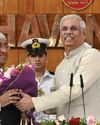
Justice Soumen Sen sworn-in as Kerala CJ
Justice Soumen Sen was on Saturday sworn-in as the Chief Justice of the Kerala High Court.
1 min
January 11, 2026
Listen
Translate
Change font size