
Magzter GOLD ile Sınırsız Olun
Sadece 9.000'den fazla dergi, gazete ve Premium hikayeye sınırsız erişim elde edin
Denemek ALTIN - Özgür
The Highland Hijacker A Weed's Himalayan Ascent
TerraGreen
|November 2025
An unassuming weed introduced in the 19th century has now become a silent ecological invader. Ageratina Adenophora, popularly known as the Mexican Devil, is devouring hills, forests, and farms across India's Himalayas and beyond. In this article, Rajshekhar Pant explains how its unchecked spread along with poor forest management has turned a botanical curiosity into an ecological crisis.
-
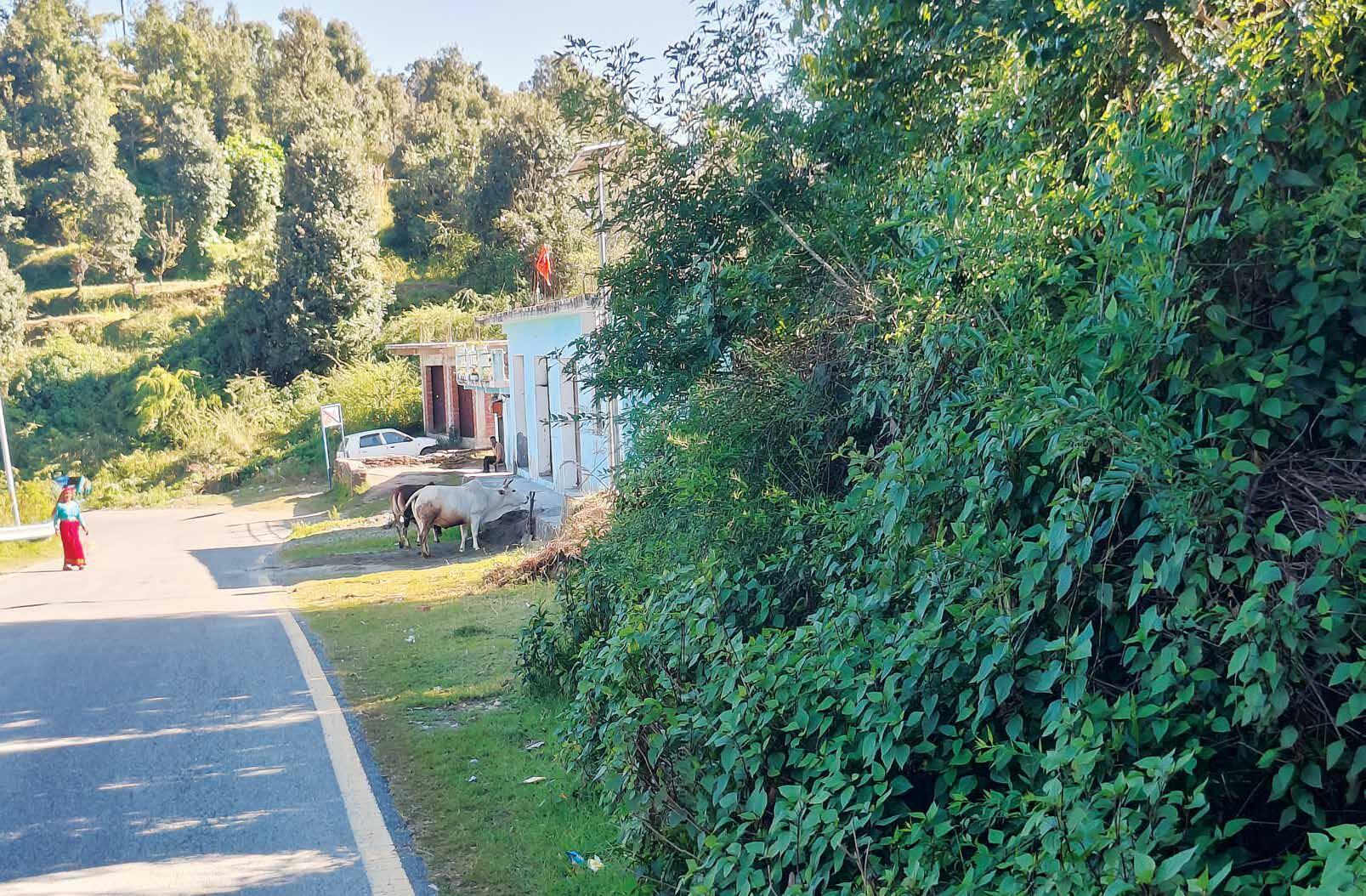
A native of the tropical and subtropical regions of Mexico and America, it felt claustrophobic in the trimmed gardens of Africa and Asia where it was introduced in the 19th century. Soon rendering the confines of those manicured gardens stale, it occupied the roadsides, slopes, fields, forests, farms, riverine stretches, and coastlines; even national boundaries fizzled out before its invasive speed, having Satanic tinges, 'it is better to rule in hell than to serve in heaven.' They gave this weed an appropriate name—Mexican Devil.
To botanists, it is known as Ageratina adenophora (syn. Eupatorium adenophorum). Its other common names include Crofton weed, sticky snakeroot, cat weed, and kala-bansa. Over 40 nations, including India, Nepal, China, Australia, Hawaii, and several African countries, are among the worst affected by it. The National Biodiversity Authority and the Ministry of Environment, Forest and Climate Change (MoEFCC) have listed it as an invasive alien species in India.
It is claimed to have been sighted in the Doon Valley in the third decade of the previous century. Doubts, however, have been raised about this claim, as the often-quoted Kanjilal's Flora—a publication of the Forest Research Institute (FRI, 1969 edition), also known as the Bible of the foresters—does not mention it. The Mexican Devil, in all probability, sneaked into the Indian subcontinent in the early 1970s from New Zealand, where it was first noticed in the late fifties. The Nilgiri Hills and Darjeeling were initially affected by it, and now it has achieved pan-tropical expansion, easily spotted in Uttarakhand, Sikkim, the Western Ghats, and several districts of Kerala, Andhra Pradesh, and Tamil Nadu.
An Ecosystem Disruptor Scaling the Himalayas
It has been reported to spread in some regions at an alarming rate of 20 km per year.


Bu hikaye TerraGreen dergisinin November 2025 baskısından alınmıştır.
Binlerce özenle seçilmiş premium hikayeye ve 9.000'den fazla dergi ve gazeteye erişmek için Magzter GOLD'a abone olun.
Zaten abone misiniz? Oturum aç
TerraGreen'den DAHA FAZLA HİKAYE

TerraGreen
Motor Efficiency
The Silent Catalyst of India's Green Industrial Revolution

4 mins
January 2026

TerraGreen
Beauty That Betrays!
The Quiet Invasion of An Ornamental Plant
3 mins
January 2026
TerraGreen
Farming Innovation Addresses Food Shortages
Also Halves Methane Emissions
4 mins
January 2026
TerraGreen
Aravalli on the Edge
Saving India's Ancient Green Shield from Collapse
3 mins
January 2026

TerraGreen
From Orchard to Table
Apple Picking, Family Time, and Fall Colours
4 mins
January 2026

TerraGreen
Coral Reefs Could Feed Millions
If We Let Them Rebuild
3 mins
January 2026

TerraGreen
Resting on Deodars
How Fallen Trees are Being Reimagined as Urban Assets in Shimla
3 mins
January 2026

TerraGreen
India's Clean-Air Innovation at Risk
Nationwide Assessment by WeNaturalists
2 mins
January 2026

TerraGreen
CNFF-25
Highlights Environmental Concern Amid India's Cultural Heritage
3 mins
January 2026
TerraGreen
Green Farming through Circular Economy
Sustainable Practices for Waste Reduction
8 mins
January 2026
Listen
Translate
Change font size