
Magzter GOLD ile Sınırsız Olun
Sadece 9.000'den fazla dergi, gazete ve Premium hikayeye sınırsız erişim elde edin
The Minerals That Made America
Rock&Gem Magazine
|March - April 2025
Iron, Copper, Lead & Zinc Transformed the United States Into a Major Industrial Power
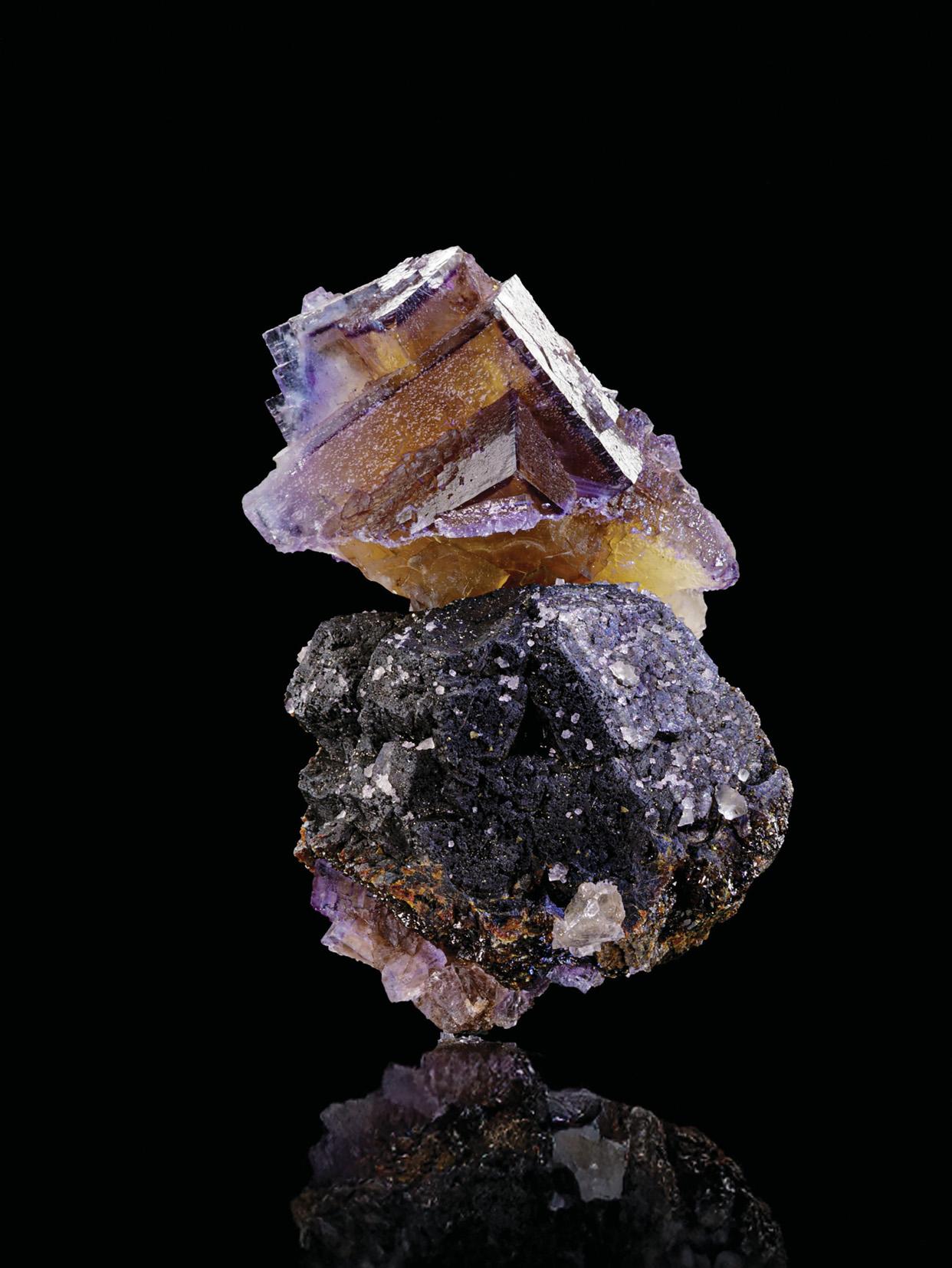
Fluorite on sphalerite from Minerva No. 1 Mine in Illinois. Ex. Walt Gaylord Arkenstone, iRocks.com
Distinctive crystal forms and colors, availability and affordability make specimens of hematite, magnetite, native copper, chalcopyrite, chalcocite, galena and sphalerite popular with many mineral collectors. Along with collectibility, these seven minerals share a historical significance: They all played major roles in the transformation of the United States from a collection of former colonies into an industrial power.
These minerals were the primary sources of iron, copper, lead, and zinc - the metals that built the infrastructure for public works, transportation, manufacturing and defense. During the nation-building era from the mid-1800s to the early 1900s, access to large deposits of these seven minerals was critical to industrial growth.
During its first 60 years of independence, the United States imported most of its metals. The development of the first substantial domestic sources of metals in the 1850s was a turning point in the nation's history. The ready availability of iron and copper opened the door to rapid industrial growth and provided exportable commodities to alleviate a negative balance in foreign trade.
HEMATITE & MAGNETITE
The minerals that had the greatest impact on national growth were hematite and magnetite, the iron oxides that are the primary ores of iron. Hematite (Fe2O3), the most abundant and widely distributed iron mineral, consists of 69.94 percent iron, crystallizes in the trigonal system, and has a high specific gravity of 5.3.

Bu hikaye Rock&Gem Magazine dergisinin March - April 2025 baskısından alınmıştır.
Binlerce özenle seçilmiş premium hikayeye ve 9.000'den fazla dergi ve gazeteye erişmek için Magzter GOLD'a abone olun.
Zaten abone misiniz? Oturum aç
Rock&Gem Magazine'den DAHA FAZLA HİKAYE
Rock&Gem Magazine
A New Amber Locality Fills a Gap
A sandstone quarry in central Ecuador has yielded the first significant deposit of Mesozoic amber from South America.

1 min
January / February 2026
Rock&Gem Magazine
Did "Left-Handed" Fish Leave Water Earlier than Thought?
Fossil evidence suggests that fish (or \"fishapods\") dragged themselves onto land during the middle Devonian Period.
1 min
January / February 2026

Rock&Gem Magazine
"Lab Quakes” Produce Surprising Results
When faults let loose and earthquakes result, the main effect we mortals experience is the violent shaking.
1 min
January / February 2026
Rock&Gem Magazine
This Egg is No Spring Chicken
How to date a dino egg
1 min
January / February 2026
Rock&Gem Magazine
Have we Already Mined the Critical Minerals We Need
Then why are we throwing them away?!
1 min
January / February 2026
Rock&Gem Magazine
One Toxic Worm
A critter that creates & tolerates orpiment!
1 min
January / February 2026
Rock&Gem Magazine
ROCK & GEM FIELD GUIDE: Silver
Silver (Ag) is a native element and one of Earth's most prized precious metals.
2 mins
January / February 2026
Rock&Gem Magazine
DINOSAURS OF THE HELL CREEK MUSEUM
In the Badlands of South Dakota, just outside the small town of Belle Fourche—pronounced “Bell Foosh”—a new attraction has taken shape that every dinosaur enthusiast should see. The Dinosaurs of the Hell Creek Museum is part hands-on exhibit, part science center and part active research lab.
3 mins
January / February 2026
Rock&Gem Magazine
The Lost Twins of Kongsberg
A Silver Story Resurfaced
3 mins
January / February 2026

Rock&Gem Magazine
Switzerland's ICE PALACE
Walk Inside a Glacier at The Top of Europe
7 mins
January / February 2026
Listen
Translate
Change font size