Denemek ALTIN - Özgür
The Green Thread
Femina
|February - March 2025
At the start of 2025, it only feels right to try and take a step in the direction of an issue that needs immediate addressing - fashion's problem with unsustainable business practices and their impact not only on the environment, but also on the people making the products. All's not grim, however. Even within this space, some brands have cut through the greenwashing noise and stand out for complete transparency in their businesses. We speak to the founders of four such fashion brands who have prioritised a slow approach to making clothes and have an overall ethical outlook. They care for environmental and social impact as much as - if not more than their profit margins, finds Ashwini Arun Kumar
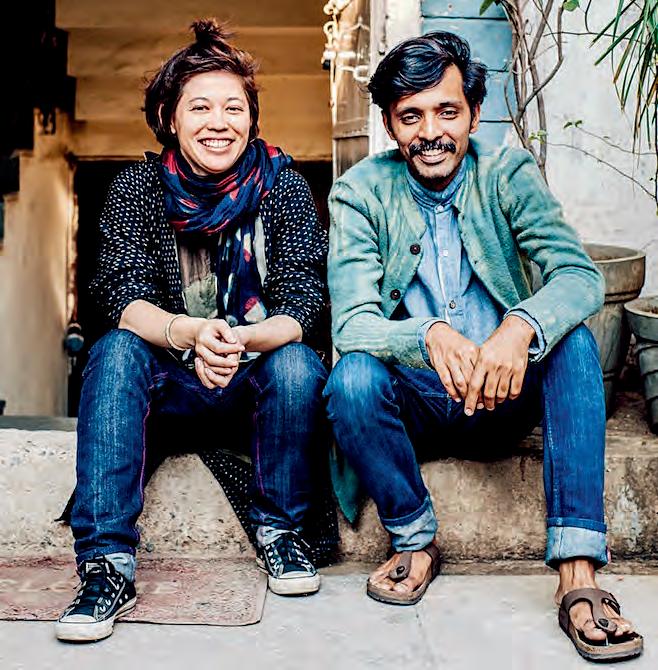
HIMANSHU SHANI Co-Founder - 11.11/eleven eleven
 Something that touches the body should be as pure as possible," believes Himanshu Shani, one half of 11.11/ eleven eleven, a 14-year-old label that has headlined every major Indian fashion week centred around sustainability. It was this ideology that made him and co-founder Mia Morikawa return to the indigenous practice of making clothes more than a decade ago. "We decided that we were only going to work with handspun yarn and practise 100% natural dyeing," he shares. "It's taken us time to build this system because these cottage industries were never meant to scale this much.
We had to revive many of these." Today, when you visit its website, you will find a detailed directory of the natural ingredients that are used to make the brand's dyes and its hero material kala cotton. In 2024, 11.11/eleven eleven was part of a special denim showcase alongside four other Indian designers - it was the only one to use handspun and handwoven denim.
Cotton gets a bad rep for its environmental implications. While commercial cotton takes up to 20,000 litres of water to produce just one kilogram, the indigenous variety that 11.11/eleven eleven works with is a purely rain-fed crop. "Kala cotton is grown in the Kachchh region of Gujarat where the rainfall is as low as 80 mm," explains Himanshu. "It doesn't need irrigation and is naturally pest resistant. It is organic by default." This cotton is hand-picked, spun into yarn on semi-mechanised hand charkhas, and hand-dyed. "It has existed for a long time. We have done nothing differently. We just implemented it in our design practice." 11.11/eleven eleven makes wardrobe staples that can be mixed and matched, and worn in multiple ways. "As a brand, we work toward making products for everyday use," says Himanshu.

Bu hikaye Femina dergisinin February - March 2025 baskısından alınmıştır.
Binlerce özenle seçilmiş premium hikayeye ve 9.000'den fazla dergi ve gazeteye erişmek için Magzter GOLD'a abone olun.
Zaten abone misiniz? Oturum aç
Femina'den DAHA FAZLA HİKAYE

Femina
Your 72-Hour Love Affair With HONG KONG
Here's why you should consider Hong Kong for your next long weekend getaway

2 mins
February - March 2026
Femina
HONOURING EXCELLENCE
Femina Achievers Awards 2025: South felicitated trailblazers who have made a mark across industries
2 mins
February - March 2026

Femina
GET YOUR GLOW ON!
The real wedding luxury is having a natural radiance on your face – and that comes only from self-care.
3 mins
February - March 2026

Femina
ONE TOOL, MANY RITUALS
What: The 8-in-1 Self Care Kit from Winston
1 min
February - March 2026

Femina
EXPLORE, EAT, REPEAT
WINDMILL in Pune offers it all – from comforting favourites to gourmet plates, and much more
1 mins
February - March 2026

Femina
Waves Of Contentment
SRI LANKA's South is a wonder to discover. But imagine finding the best Italian food on our side of the equator?
4 mins
February - March 2026

Femina
Walnuts for Women
For women who want an edge on wellness, eating the right foods can be simple, especially when you choose nutrient-dense choices such as walnuts
2 mins
February - March 2026

Femina
FROM PAIN TO EMPOWERMENT
Founder and CEO of Luma Fertility NEHA MOTWANI is on the mission to redefine fertility healthcare for patients.
3 mins
February - March 2026

Femina
SMOOTH UNDER EVERYTHING
What: The Intense Strapless Bodyshaper from Invogue
1 min
February - March 2026
Femina
ANDHRA'S FIERY FAVOURITE
Bold menus and fresh design mark the newer outlet of NANDHINI, one of the iconic dining destinations of the garden city
1 mins
February - March 2026
Listen
Translate
Change font size