Denemek ALTIN - Özgür
Women-Centric FPOS Reshape Farm Economy
AgroSpectrum
|AgroSpectrum India Feb 2026
Women-led Farmer Producer Organisations (FPOS) in India have gained momentum in 2025, driven by government schemes and sustainability goals. As of June 2025, 1,663 FPOs are registered with 100 per cent women members, and 949 have over 50 women members under the Central Sector Scheme for 10,000 FPOs.
With the number of 100 per cent women shareholder FPOs, Telangana leads with 359 FPOs, followed by Andhra Pradesh at 228 in the country. Industry is expecting that by 2030 women-led and women-majority FPOS will be operating as robust, professionally managed agribusinesses, with strong governance, digital systems, diversified revenue streams, and reliable access to working capital.
A ccording to an impact study of Sambodhi, an impact measurement firm in 2024, greater independence among women in programme FPOs, with fewer needing to borrow from their households to pay FPO share capital amount (22 per cent vs. 40 per cent in the non-access programme comparison). Moreover, women-led FPOs can play a pivotal role in realising the revised target of the Lakhpati Didi scheme, which has been increased from two crore to three crore women, as announced during the interim budget for FY25. Women-led FPOs show higher cropping intensity (210 per cent vs. 149 per cent), greater crop diversity, and stronger financial participation through share capital. They benefit from Self Help Groups (SHGS) experience, prudent risk management, and spousal support in marketing.
Key policy drivers
The Central Sector Scheme for Formation and Promotion of 10,000 FPOs mandates at least onewoman directors per board and prioritises women Self Help Groups (SHGs), with over 8,780 FPOS registered by mid-2025, including incentives like equity grants up to Rs 18 lakh and credit guarantees. NABARD'S PRODUCE Fund and PODF have promoted thousands of FPOs, with 179 exclusively for women, focusing on activities like spices, millets, and beekeeping. The Lakhpati Didi initiative targets 3 crore women for Rs 1 lakh annual income, linking SHGs to FPOs for sustainable livelihoods.
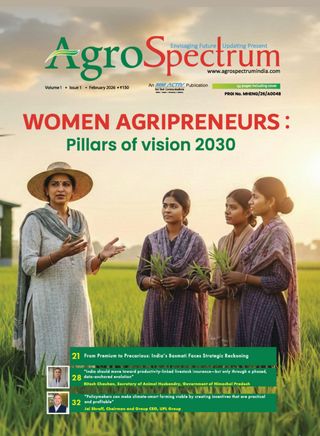

Bu hikaye AgroSpectrum dergisinin AgroSpectrum India Feb 2026 baskısından alınmıştır.
Binlerce özenle seçilmiş premium hikayeye ve 9.000'den fazla dergi ve gazeteye erişmek için Magzter GOLD'a abone olun.
Zaten abone misiniz? Oturum aç
AgroSpectrum'den DAHA FAZLA HİKAYE

AgroSpectrum
How AI Is Rewiring Decision-Making Across Indian Agriculture
For decades, Indian agriculture has lived with uncertainty as a structural condition—of weather, markets, prices, and outcomes. Decisions were shaped as much by intuition as by information, and risk was absorbed almost entirely by those closest to the soil. That equilibrium is now being quietly but decisively rewritten. Artificial intelligence, once confined to pilots and proof-of-concepts, has crossed a threshold. It is no longer an experiment in agriculture—it is becoming infrastructure.

7 mins
AgroSpectrum India Feb 2026
AgroSpectrum
Rewriting the Rules for Farm Inputs
India’s agricultural reform agenda is entering a crucial moment. After decades of relying on outdated, paper-based regulation, the government is now signalling a decisive shift towards technology-driven transparency and accountability.
2 mins
AgroSpectrum India Feb 2026
AgroSpectrum
"India should move toward productivity-linked livestock insurance–but only through a phased, data-anchored evolution"
As livestock becomes an increasingly critical pillar of rural incomes amid climate and market uncertainties, the lack of effective risk protection remains a major gap in India’s agricultural policy landscape. In this exclusive AgroSpectrum interview, Ritesh Chauhan, Secretary of Animal Husbandry, Government of Himachal Pradesh, explains why advances in digital identification, veterinary networks, cooperatives, and fintech now make a scalable livestock insurance framework both viable and essential. Drawing from Himachal Pradesh’s on-ground experience, he shares practical insights on building trust, improving claim settlement, and strengthening insurer participation. Edited excerpts:
7 mins
AgroSpectrum India Feb 2026

AgroSpectrum
Why 2026 Could Be a Turning Point for India's Aquaculture Sector
India's aquaculture sector is entering a decisive phase of transformation, driven by rising domestic demand, strong export growth and sustained policy support. As the world's second-largest aquaculture producer, contributing nearly 8 per cent of global fish output, India has achieved remarkable gains in production, productivity and economic value. However, escalating input costs, climate stress and disease risks are testing the limits of conventional practices. The next stage of growth will depend on adopting sustainable, resilient approaches that improve feed efficiency, diversify farmed species and strengthen climate adaptation across production systems.
4 mins
AgroSpectrum India Feb 2026

AgroSpectrum
How Integrated Sugarcane-based Industries are Driving Sustainable Growth, Ethanol Output & Rural Transformation
Sugarcane is called the \"green gold\" of agriculture, and indeed, this crop has historically been vital to the prosperity of rural communities. This versatile crop, esteemed for its production of sugar, jaggery, and khansari, is now at the forefront of a transformative movement. In fact, this transformation is leveraging the crop's immense potential. Utilising its agricultural strengths, India, recognised as the second-largest producer of sugarcane globally, is addressing multiple critical issues of our time, including climate change, energy security, and rural development. The area designated for sugarcane cultivation has grown to over 5.4 million hectares, with yearly outputs exceeding 400 million metric tonnes. As a result, sugarcane has evolved beyond being just a crop; it has emerged as a catalyst for change.
4 mins
AgroSpectrum India Feb 2026
AgroSpectrum
AgroSpectrum to host 2nd edition of Technovate 2026 on March 12-13 in Vashi
After the successful completion of its first edition, AgroSpectrum is again ready for its second edition of AgroSpectrum Technovate 2026 on 12 and 13th March 2026 with the theme \"Transforming Agriculture with Innovation and Technology\" at CIDCO Exhibition & Convention Centre in Vashi, Navi Mumbai.
1 min
AgroSpectrum India Feb 2026

AgroSpectrum
Boosting turmeric supply chain initiatives
India leads the global turmeric supply chain, being the largest producer, consumer and exporter of turmeric. The major turmeric export markets for the country are Bangladesh, the UAE, and the US. It accounts for over 62 per cent of the market, with its supply chain spanning cultivation in key states like Andhra Pradesh, Telangana, and Bihar. This yellow spice from the Curcuma longa plant serves as both a culinary staple and a traditional remedy with anti-inflammatory properties. Though India is one of the largest producers of turmeric, the country imports a substantial amount from other countries. Erratic climatic conditions, value addition, product innovation and product development appear weaker, leading to a shortfall in output. Proper strategies should be in place to boost turmeric production and the supply chain. Let's dig deeper.
5 mins
AgroSpectrum India Feb 2026

AgroSpectrum
"Our technology bridges scientific precision with farmer knowledge, creating a system that is scalable, future-ready, and capable of transforming agriculture at scale"
As climate volatility reshapes Indian agriculture, digital intelligence is emerging as a critical resilience tool. In this exclusive AgroSpectrum interview, Ajay Shelke of WOTR explains how FarmPrecise applies AI and hyperlocal weather data to deliver field-level advisories and evolve into a farmer-centric digital operating system for climate-vulnerable regions. Edited experts;
4 mins
AgroSpectrum India Feb 2026

AgroSpectrum
How AI is Reimagining Agriculture in India
Agriculture remains central to India's economy, contributing to GDP and employing nearly half the workforce, but it faces challenges such as fragmented landholdings, monsoon dependence and resource inefficiencies. Technology, particularly Artificial Intelligence (AI), is emerging as a key enabler alongside policy support. AI-driven tools like satellite imagery, Internet of Things (IoT) sensors and data analytics are strengthening precision farming through yield forecasting, risk mapping and micro-climate prediction. Focusing on the current Rabi season, this analysis draws on pilot initiatives to examine how AI is improving efficiency and profitability while addressing accessibility challenges for small and marginal farmers.
4 mins
AgroSpectrum India Feb 2026

AgroSpectrum
“Policymakers can make climate-smart farming viable by creating incentives that are practical and profitable.”
UPL, with its presence in over 140 countries, has recently launched its global campaign #AFarmerCan. Jai Shroff, Chairman and Group CEO, UPL Group, in an interaction with AgroSpectrum, elaborates on how UPL is advocating stronger financial and institutional mechanisms that reward sustainable practices and build long-term resilience. Edited excerpts;
4 mins
AgroSpectrum India Feb 2026
Listen
Translate
Change font size