Denemek ALTIN - Özgür
Whose Space Is It?
Down To Earth
|May 01, 2019
Governments have been exploring space for a while, but the influx of private players has altered the rules of the game. What are the laws that govern space today?

WHEN WE THINK of space players, we think of state and regional space agencies, such as the Indian Space Research Organisation (ISRO) and the European Space Agency (ESA). But the world has changed since the cold war decades of the last century. In 2015, governments spent the US $76.7 billion in space—which was just over one-fifth of all such expenditure. Four-fifths of the space economy is in the hands of private corporations. These include “old space” such as Airbus and Boeing, and “new space” such as Elon Musk’s SpaceX and Jeff Bezos’ Blue Origins. In China, a generation of new private space companies grows alongside the Chinese National Space Agency. In India, ISRO has a parastatal as its commercial wing—Antrix. Now the ball is in the court of famous conglomerates such as Tata, Mahindra, and others, to diversify into satellites and space launchers.
Today we have six decades of developing an acquis of international space law. TheInternational Institute of Space Law was founded in 1960. Universities such as Leiden in the Netherlands and McGill in the US have schools of air and space law.
Space law builds on aviation law, the law of the high seas, and the Antarctic Treaty. The foundational Outer Space Treaty of 1967 has been signed and ratified by 108 states. Its principles include that all nations may participate in space exploration. It prohibits annexing the moon or other celestial bodies, building military fortresses on them, and stationing nuclear and other weapons of mass destruction in space or on the moon.
The treaty defines astronauts as envoys of all humanity. Provisions of this treaty were elaborated by a series of later treaties. The Rescue Agreement of 1968 obliges all countries to rescue stranded astronauts and return them to their home country. So far, astronauts whose flights have been aborted all landed within their own country.
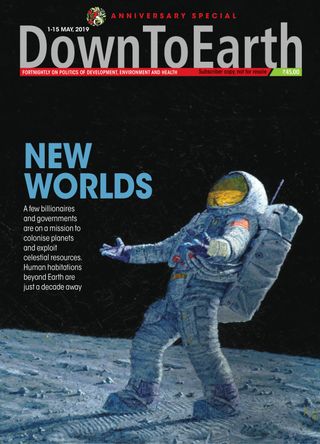

Bu hikaye Down To Earth dergisinin May 01, 2019 baskısından alınmıştır.
Binlerce özenle seçilmiş premium hikayeye ve 9.000'den fazla dergi ve gazeteye erişmek için Magzter GOLD'a abone olun.
Zaten abone misiniz? Oturum aç
Down To Earth'den DAHA FAZLA HİKAYE
Down To Earth
Popular distrust
THE WORLD seems to be going through a period of stasis despite facing an unfathomable polycrisis.

2 mins
February 01, 2026
Down To Earth
CONSERVE OR PERISH
Periyar Tiger Reserve has rewritten Indian conservation by turning poachers into protectors and conflict into coexistence
5 mins
February 01, 2026

Down To Earth
'Rivers need to run free'
From Tibet to West Bengal, the Brahmaputra is the pulse of communities and ecosystems along its course. But what are the risks the river faces through human interventions, particularly dams, discusses journalist, author and filmmaker SANJOY HAZARIKA in his new book, River Traveller.
4 mins
February 01, 2026

Down To Earth
India is facing up to its innovation lag
There are signs now that India is acknowledging the superior strides made by China in a frontier technology like Al
4 mins
February 01, 2026

Down To Earth
Competing concerns
What are the repercussions of the EU-Mercosur pact that have made European farmers protest against the free trade agreement?
4 mins
February 01, 2026

Down To Earth
From fryer to flight
Sustainable fuel made from used cooking oil can play a pivotal role in helping India achieve its aviation emission reduction goals. Measures to collect this oil must be revamped
4 mins
February 01, 2026

Down To Earth
ACCESS OPEN
An amendment to India's nodal forest conservation law opens up forests across India to commercial exploitation by the paper industry
6 mins
February 01, 2026
Down To Earth
DRINK FROM TAP CAN BE A REALITY
As cities across India struggle to supply safe piped water, Odisha offers a success story
2 mins
February 01, 2026

Down To Earth
GREAT DRYING
The Earth is hotter than at any point in the past 100,000 years, with 2023-25 becoming the warmest three-year period on record and also breaching the 1.5°C threshold for the first time. One fallout is dwindling freshwater.
22 mins
February 01, 2026

Down To Earth
Green redemption
Restoration of grasslands of Kerala's Pampadum Shola National Park, once dominated by invasive Australian wattles, see a return of streams and native species
1 mins
February 01, 2026
Translate
Change font size