Denemek ALTIN - Özgür
The Malthusian Muddle
Down To Earth
|April 16, 2018
In these times of climate change, the world needs fresh ideas to get out of the logjam over whether population is a curse or a resource

IN 1968, a young American butterfly expert named Paul Ehrlich published The Population Bomb in which he made the controversial claim that “the battle to feed humanity is over”, and that hundreds of millions will “starve to death” in the following two decades. He also prophesied that should we fail to contain the population juggernaut, not to mention our obsession with economic growth, Earth itself would go into terminal decline.
His “bomb”, however, turned out to be a damp squib, as he underestimated the power of human ingenuity (read modern science)—the Green Revolution managed to produce enough food to save the surging millions from the jaws of the proverbial wolf.
It is 50 years since the book came out, but despite being proven wrong, the septuagenarian, who was once slurred as “worse than Hitler” for advocating forced sterilisation, is crying wolf again. He recently told The Guardian “the collapse of civilisation is a near certainty within decades…as long as perpetual growth of the human enterprise remains the goal of economic and political systems.”
Ehrlich is the poster boy for the neo-Malthusians who have revived the debate about the catastrophic consequences of run away population growth first articulaed by an English Reverand T R Malthus in his 1798 Essay on the Principle of Population. Malthus, appealing to the powerful metaphor of an inexorable machine, essentially argued that the progress of population tends to be geometric (that is, 1, 2, 4, 8, 16, 32, 64…), while available food, even if we account for the extra impetus of more farms hands, increases at most by arithmetic amounts (1, 2, 3, 4, 5, 6, 7, 8…). Anyone, even those unschooled in basic arithmetic, can figure out the eventual, albeit fallacious, outcome of this discrepancy.
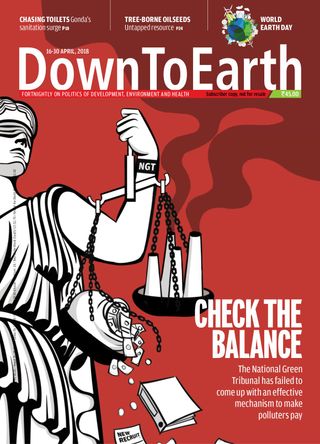

Bu hikaye Down To Earth dergisinin April 16, 2018 baskısından alınmıştır.
Binlerce özenle seçilmiş premium hikayeye ve 9.000'den fazla dergi ve gazeteye erişmek için Magzter GOLD'a abone olun.
Zaten abone misiniz? Oturum aç
Down To Earth'den DAHA FAZLA HİKAYE

Down To Earth
THINK TWICE BEFORE FELLING SAL TREES
Many trees considered to be affected by sal borer in the 1990s are still alive today

1 mins
February 16, 2026

Down To Earth
EDGE OF SURVIVAL
Caste divides deny marginalised communities land, resources and essential aid, leaving them more vulnerable to climate disasters
6 mins
February 16, 2026

Down To Earth
A WISH LIST?
Union Budget for 2026-27 conveys the impression of a roll-call of intentions and ambitious proposals, with little detail on their formulation
6 mins
February 16, 2026
Down To Earth
Break down the gender wall
THE RULING National Democratic Alliance (NDA) government has been heavily invested in the goal to make India a developed economy by 2047.
2 mins
February 16, 2026

Down To Earth
MENSTRUAL HEALTH, NOW A FUNDAMENTAL RIGHT
In a landmark judgement, the Supreme Court has recognised menstrual health and hygiene as a fundamental right under Article 21 of the Constitution of India, which guarantees the right to life and dignity.
8 mins
February 16, 2026

Down To Earth
Of devolution and new disasters
The 16th Finance Commission pushes for changes in view of new fiscal and climatic conditions
11 mins
February 16, 2026
Down To Earth
Rising risks of plastics
NEGATIVE IMPACTS on human health due to emissions linked to the plastic lifecycle could double by 2040, according to a study published in The Lancet Planetary Health in January.
1 min
February 16, 2026

Down To Earth
GAP BETWEEN EPIDEMICS NARROWING
A watershed-based and landscape-level approach is needed to address forest degradation
2 mins
February 16, 2026
Down To Earth
WAITING TO STRIKE
Sal heartwood borer is considered the biggest threat to forestry in India, especially to the sal tree, where it lives and breeds.
11 mins
February 16, 2026
Down To Earth
A SPRING DELIGHT
Mustard flowers are not meant only for the eyes. Invite them to your plate once in a while
3 mins
February 16, 2026
Translate
Change font size