Denemek ALTIN - Özgür
Let It Flow
Down To Earth
|November 16, 2019
Two private and one government owners of dams on the Ganga refuse to follow the upcoming water discharge guidelines necessary for the cleaning and rejuvenation of the river

THE FUTURE of government-prescribed minimum water discharge guidelines for the Ganga appears to be in jeopardy. These environmental flow (e-flow) norms stipulate the volume of water that dams and barrages must release to allow the river to naturally clean itself and protect its aquatic biodiversity. The e-flow norms were notified in September 2018 by the National Mission for Clean Ganga (NMCG), the apex body responsible for the cleaning and rejuvenation of the river, and are to be enforced from December 15, 2019. While all the barrages have started following them, owners of three dams have said that they cannot increase the flow from their reservoirs, as required by the notification, because it would reduce their power generation capacity and lead to huge financial losses. Two of the dams are owned by private companies while one is under the Uttarakhand government.
The Ganga has six dams and four barrages along its run in the country. In the upper Ganga basin (Tehri Garhwal to Haridwar in Uttarakhand), where all the dams are located, the notification prescribes three norms: the outflow should be 30 per cent of the monthly average inflow from June to September, which is the high flow season; 25 per cent in October, April and May; and 20 per cent from November to March, which is the lean period. For the middle Ganga basin (Haridwar to Kanpur in Uttar Pradesh), where all the barrages are located, the e-flow is different for each project.
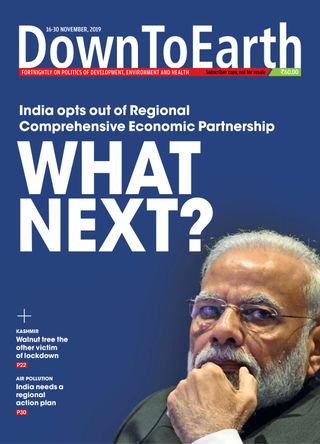

Bu hikaye Down To Earth dergisinin November 16, 2019 baskısından alınmıştır.
Binlerce özenle seçilmiş premium hikayeye ve 9.000'den fazla dergi ve gazeteye erişmek için Magzter GOLD'a abone olun.
Zaten abone misiniz? Oturum aç
Down To Earth'den DAHA FAZLA HİKAYE
Down To Earth
Popular distrust
THE WORLD seems to be going through a period of stasis despite facing an unfathomable polycrisis.

2 mins
February 01, 2026
Down To Earth
CONSERVE OR PERISH
Periyar Tiger Reserve has rewritten Indian conservation by turning poachers into protectors and conflict into coexistence
5 mins
February 01, 2026

Down To Earth
'Rivers need to run free'
From Tibet to West Bengal, the Brahmaputra is the pulse of communities and ecosystems along its course. But what are the risks the river faces through human interventions, particularly dams, discusses journalist, author and filmmaker SANJOY HAZARIKA in his new book, River Traveller.
4 mins
February 01, 2026

Down To Earth
India is facing up to its innovation lag
There are signs now that India is acknowledging the superior strides made by China in a frontier technology like Al
4 mins
February 01, 2026

Down To Earth
Competing concerns
What are the repercussions of the EU-Mercosur pact that have made European farmers protest against the free trade agreement?
4 mins
February 01, 2026

Down To Earth
From fryer to flight
Sustainable fuel made from used cooking oil can play a pivotal role in helping India achieve its aviation emission reduction goals. Measures to collect this oil must be revamped
4 mins
February 01, 2026

Down To Earth
ACCESS OPEN
An amendment to India's nodal forest conservation law opens up forests across India to commercial exploitation by the paper industry
6 mins
February 01, 2026
Down To Earth
DRINK FROM TAP CAN BE A REALITY
As cities across India struggle to supply safe piped water, Odisha offers a success story
2 mins
February 01, 2026

Down To Earth
GREAT DRYING
The Earth is hotter than at any point in the past 100,000 years, with 2023-25 becoming the warmest three-year period on record and also breaching the 1.5°C threshold for the first time. One fallout is dwindling freshwater.
22 mins
February 01, 2026

Down To Earth
Green redemption
Restoration of grasslands of Kerala's Pampadum Shola National Park, once dominated by invasive Australian wattles, see a return of streams and native species
1 mins
February 01, 2026
Translate
Change font size