
Magzter GOLD ile Sınırsız Olun
Sadece 9.000'den fazla dergi, gazete ve Premium hikayeye sınırsız erişim elde edin
Denemek ALTIN - Özgür
INSTITUTIONAL OVERSIGHT
Down To Earth
|April 01, 2022
Though hospital births have seen a record rise in the past 15 years, maternal and infant mortality rates remain high

AT THE maternal care ward in Madhya Pradesh's Tikamgarh District Hospital, 19-year-old Sarita (name changed) is in distress. “I have no idea how my one-week-old son is doing,” she says. Her baby was born severely underweight and puking, and was admitted to the Sick Newborn Care Unit (SNCU). The young mother admits she did not come in for any antenatal care (ANC) checkups prior to delivery. The World Health Organization (WHO) mandates at least four ANC checkups during pregnancy to monitor the mother and child's health.
Sarita is one of 28 new mothers in the maternal care ward, which is most of the time filled to capacity. About half of the 200 beds at the Tikamgarh District Hospital are allocated for expectant and new mothers. As per the "Indian Public Health Standards", a set of guidelines under the National Rural Health Mission, district hospitals seeing more than 75 childbirths a month need one senior doctor and one staff nurse for the postnatal care unit, while those with over 100 childbirths a month need nine nurses for ante- and postnatal care. The Tikamgarh District Hospital meets these standards, with four senior doctors, nine medical students and around 20 nurses in the maternal and child care units. However, with the staff working in eight-hour shifts and the hospital conducting 30-40 deliveries on average daily, resources are stretched. "Ideally, a mother should stay in the facility for 48-72 hours after a normal delivery. But we are not always able to accommodate them. So in case of a normal delivery, we discharge her within a day," says a nurse on condition of anonymity.
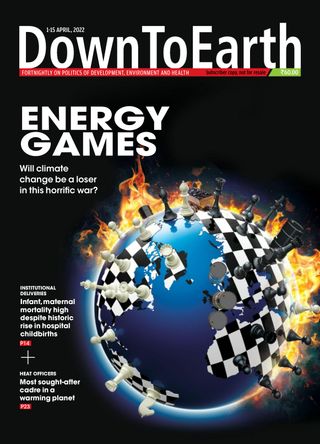

Bu hikaye Down To Earth dergisinin April 01, 2022 baskısından alınmıştır.
Binlerce özenle seçilmiş premium hikayeye ve 9.000'den fazla dergi ve gazeteye erişmek için Magzter GOLD'a abone olun.
Zaten abone misiniz? Oturum aç
Down To Earth'den DAHA FAZLA HİKAYE

Down To Earth
THINK TWICE BEFORE FELLING SAL TREES
Many trees considered to be affected by sal borer in the 1990s are still alive today

1 mins
February 16, 2026

Down To Earth
EDGE OF SURVIVAL
Caste divides deny marginalised communities land, resources and essential aid, leaving them more vulnerable to climate disasters
6 mins
February 16, 2026

Down To Earth
A WISH LIST?
Union Budget for 2026-27 conveys the impression of a roll-call of intentions and ambitious proposals, with little detail on their formulation
6 mins
February 16, 2026
Down To Earth
Break down the gender wall
THE RULING National Democratic Alliance (NDA) government has been heavily invested in the goal to make India a developed economy by 2047.
2 mins
February 16, 2026

Down To Earth
MENSTRUAL HEALTH, NOW A FUNDAMENTAL RIGHT
In a landmark judgement, the Supreme Court has recognised menstrual health and hygiene as a fundamental right under Article 21 of the Constitution of India, which guarantees the right to life and dignity.
8 mins
February 16, 2026

Down To Earth
Of devolution and new disasters
The 16th Finance Commission pushes for changes in view of new fiscal and climatic conditions
11 mins
February 16, 2026
Down To Earth
Rising risks of plastics
NEGATIVE IMPACTS on human health due to emissions linked to the plastic lifecycle could double by 2040, according to a study published in The Lancet Planetary Health in January.
1 min
February 16, 2026
Down To Earth
GAP BETWEEN EPIDEMICS NARROWING
A watershed-based and landscape-level approach is needed to address forest degradation
2 mins
February 16, 2026
Down To Earth
WAITING TO STRIKE
Sal heartwood borer is considered the biggest threat to forestry in India, especially to the sal tree, where it lives and breeds.
11 mins
February 16, 2026

Down To Earth
A SPRING DELIGHT
Mustard flowers are not meant only for the eyes. Invite them to your plate once in a while
3 mins
February 16, 2026
Translate
Change font size