Denemek ALTIN - Özgür
Separate And Unequal
The Caravan
|September 2019
How growing communalisation led to a rise in Muslim-only enclaves

Earlier this year, Muhammad Raees, a 57-year-old resident of Jamia Nagar, began looking for a new house for his family. In his years of living in Delhi, he had never found a house that suited his requirements, a secure locality being top of his list. In May, a fortnight before Eid-ul-Fitr, he found a lead. “Festivities before festivity for Muslims who wish to live in Noida,” an online advertisement read. It offered residential towers “exclusively for Muslims” at R4,200 per square foot.
Jamia Nagar, the predominantly Muslim neighbourhood where Raees has lived for the past fifteen years, lacks several basic facilities, such as clean drinking water, schools, parks and dispensaries, like most other Muslim localities in India. Nevertheless, it provided Raees “a sense of security,” he told me. “The first and foremost thing for anyone is being free from a sense of threat. I can afford a flat at many places in Delhi, but I did not move anywhere as I felt more safe living among the members of my own community.”
In his 2017 paper, “Muslims in Indian Cities: Degrees of Segregation and the Elusive Ghetto,” Raphael Susewind, a lecturer in social anthropology and development at King’s College in London, studied religious demography and segregation in 11 Indian cities. He found that the segregation faced by the Muslim community in Delhi and its adjoining areas was the third highest among those cities, behind only Ahmedabad and Hyderabad. He wrote that “in order to achieve a religiously even spatial pattern in Delhi, either half of the capital’s Muslims or half of its non-Muslim citizens would need to relocate to another neighbourhood.”
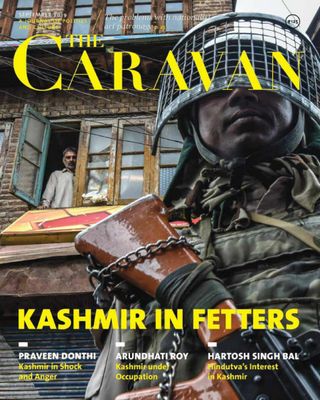

Bu hikaye The Caravan dergisinin September 2019 baskısından alınmıştır.
Binlerce özenle seçilmiş premium hikayeye ve 9.000'den fazla dergi ve gazeteye erişmek için Magzter GOLD'a abone olun.
Zaten abone misiniz? Oturum aç
The Caravan'den DAHA FAZLA HİKAYE
The Caravan
ANY RESEMBLANCE TO ACTUAL EVENTS IS NOT COINCIDENTAL
INTERFAITH ROMANCE FICTION IN THE ERA OF LOVE JIHAD

31 mins
December 2025
The Caravan
Manufacturing Legitimacy
How a Washington Post columnist laundered the Sangh's violent history
7 mins
December 2025

The Caravan
DEATH of REPORTAGE
THE DISMANTLING OF OUTLOOK'S LEGACY
32 mins
December 2025

The Caravan
FOG LIGHT
Samayantar's two-and-half-decade fight against the shrinking of Hindi's world
22 mins
December 2025
The Caravan
THE FINE PRINT
ON 19 MARCH 2005, thousands came out on the streets of Udupi, in coastal Karnataka, to protest a gruesome incident that had shaken the region a week earlier.
23 mins
December 2025
The Caravan
CHARACTER BUILDING
The enduring language of Indian streets
5 mins
December 2025

The Caravan
THE CONVENIENT EVASIONS OF RAJDEEP SARDESAI
DRESSED IN A turban and white kurta pyjama, Narendra Modi sat in the passenger seat of a van crossing the Patan district of Gujarat, in September 2012. Next to him sat Rajdeep Sardesai, the founder-editor of the news channel CNN-IBN.
63 mins
December 2025

The Caravan
Ahmed Kamal Junina: “Every class we hold is a defiant refusal to surrender”
A professor in Gaza on teaching during a genocide / Conflict
11 mins
December 2025
The Caravan
Bangla Pride, Urdu Prejudice
The language wars have primed West Bengal for the RSS
8 mins
November 2025

The Caravan
THE INTERVIEW
\"The people are naked before the government but the government is opaque to them\"
16 mins
November 2025
Translate
Change font size