Denemek ALTIN - Özgür
Poor Prognosis
The Caravan
|March 2019
All is not well with Modi’s flagship health scheme.

Dalli–Rajhara is a small town in the Balod district of Chhattisgarh, home to iron-ore mines that feed the Bhilai steel plant. Situated in the town is the Shaheed hospital, famous for being run for, and by, the mine workers. While it provides many services—such as internal medicine, surgery and psychiatry—the mainstay of the hospital is its department of obstetrics and gynaecology. Dr Saibal Jana, one of the founders, has been carrying out deliveries since the hospital was established in 1983. Pregnant women travel as far as a hundred kilometres in the hope of a safe delivery at the hospital.
The Shaheed hospital was initially financed by mine workers. They were inspired by Shankar Guha Niyogi, who founded the Chhattisgarh Mines Shramik Sangh, a trade union for miners, in 1977. The hospital was named after the 11 striking contract workers killed in police firing that year. Although the hospital excelled in its services, it did not grow significantly until the early 2000s, due to a lack of funds. Its clientele was restricted to the mine workers, and villagers from nearby districts. It charged its patients a minimal amount in order to sustain itself.
The hospital’s fate started to change in 2008, with the introduction of the Rashtriya Swasthya Bima Yojana, a health-insurance programme started by the then Congress-led central government. The Shaheed hospital was empanelled with the RSBY, under which the prescribed rates for procedures were significantly higher than what it was charging its patients. As it was receiving a large number of patients who were below the poverty line, and therefore eligible to file an insurance claim, the management started to use the surplus amount to develop the hospital. Since then, the hospital has added a new multistorey building, with dedicated wards for maternal and child health, and another one to house its junior doctors.
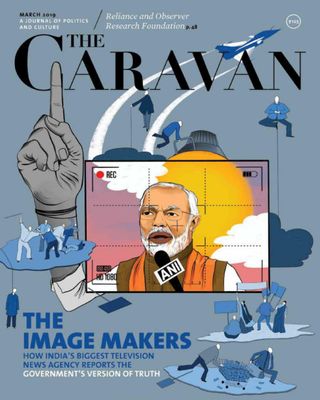

Bu hikaye The Caravan dergisinin March 2019 baskısından alınmıştır.
Binlerce özenle seçilmiş premium hikayeye ve 9.000'den fazla dergi ve gazeteye erişmek için Magzter GOLD'a abone olun.
Zaten abone misiniz? Oturum aç
The Caravan'den DAHA FAZLA HİKAYE
The Caravan
ANY RESEMBLANCE TO ACTUAL EVENTS IS NOT COINCIDENTAL
INTERFAITH ROMANCE FICTION IN THE ERA OF LOVE JIHAD

31 mins
December 2025
The Caravan
Manufacturing Legitimacy
How a Washington Post columnist laundered the Sangh's violent history
7 mins
December 2025

The Caravan
DEATH of REPORTAGE
THE DISMANTLING OF OUTLOOK'S LEGACY
32 mins
December 2025

The Caravan
FOG LIGHT
Samayantar's two-and-half-decade fight against the shrinking of Hindi's world
22 mins
December 2025
The Caravan
THE FINE PRINT
ON 19 MARCH 2005, thousands came out on the streets of Udupi, in coastal Karnataka, to protest a gruesome incident that had shaken the region a week earlier.
23 mins
December 2025
The Caravan
CHARACTER BUILDING
The enduring language of Indian streets
5 mins
December 2025

The Caravan
THE CONVENIENT EVASIONS OF RAJDEEP SARDESAI
DRESSED IN A turban and white kurta pyjama, Narendra Modi sat in the passenger seat of a van crossing the Patan district of Gujarat, in September 2012. Next to him sat Rajdeep Sardesai, the founder-editor of the news channel CNN-IBN.
63 mins
December 2025

The Caravan
Ahmed Kamal Junina: “Every class we hold is a defiant refusal to surrender”
A professor in Gaza on teaching during a genocide / Conflict
11 mins
December 2025

The Caravan
Bangla Pride, Urdu Prejudice
The language wars have primed West Bengal for the RSS
8 mins
November 2025

The Caravan
THE INTERVIEW
\"The people are naked before the government but the government is opaque to them\"
16 mins
November 2025
Translate
Change font size