
Magzter GOLD ile Sınırsız Olun
Sadece 9.000'den fazla dergi, gazete ve Premium hikayeye sınırsız erişim elde edin
The Women Count
Outlook
|March 18, 2019
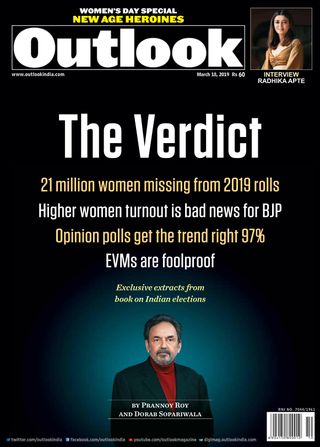
India’s pioneering psephologists slice through the clutter with some revelations: women might outvote men in 2019, despite millions being disenfranchised.
-

PERHAPS the most heartening sight while travelling around the country during elections is long queues of women outside polling booths, waiting to vote. These lines are often longer than the separate queues for men. The current high level of women’s participation has been a major development in India’s democracy. In 1962, the turnout of women was only 47 per cent (of the total female electorate), yet by 2014, it had shot up to 66 per cent—up by nearly 19 percentage points. On the other hand, men’s turnout grew by only 5 per cent over the same period.
This differential growth rate in turnout has meant that, over time, women’s turnout in Lok Sabha elections has almost caught up with and is likely to overtake that of men soon, perhaps even as soon as the 2019 Lok ​Sabha elections. In 1962, women’s turnout was 15 per cent lower than men’s turnout; but by 2014, women’s turnout had almost reached parity with men, short by only 1.5 per cent. This represents a remarkable, if belated, turnaround over the last halfcentury.
As an aside, this very strong statement by women on ensuring a greater say in the democratic process in India almost parallels the significant finding by Imperial College, London, that the height of women in India has grown significantly more than that of men: an average Indian woman’s height has gone up by 4.9 cm as against an increase of 2.9 cm in an average Indian man’s height over the past century. Of course, women are still, on average, not as tall as men: 152.4 cm (5 ft) vs 165 cm (5 ft 4.9 inches), but women are catching up!

Bu hikaye Outlook dergisinin March 18, 2019 baskısından alınmıştır.
Binlerce özenle seçilmiş premium hikayeye ve 9.000'den fazla dergi ve gazeteye erişmek için Magzter GOLD'a abone olun.
Zaten abone misiniz? Oturum aç
Outlook'den DAHA FAZLA HİKAYE

Outlook
The Big Blind Spot
Caste boundaries still shape social relations in Tamil Nadu-a state long rooted in self-respect politics

8 mins
December 11, 2025

Outlook
Jat Yamla Pagla Deewana
Dharmendra's tenderness revealed itself without any threats to his masculinity. He adapted himself throughout his 65-year-long career as both a product and creature of the times he lived through
5 mins
December 11, 2025

Outlook
Fairytale of a Fallow Land
Hope Bihar can once again be that impossibly noisy village in Phanishwar Nath Renu's Parti Parikatha-divided, yes, but still capable of insisting that rights are not favours and development is more than a slogan shouted from a stage
14 mins
December 11, 2025

Outlook
The Lesser Daughters of the Goddess
The Dravidian movement waged an ideological war against the devadasi system. As former devadasis lead a new wave of resistance, the practice is quietly sustained by caste, poverty, superstition and inherited ritual
2 mins
December 11, 2025

Outlook
The Meaning of Mariadhai
After a hundred years, what has happened to the idea of self-respect in contemporary Tamil society?
5 mins
December 11, 2025

Outlook
When the State is the Killer
The war on drugs continues to be a war on the poor
5 mins
December 11, 2025

Outlook
We Are Intellectuals
A senior law officer argued in the Supreme Court that \"intellectuals\" could be more dangerous than \"ground-level terrorists\"
5 mins
December 11, 2025

Outlook
An Equal Stage
The Dravidian Movement used novels, plays, films and even politics to spread its ideology
12 mins
December 11, 2025
Outlook
The Dignity in Self-Respect
How Periyar and the Self-Respect Movement took shape in Tamil Nadu and why the state has done better than the rest of the country on many social, civil and public parameters
5 mins
December 11, 2025

Outlook
When Sukumaar Met Elakkiya
Self-respect marriage remains a force of socio-political change even a century later
7 mins
December 11, 2025
Translate
Change font size