Denemek ALTIN - Özgür
Colonial Coat Tails In Feudal Fabric
Outlook
|April 10, 2017
Thoroughly liveried, the judge comes across as a maharaja. A time-warp cloaks Indian judiciary’s etiquette.

Every day, courts across India begin proceedings at 10.30 am when an usher in a crisp white uniform, and in some places a turban, holds open the door. It is then that the waiting lawyers, litigants and others stand up and, after a very brief pause, the judge (or judges) walks in. An attendant holds the chair till the judge sits down…more than one of them, if it’s judges.
This ceremonial seating begins the gruelling day for high court or Supreme Court judges who have to traverse through reams of paperwork and scores of ‘milording’ advocates. As lunch hour or 4 pm draws closer, waiting lawyers keep one eye on the clock and the other on the usher. When the attendant reaches for the judge’s chair from the back, it’s the sign that his lordship will now rise and retire from the open court.
Everything about that scene—the unevenly distributed privilege, the visual cues, the obeisant forms of address—is straight out of a pre-modern protocol, a feudal code. Its survival into modern contexts was seen to have served a function—ennobling the idea of justice and its arbiters, granting them a safe distance from the mundane, conferring on them the right to the last word.
In India, though, the risk of all this being read in terms of older forms of privilege is never too far. Ushers are part of the small, visible tokens reserved for India’s higher judiciary. (One argument advanced in its defence is that it creates jobs, though in economics there also exists the concept of disguised unemployment.) There are other privileges, both seen and unseen. In the latter category are protocol officers at airports. Their job is to help judges, both serving and retired, past airport security as well as run other errands.
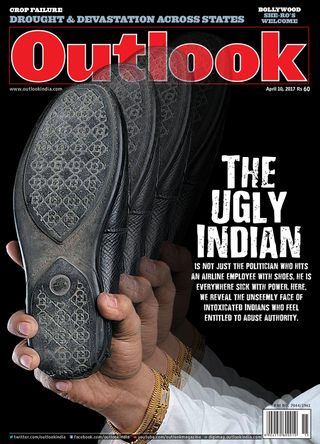

Bu hikaye Outlook dergisinin April 10, 2017 baskısından alınmıştır.
Binlerce özenle seçilmiş premium hikayeye ve 9.000'den fazla dergi ve gazeteye erişmek için Magzter GOLD'a abone olun.
Zaten abone misiniz? Oturum aç
Outlook'den DAHA FAZLA HİKAYE

Outlook
Hating Dating
For many women, dating in their 30s and 40s is defined less by romance than by exhaustion, confusion and a sense of emotional attrition

2 mins
February 21, 2026

Outlook
Rage of Betrayals
THIS is a popular poem often shared when anyone talks of the 4B movement in South Korea. The women in this movement boycott the world of men; boycott heterosexual marriage, relationships, sex, and giving birth.
2 mins
February 21, 2026

Outlook
Class and Caste
Caste hierarchies continue to exist in everyday life and across campuses. Due to the persistence of caste in schools and colleges, long believed to be places for upward mobility and rational thought, these institutions end up becoming spaces where questions of \"merit\", cultural capital, language and access-or the lack of thereof-are highlighted and ridiculed. The discrimination persists from Kashmir to Kerala. From delayed degrees and stalled promotions to verbal abuse, professional isolation, and sometimes death, these case studies underscore not isolated instances but a pattern
18 mins
February 21, 2026

Outlook
The Misuse Myth
A close look at reported cases over the past ten years shows that there is no pattern of rampant misuse of the SC/ST Act in universities or higher education institutions
6 mins
February 21, 2026
Outlook
The Higher, The Lower
What is clear is that the entrenched caste hierarchy feels that power is slipping out from their grasp
6 mins
February 21, 2026
Outlook
Writing is Acting by Another Name
My wife spots him first while my attention is focused on the bucket of theatre popcorn (medium, salt and caramel mix). I look up and there he is. Pico Iyer, great travel writer, essayist, novelist, columnist, humanist, and in recent years, friend and correspondent. While the rest gasp when Timothee Chalamet appears in Marty Supreme, we gasp when Pico does.
3 mins
February 21, 2026

Outlook
Sins of Savarnatva
The upper castes believe that the UGC regulations are a death knell to their own existence
6 mins
February 21, 2026

Outlook
Invisible Labour, Visible Costs
Women shoulder disproportionate emotional and domestic work, shaping how they view intimacy and relationships
2 mins
February 21, 2026

Outlook
Between textbooks and court orders
From first choice to uncertainty as HIMSR-Jamia Hamdard dispute leaves students stranded
5 mins
February 21, 2026

Outlook
Aggressive Victimhood Versus Predictable Protests
The current controversy around the UGC regulations is meant neither to promote social justice and equity nor hurt the interests of the dominant castes. It's meant for the two to be at loggerheads and further consolidate their support behind the BJP-RSS combine
5 mins
February 21, 2026
Translate
Change font size