
Magzter GOLD ile Sınırsız Olun
Sadece 9.000'den fazla dergi, gazete ve Premium hikayeye sınırsız erişim elde edin
Denemek ALTIN - Özgür
Untying The Kabul Knot
Geopolitics
|Sep-2018
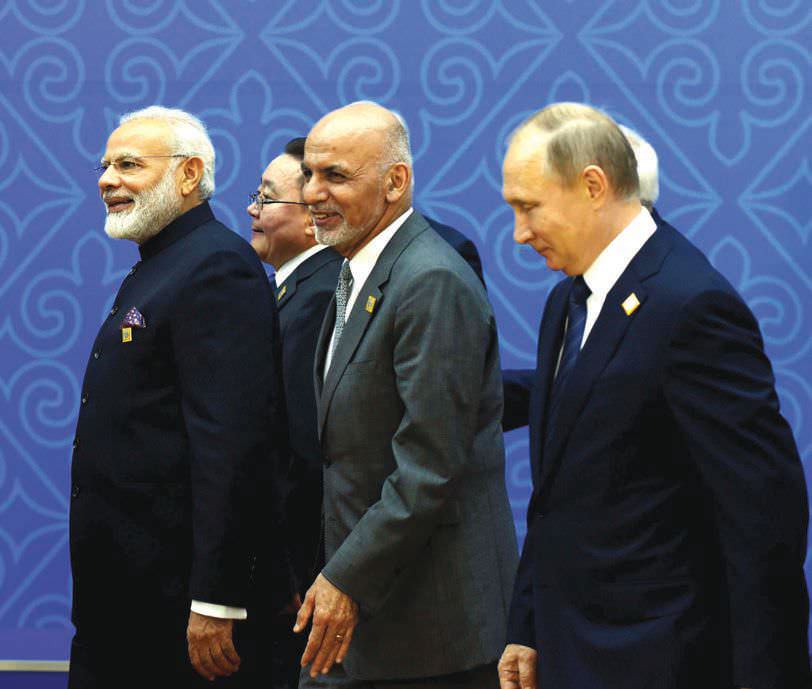
Seventeen long years have gone by since the war against the Taliban ended. But peace has not returned. The Taliban regrouped, thanks to the unceasing support of Pakistan, and returned with vengeance in less than a year and have since managed to wreak havoc all over the country. Since 2014, the Islamic State has joined in to find a niche for itself as it faces stiff resistance and rout in West Asia. Since 2001, the total number of Afghans killed in war is a staggering 111,000. APRATIM MUKARJI explains what is wrong with Afghanistan

There are two ways to look at Afghanistan at this juncture. As many as 5,122 civilians became victims of various terror-related incidents in the first six months of 2018,as many as 1,692 of them killed, a much higher level of casualties in vogue for the last three years. This year, the country will be holding its third parliamentary elections, a democratic exercise introduced after the liberation of the country from the Islamic fundamentalist Taliban in 2001. This is also the 30th. year of continuous warfare for the country. The Afghans live with war every day of their lives. There is no other country with that kind of debilitating qualification.
However, there are three distinctly new trends in the situation. The most significant of these is the people’s frustration and anger over the never-ending warfare and a devastated life they are being forced to live. This was manifest in a long march which common Afghans took out in early July covering 700 km. from the north to Kabul, demanding that the fighting be stopped by both the insurgents and the government and that peace negotiations begun. Peace activists in the march questioned the efficacy of the billion-dollar-worth international efforts to bring peace and reconstruction to the country.
However, the people’s search for peace and the government’s and the international players’ desperation to get the Taliban to the negotiating table underscores just one thing, and that is the unquestionable ascendancy of the Taliban in the intervening years since their ouster at the end of 2001. The fundamentalist force is now said to be controlling half of the country.

Bu hikaye Geopolitics dergisinin Sep-2018 baskısından alınmıştır.
Binlerce özenle seçilmiş premium hikayeye ve 9.000'den fazla dergi ve gazeteye erişmek için Magzter GOLD'a abone olun.
Zaten abone misiniz? Oturum aç
Geopolitics'den DAHA FAZLA HİKAYE
Geopolitics
Navy Flags Critical Engine Dependency Gap
Despite significant advances in indigenous warship construction, India's continued reliance on foreign marine propulsion systems remains a critical vulnerability in its defence framework.

1 mins
April 2026
Geopolitics
GTRE Advances Engine Testing With Su-30
India's aero-engine development programme is set to accelerate as GTRE proceeds to convert two Su-30 MKI fighters into dedicated flying testbeds, enabling real-time validation of indigenous propulsion technologies.
1 mins
April 2026
Geopolitics
Indigenous Anti-Tank Missile Nears Production Clearance
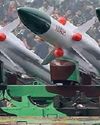
India's indigenous man-portable anti-tank guided missile is approaching final clearance for mass production following successful validation trials against moving targets.
1 min
April 2026
Geopolitics
A RE-LOOK AT INDIAN MILITARY LOGISTICS & THEATRE COMMANDS
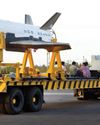
JOSEPH P CHACKO explains why logistics systems must be integrated to be capable of seamlessly supporting modern warfare operations, which necessitate rapid, coordinated responses across multiple domains
14 mins
April 2026
Geopolitics
Defence Spending Drives Acquisition Surge
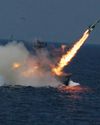
India's defence modernisation programme has entered a phase of rapid implementation, with FY 2025-26 seeing full utilisation of capital expenditure and a clear focus on addressing critical capability gaps across the armed forces.
3 mins
April 2026

Geopolitics
K9 Vajra Hits mega Indigenisation
India's India's flagship tracked artillery programme has reached a crucial turning point, with the K9 Vajra-T now achieving over 82 per cent indigenous content at the work package level, marking a fundamental shift in domestic defence manufacturing capability.
1 min
April 2026
Geopolitics
NUCLEAR SHARKS OF STEEL!
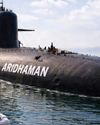
India’s third Arihant-class submarine, INS Aridhaman, was commissioned into the Indian Navy on April 3, 2026, at Visakhapatnam by Defence Minister Rajnath Singh.
2 mins
April 2026
Geopolitics
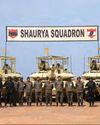
Army Eyes Tank-Launched Drone Strikes
The Indian Army is advancing a new concept to equip its main battle tanks with indigenous loitering munitions that can be deployed directly from existing 81mm smoke grenade launchers.
1 min
April 2026

Geopolitics
THE ANATOMY OF A POLARISED FRONTIER
West Bengal has changed from a longtime “Red Bastion” to one of the most hotly contested states in Indian politics.
2 mins
April 2026
Geopolitics
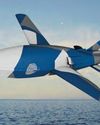
Navy Advances Drone-Ready Amphibious Carriers
India's next-generation amphibious warfare programme has entered a crucial -phase as the Navy advances its evaluation of four large-deck platforms designed to revolutionise expeditionary operations.
1 mins
April 2026
Translate
Change font size