Denemek ALTIN - Özgür
Painted Worlds
Archaeology
|September/October 2017
Searching for the meaning of self-expression in the land of the Moche

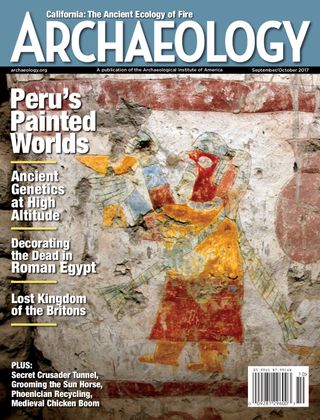
THE COVER OF THE AUTUMN 1951 issue of ARCHAEOLOGY features a dramatic scene of close combat between two men, teeth bared, faces bright red with exertion, garments flying, pulling each other’s hair so violently that each grips the ripped-out forelock of his foe. Created by the artist Pedro Azabache, this cover is a replica of a wall painting at the site of Pañamarca on the northwest coast of Peru, done very shortly after the work’s rediscovery. Mural A depicts a contest between Ai-Apaec, the mythological hero worshipped by the Moche culture, which flourished in this region between about A.d. 200 and 900, and his twin or double. Although Pañamarca’s impressive ruins on a granite outcropping in the lower Nepeña River Valley were well known in the first half of the twentieth century, and had been described by travelers in the late nineteenth century, only a few articles about the site had been published and very little had been said about its wall paintings. Thus, when American archaeologist Richard Schaedel arrived there in 1950, he believed that any paintings he might find would be fragmentary at best. Once there, however, he soon found that Pañamarca’s adobe structures had been completely covered in polychrome murals. In a single week—originally planned for five days, the trip was extended when more murals and a group of burials were discovered—Schaedel and his five-person team not only recorded the combat scene, but also discovered new murals of what he identified as a large cat-demon and an anthropomorphic bird. On the walls of a large plaza, they documented a 30-foot-long composition showing a procession of warriors and priests wearing a costume with knife-shaped back flaps known to have been part of Moche sacrificial rituals.

Bu hikaye Archaeology dergisinin September/October 2017 baskısından alınmıştır.
Binlerce özenle seçilmiş premium hikayeye ve 9.000'den fazla dergi ve gazeteye erişmek için Magzter GOLD'a abone olun.
Zaten abone misiniz? Oturum aç
Archaeology'den DAHA FAZLA HİKAYE
Archaeology
THE EGYPTIAN SEQUENCE
Until now, the earliest Egyptians to have even part of their DNA sequenced were three people who lived between 787 and 544 B.C.

1 mins
November/December 2025
Archaeology
SOURCE MATERIAL
As early as 40,000 years ago, some hunter-gatherers in southern Africa ventured long distances to procure special types of stone to make their tools.
1 min
November/December 2025

Archaeology
Secrets of the Seven Wonders
How archaeologists are rediscovering the ancient world's most marvelous monuments
13 mins
November/December 2025
Archaeology
ACTS OF FAITH
Evidence emerges of the day in 1562 when an infamous Spanish cleric tried to destroy Maya religion
12 mins
November/December 2025

Archaeology
OASIS MAKERS OF ARABIA
Researchers are just beginning to understand how people thrived in the desert of Oman some 5,000 years ago
8 mins
November/December 2025

Archaeology
FOSSIL FORCE
One of the planet's most successful arthropods, trilobites, abounded in the oceans from about 520 million to 250 million years ago.
1 min
November/December 2025
Archaeology
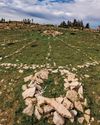
BIGHORN MEDICINE WHEEL, WYOMING
Perched almost 9,700 feet above sea level on Medicine Mountain in Wyoming's Bighorn Range, the Medicine Wheel is an 80-foot-diameter circular structure made from limestone boulders.
2 mins
November/December 2025
Archaeology
ANCIENT LOOK BOOK
A young woman buried in China's Tarim Basin some 2,000 years ago went to the afterlife accompanied by the height of fashion.
1 mins
November/December 2025
Archaeology
A FAMILIAR FACE
In the early eleventh century, a landslide on the island of Ostrów Lednicki in western Poland caused a hillfort to collapse and slip to the bottom of Lake Lednica.
1 min
November/December 2025
Archaeology
Temples to Tradition
A looted cache of bronzes compels archaeologists to explore Celtic sanctuaries across Burgundy
13 mins
November/December 2025
Translate
Change font size