Denemek ALTIN - Özgür
Fooled Again
The New Yorker
|April 03, 2023
What can we learn from the strategies of deception in the animal world?

On April 20, 1848, Alfred Russel Wallace and Henry Walter Bates set off for the Amazon on a boat named Mischief. The two young men—Bates was twenty-three, Wallace twenty-five—had met a few years earlier, probably at a library in Leicester, in England’s East Midlands. Both were passionate naturalists, and both were strapped for cash. (Neither had been able to afford university.) To finance their adventures, they planned to ship specimens back to London, where they could be sold to wealthy collectors.
For reasons that no one has ever been able to explain—but that many have speculated about—Wallace and Bates separated soon after they reached Brazil. In the decade that followed, Wallace amassed an immense trove of new species; lost most of them in a ship fire; set off again, for Southeast Asia; and, with Charles Darwin, discovered natural selection.
Bates, meanwhile, remained in Brazil. He sailed up the Tapajós, an Amazon tributary, and then up the Cupari, a tributary of the Tapajós. Travel in the region was often agonizingly slow; to get from the town of Óbidos to Manaus, a journey of less than four hundred miles, took him nine weeks. (At some point during the trip, he was robbed of most of the money he was carrying.) Bates would find a congenial town and spend months, even years, there, making daily forays into the surrounding rainforest. He tromped around in a checked shirt and denim pants, an outfit considered outré by the British merchants he encountered in Brazil, who wore their top hats rain or shine.
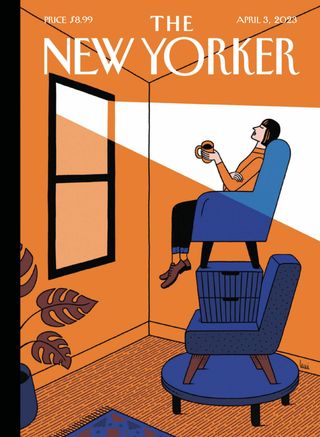

Bu hikaye The New Yorker dergisinin April 03, 2023 baskısından alınmıştır.
Binlerce özenle seçilmiş premium hikayeye ve 9.000'den fazla dergi ve gazeteye erişmek için Magzter GOLD'a abone olun.
Zaten abone misiniz? Oturum aç
The New Yorker'den DAHA FAZLA HİKAYE
The New Yorker
DEPT. OF ETCHING
One recent weekday morning, the British painter Peter Doig arrived at a bonded warehouse—a cavernous brick building—about a mile south of the River Thames, but not subject to the import taxes of the United Kingdom.

3 mins
January 19, 2026

The New Yorker
SUBWAY VIGILANTE
Revisiting the New York shooting that defined an era
17 mins
January 19, 2026

The New Yorker
MOM AND DAD: THE PERFORMANCE REVIEW
Mom, Dad, thanks for being on time this year. Dad, I can see by your T-shirt that it was a challenge. So you've already exceeded expectations.
3 mins
January 19, 2026
The New Yorker
Patrick Radden Keefe on Truman Capote's “In Cold Blood”
In 1972, on “The Tonight Show,” Johnny Carson asked Truman Capote about capital punishment. Capote had written, in unsettling detail, about the hanging of two killers, Dale Hickock and Perry Smith. Carson said, of the death penalty, “As long as the people don't have to see it, they seem to be all for it”; if executions occurred “in the public square,” Americans might stop doing them. Capote wasn't so sure. His hands laced together professorially, he murmured, in his baby-talk drawl, “Human nature is so peculiar that, really, millions of people would watch it and get some sort of vicarious sensation.”
3 mins
January 19, 2026
The New Yorker
BOOTS ON THE GROUND
There aren't many moments in Donald Trump's political career that could be called highlights.
4 mins
January 19, 2026
The New Yorker
CALL OF THE WILD
When calamity strikes in America's busiest national park, who comes to the rescue?
35 mins
January 19, 2026

The New Yorker
UNDER THREAT
The Danes were America's most loyal ally. Now they feel targeted—and terrified.
22 mins
January 19, 2026

The New Yorker
CONTAGION
A Broadway revival of Tracy Letts's “Bug.”
6 mins
January 19, 2026

The New Yorker
ANNALS OF TECHNOLOGY: HEY THERE!
How WhatsApp took over the global conversation.
25 mins
January 19, 2026
The New Yorker
M.I.P. IN CHAINS
Whatever else you think about invading a country and capturing its President, there's no getting around the inconvenience of imprisoning Nicolás Maduro in New York City.
7 mins
January 19, 2026
Translate
Change font size