
Magzter GOLD ile Sınırsız Olun
Sadece 9.000'den fazla dergi, gazete ve Premium hikayeye sınırsız erişim elde edin
Denemek ALTIN - Özgür
WET SPINNING
Textile Value Chain
|July 2020
Highlight of the article:Wet spinning is the oldest process.- It is used for fiber-forming substances that have been dissolved in a solvent.- The spinnerets are submerged in a chemical bath and as the filaments emerge they precipitate from solution and solidify.- It is called “Wet spinning” since the solution is extruded directly into the precipitating liquid.- Examples: Rayon, Aramid, Acrylic, etc.

The first monetarily effective strategy for the production of synthetic fiber was the wet turning of the cellulosic fiber, rayon. This technique is as yet utilized today. Basically, the procedure includes the utilization of a proper fluid arrangement, which is siphoned through a little spout, which is known as a spinneret, into a synthetic shower that coagulates the expelled arrangement of unlimited strands of fibers. These coagulated persistent filaments are drawn out of the shower, cleansed by washing, dried and afterward twisted onto spools. The development of the spinneret might be shifted by the ideal outcomes. On the offchance that the spinneret has one expulsion gap, at that point a monofilament yarn will be created. In the event that the spinneret has numerous gaps, at that point a multifilament yarn will be created. The size and number of the openings of spinneret might be fluctuated. In this manner, the number and size of the fibers of which it is developed decide the thickness, or denier of the yarn. Likewise, the measure of turn given the prepared yarn will influence its surface and quality.
On the offchance that we talk in detail, Wet turning is the most mind boggling of the turning procedures. Some wet turning forms require the polymer answer for be kept above or beneath surrounding temperature and subsequently a warmth exchanger is utilized. The spinnerets are drenched in tanks containing the coagulation into which the fibers are expelled. The expulsion course is variable from vertically upwards to flat. The spinnerets utilized in wet-turning can have up to 2,000 gaps for business applications. In any case, ordinary wet turning is the slowest of the chief procedures having windup rates to roughly 150 m/min.
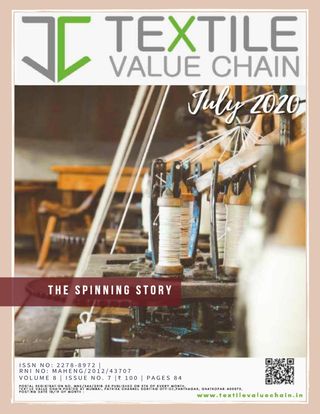

Bu hikaye Textile Value Chain dergisinin July 2020 baskısından alınmıştır.
Binlerce özenle seçilmiş premium hikayeye ve 9.000'den fazla dergi ve gazeteye erişmek için Magzter GOLD'a abone olun.
Zaten abone misiniz? Oturum aç
Textile Value Chain'den DAHA FAZLA HİKAYE

Textile Value Chain
The New Age of Men's Tailoring: From Bespoke to Hybrid Models
Part 1 of the Series: The Evolving World of Men's Tailored Wear

4 mins
January 2026

Textile Value Chain
The Textile Landscape of 2025: A Year of Transformation
Navigating Policy Reforms, Trade Agreements, and Global Events
5 mins
January 2026

Textile Value Chain
Recycled Fibres vs Virgin Fibres: The Real Cost, Footprint & Business Opportunity
For decades, the textile industry asked only one question when choosing raw material:
3 mins
January 2026

Textile Value Chain
2025 in Perspective: A Stronger, Cleaner, Smarter Future for Textiles
The year 2025 reminded the textile and apparel sector that resilience now matters more than pace.
5 mins
January 2026
Textile Value Chain
Heimtextil as a Working lab for Sutlej and its Customers
When the global home textiles industry gathers in Frankfurt this January, Sutlej Textiles is approaching Heimtextil with a clear intent: to treat the fair less as a product parade and more as a live development lab with its buyers and partners.
4 mins
January 2026

Textile Value Chain
Weaving Heritage into Future: A Conversation with Ms Roop Rashi Mahapatra
In an era where fast fashion dominates the global textile landscape, Khadi stands as a timeless symbol of India's heritage, sustainability, and self-reliance.
11 mins
January 2026

Textile Value Chain
Home Textiles: Ever-growing Market to Evergreen Product Source
Indian Home textiles have always enjoyed a special market position, and demand continues to increase, capturing a premium to the budgeted market across different markets, but with one constant hunger for extraordinary design, a super comfortable feel, and the appeal of sophistication, along with changing market dynamics.
4 mins
January 2026

Textile Value Chain
The Velvet Revolution: How This Timeless Fabric is Redefining Modern Textiles
When you run your hand across velvet, something happens.
3 mins
January 2026

Textile Value Chain
SPGPrints Achieves Landmark Success at ITMA ASIA 2025 With Transformative Textile Printing Technology and Key Order Closures
SPGPrints, the global leader in innovative textile printing solutions, announced an overwhelmingly successful participation in ITMA ASIA 2025 at the Singapore Expo.
2 mins
January 2026

Textile Value Chain
Development of Home Textile Products from Post-Consumer Textile Waste
With the growing concern over textile waste and its environmental impact, sustainable approaches for fabric reuse are urgently needed.
5 mins
January 2026
Translate
Change font size