Denemek ALTIN - Özgür
Developing Employability
DataQuest
|May 2019
Opportunities to deploy technology in Indian schools with the goal of making education more inclusive and industry ready
-

Status Of ICT In Education
Since the introduction of Information and Communication Technology (ICT) hardware in schools in 1985, India has progressed rapidly, bringing in new technologies into the classrooms. there is a noticeable transition from the use of chalk and blackboards, to laptops and tablets. Flagship programmes like the Rashtriya Madhyamik Shiksha Abhiyan supported the growth of 85,127 ICT enabled schools through 2015 and generated momentum for the Government’s current focus on cultivating digital literacy. today, India’s national Policy of ICT in School education underscores the Government’s commitment to providing universal, equitable access to state-of-the-art-tools to students and teachers. Additionally, the Government has also launched ambitious plans to provide ICT training to 5.25 million people through the Digital Saksharta Adhiyan (DIShA) programme, and hopes to advance digitisation initiatives by introducing eGovernance in the Ministry of electronics and Information technology (MeitY) through its Digital India Programme. India offers a great opportunity to implement ICT in education-with approximately 29% of India’s population being between the age group of 0-14 years. the education sector is estimated at US$ 91.7 billion in FY18 and is expected to reach US$ 101.1 billion in FY19. India has over 250 million school going students, more than any other country. It also has one of the largest networks of higher education institutions in the world. number of colleges and universities in India reached 39,050 and 903, respectively in 2017-18. India had 36.64 million students enrolled in higher education in 2017-18. Gross enrolment Ratio in higher education reached 25.8% in 2017-18.
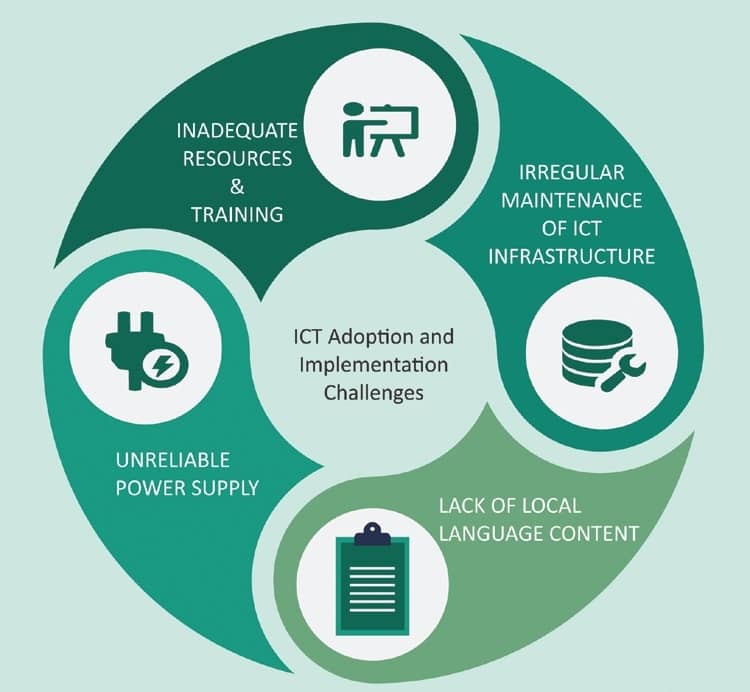
Challenges


Bu hikaye DataQuest dergisinin May 2019 baskısından alınmıştır.
Binlerce özenle seçilmiş premium hikayeye ve 9.000'den fazla dergi ve gazeteye erişmek için Magzter GOLD'a abone olun.
Zaten abone misiniz? Oturum aç
DataQuest'den DAHA FAZLA HİKAYE

DataQuest
Engineering India's Al-First Data Centres at Hyperscale
Rohan Sheth explains how AI and HPC are reshaping India's data centres, from density and cooling to power economics, sustainability, and hyperscale decision criteria.

4 mins
February 2026

DataQuest
From copilots to colleagues: Why agentic AI is forcing enterprises to rethink control, trust, and culture
As AI agents shift from assisting to acting, enterprises must redesign governance, data controls, and security guardrails so autonomy stays auditable, reversible, and trusted.
2 mins
February 2026

DataQuest
Reclaiming Control in the AI Era: A Conversation with Kalyan Kumar, CPO, HCLSoftware
Enterprises are reassessing cloud-first strategies as AI becomes core to operations. HCLSoftware's Kalyan Kumar explains why sovereignty, choice and control now shape decisions.
5 mins
February 2026

DataQuest
When infrastructure learns: The rise of the Al-native core
AI-native infrastructure is moving from concept to operational reality, reshaping how organisations build, govern, and scale intelligence across their digital core.
6 mins
February 2026

DataQuest
Bridging the gap between connectivity and compute at scale
As AI scales in India, data centres are evolving into high-density, low-latency platforms that unify connectivity, compute, and sustainability at national scale.
4 mins
February 2026

DataQuest
PUE is not a grapefruit metric, anymore
So what are the new high-hanging fruits for data centre strategists today? And are players going after them?
4 mins
February 2026

DataQuest
Even if Al demand fades, India need not worry - about data centres
For every megawatt (MW) of installed colocation capacity, users here generate approximately 13.2 PB of data monthly- compared to 0.3 PB for Australia and just 0.01 PB for Singapore. India's data centre growth is not dependent on one tech lever. Plus, it is phased and modular and not kneejerk. Manoj Paul explains these contours in detail.
7 mins
February 2026

DataQuest
AI infrastructure and systemic risk
What has been the biggest change in data centre industry-specially after AI workloads? Is Al-bubble a big risk for data centre infra- how much will it affect data centres if something cracks?
1 min
February 2026

DataQuest
Inside the Shift to High-Density, Al-Ready Data Centres
CtrlS' Vipin Jain discusses what it truly takes to build AI-ready data centres in India, balancing high density, liquid-ready cooling, resilience, and ESG accountability.
4 mins
February 2026

DataQuest
Sustainability is now the headline, not a footnote
Sanjay Agrawal, Head Presales and CTO at Hitachi Vantara India and SAARC opines that the conversation is moving beyond headline metrics like PUE toward a broader view of how data lifecycle management and infrastructure efficiency reduce the overall environmental footprint. Let's see why and how- while also touching upon adjacent (or not-so-adjacent) factors like redundancies, availability and AI-readiness
3 mins
February 2026
Translate
Change font size