Denemek ALTIN - Özgür
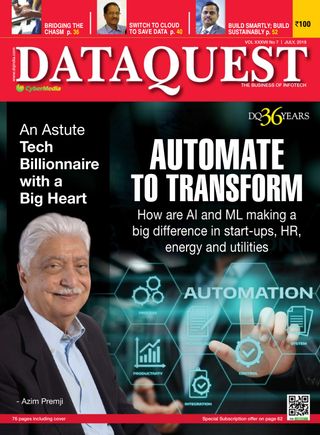
Build Smartly; Build Sustainably
DataQuest
|July 2019
While building cities according to the new age tech is becoming more and more imperative today, it’s also essential to create eco-friendly spaces. Deepak NG, Founder, Dassault Systèmes shares his views with us.

How are cities of future evolving with technological innovation in architecture, engineering and construction space – can you give some examples from India and other countries?
The notion of smart cities is always perceived as what the future will look like, but it is not the sole purpose for the inception of smart cities. Rather requirement of sufficient water resources, universal access to clean energy, adequate transportation facilities and sense of security are some of the major reasons behind the emergence of smart cities in India. With rapid increase in urbanisation, it is expected that by 2050, 66% of the world’s population will move into urban areas, thus posing a serious challenge for city planners to make available the basic amenities and resources to the population.
Smart Cities coupled with the latest technology innovations have been heralded as the key to tackle the challenges posed by rapid urbanisation. Smart cities create a place where everything is connected and technology operates behind the scenes to ensure that all the elements of daily life run smoothly. Smart technologies such as a municipal network of optical fibre, free Wi-Fi, routed street lighting and sensors to monitor air quality would help smart cities evolve more and serve the society as a whole. Technology innovations in the engineering and construction space provide an extra mile for the successful establishment of a smart city. 3D modelling, data analytics and simulation have helped the smart city project managers in collaboration and management of the complex projects. One of the major contribution of technology to the cities of the future is the relevance of the bundles of data that needs to be analysed for customisation and more viability of smart cities.

Bu hikaye DataQuest dergisinin July 2019 baskısından alınmıştır.
Binlerce özenle seçilmiş premium hikayeye ve 9.000'den fazla dergi ve gazeteye erişmek için Magzter GOLD'a abone olun.
Zaten abone misiniz? Oturum aç
DataQuest'den DAHA FAZLA HİKAYE

DataQuest
Engineering India's Al-First Data Centres at Hyperscale
Rohan Sheth explains how AI and HPC are reshaping India's data centres, from density and cooling to power economics, sustainability, and hyperscale decision criteria.

4 mins
February 2026

DataQuest
From copilots to colleagues: Why agentic AI is forcing enterprises to rethink control, trust, and culture
As AI agents shift from assisting to acting, enterprises must redesign governance, data controls, and security guardrails so autonomy stays auditable, reversible, and trusted.
2 mins
February 2026

DataQuest
Reclaiming Control in the AI Era: A Conversation with Kalyan Kumar, CPO, HCLSoftware
Enterprises are reassessing cloud-first strategies as AI becomes core to operations. HCLSoftware's Kalyan Kumar explains why sovereignty, choice and control now shape decisions.
5 mins
February 2026

DataQuest
When infrastructure learns: The rise of the Al-native core
AI-native infrastructure is moving from concept to operational reality, reshaping how organisations build, govern, and scale intelligence across their digital core.
6 mins
February 2026

DataQuest
Bridging the gap between connectivity and compute at scale
As AI scales in India, data centres are evolving into high-density, low-latency platforms that unify connectivity, compute, and sustainability at national scale.
4 mins
February 2026

DataQuest
PUE is not a grapefruit metric, anymore
So what are the new high-hanging fruits for data centre strategists today? And are players going after them?
4 mins
February 2026

DataQuest
Even if Al demand fades, India need not worry - about data centres
For every megawatt (MW) of installed colocation capacity, users here generate approximately 13.2 PB of data monthly- compared to 0.3 PB for Australia and just 0.01 PB for Singapore. India's data centre growth is not dependent on one tech lever. Plus, it is phased and modular and not kneejerk. Manoj Paul explains these contours in detail.
7 mins
February 2026

DataQuest
AI infrastructure and systemic risk
What has been the biggest change in data centre industry-specially after AI workloads? Is Al-bubble a big risk for data centre infra- how much will it affect data centres if something cracks?
1 min
February 2026

DataQuest
Inside the Shift to High-Density, Al-Ready Data Centres
CtrlS' Vipin Jain discusses what it truly takes to build AI-ready data centres in India, balancing high density, liquid-ready cooling, resilience, and ESG accountability.
4 mins
February 2026

DataQuest
Sustainability is now the headline, not a footnote
Sanjay Agrawal, Head Presales and CTO at Hitachi Vantara India and SAARC opines that the conversation is moving beyond headline metrics like PUE toward a broader view of how data lifecycle management and infrastructure efficiency reduce the overall environmental footprint. Let's see why and how- while also touching upon adjacent (or not-so-adjacent) factors like redundancies, availability and AI-readiness
3 mins
February 2026
Translate
Change font size