Prova GOLD - Gratis
The Chip That Turns AI MODELS INTO SILICON
Electronics For You
|July 2026
The AI industry has spent years scaling models through brute-force computing. HC1 takes a different path entirely, collapsing hardware and software into a single architectural layer.
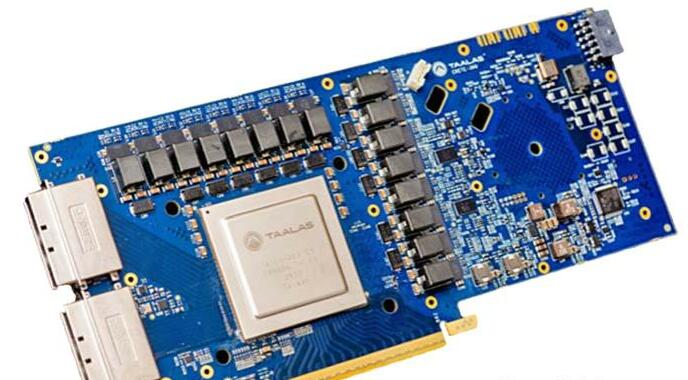
A radical compute-in-memory architecture is collapsing the boundary between hardware and AI models, eliminating data movement and redefining performance-per-watt.
The HC1 by Taalas is not just faster, it signals a fundamental shift in how chips are conceived, built, and optimised for the next era of AI inference.
The unveiling of the HC1 is not merely another addition to the crowded AI chip market—it represents a fundamental rethinking of how artificial intelligence workloads are executed. HC1 addresses inefficiencies in current AI infrastructure by targeting escalating costs, rising energy demands, and architectural bottlenecks that are beginning to constrain large-scale AI deployment.
At its core, the HC1 introduces a new category of compute hardware in which AI models are no longer software artefacts running on general-purpose processors. Instead, they are physically instantiated into silicon. This shift effectively turns the chip into the model itself, collapsing the distinction between hardware and software while enabling performance levels that exceed current inference benchmarks.
The company claims the HC1 achieves throughput of 17,000 tokens per second on Llama 3.1 8B—an order-of-magnitude leap over existing systems. Crucially, this performance is delivered without reliance on high-bandwidth memory (HBM), liquid-cooling systems, or hyperscale infrastructure. A fully configured server equipped with ten HC1 cards operates at approximately 2.5kW using standard air cooling, dramatically lowering the barrier to deployment.
The infrastructure crisis driving innovation
The HC1 emerges against the backdrop of a growing crisis in AI infrastructure, where traditional system architectures are struggling to keep pace with demand. The central issue lies in the ‘memory wall’—a longstanding limitation in computing where data transfer between memory and processing units becomes the dominant bottleneck.

Den här artikeln är från utgåvan July 2026 av Electronics For You.
Prenumerera på Magzter GOLD för att få tillgång till tusentals kurerade premiumartiklar samt 10 000+ tidskrifter och dagstidningar.
Redan prenumerant? Logga in
FLER ARTIKLAR FRÅN Electronics For You
Electronics For You
FM RADIO RECEIVER Using TDA7000
This FM radio receiver demonstrates the practical application of RF engineering and analogue signal-processing techniques.

4 mins
July 2026

Electronics For You
Latest 3D chip stacking method could extend Moore's Law
Engineered by a team at the University of Illinois Grainger College of Engineering in Urbana-Champaign, the process uses ultrathin single-crystalline silicon nanomembranes transferred at temperatures below 200°C, avoiding heat damage to underlying circuits.
1 min
July 2026
Electronics For You
Stretchable patch detects heart failure risks
Researchers at the University of Chicago's Pritzker School of Molecular Engineering in Chicago have developed an AI-powered stretchable computing patch capable of processing health data directly on the body in milliseconds, eliminating the need for external servers or wireless connections.
1 min
July 2026

Electronics For You
Simple 12V To 24V VOLTAGE DOUBLER
Many electronic circuits require a voltage higher than that available from the power supply.
3 mins
July 2026
Electronics For You
Crystal stress method reshapes nanochip manufacturing techniques
Research conducted at Rice University in Houston, Texas, demonstrated that alpha-molybdenum trioxide crystals can deform under an electron beam, generating highly ordered nanoscale wrinkles that function as optical gratings for guiding and manipulating light on chips.
1 min
July 2026

Electronics For You
Hidden Costs In IoT PRODUCT DEVELOPMENT
Hardware mistakes do not show up early in development. The most expensive hardware mistakes are rarely the obvious ones. Decisions made during design, testing, and architecture shape costs for years.
7 mins
July 2026
Electronics For You
Temperature-Based DUAL SAFETY SYSTEM For Smart Homes
A temperature-based dual safety system addresses common household risks through intelligent control.
4 mins
July 2026

Electronics For You
Smart material developed to fight counterfeiting
Engineered by a team at the Indian Institute of Technology Guwahati, the technology uses perovskite nanocrystals with a double-layer protective coating that improves resistance to heat and chemicals while maintaining optical performance.
1 min
July 2026

Electronics For You
President Murmu inaugurates semiconductor training fab at IISc
On June 3, 2026, President Droupadi Murmu inaugurated IISc Bengaluru’s Semiconductor Training Fab at CeNSE, established with support from the Ministry of Tribal Affairs.
4 mins
July 2026

Electronics For You
Quantum Li-Fi secures networks
Research conducted in Germany by a consortium led by KEEQuant and supported by Fraunhofer IPMS highlights a pathway toward flexible, high-security next-generation wireless networks.
1 min
July 2026
Listen
Translate
Change font size