Prova GOLD - Gratis
The Lab of the Future Runs Itself
Scientific American
|July/August 2026
Artificial intelligence and robotics have turned research into an around-the-clock engine. Whether the science is reliable is another question
-
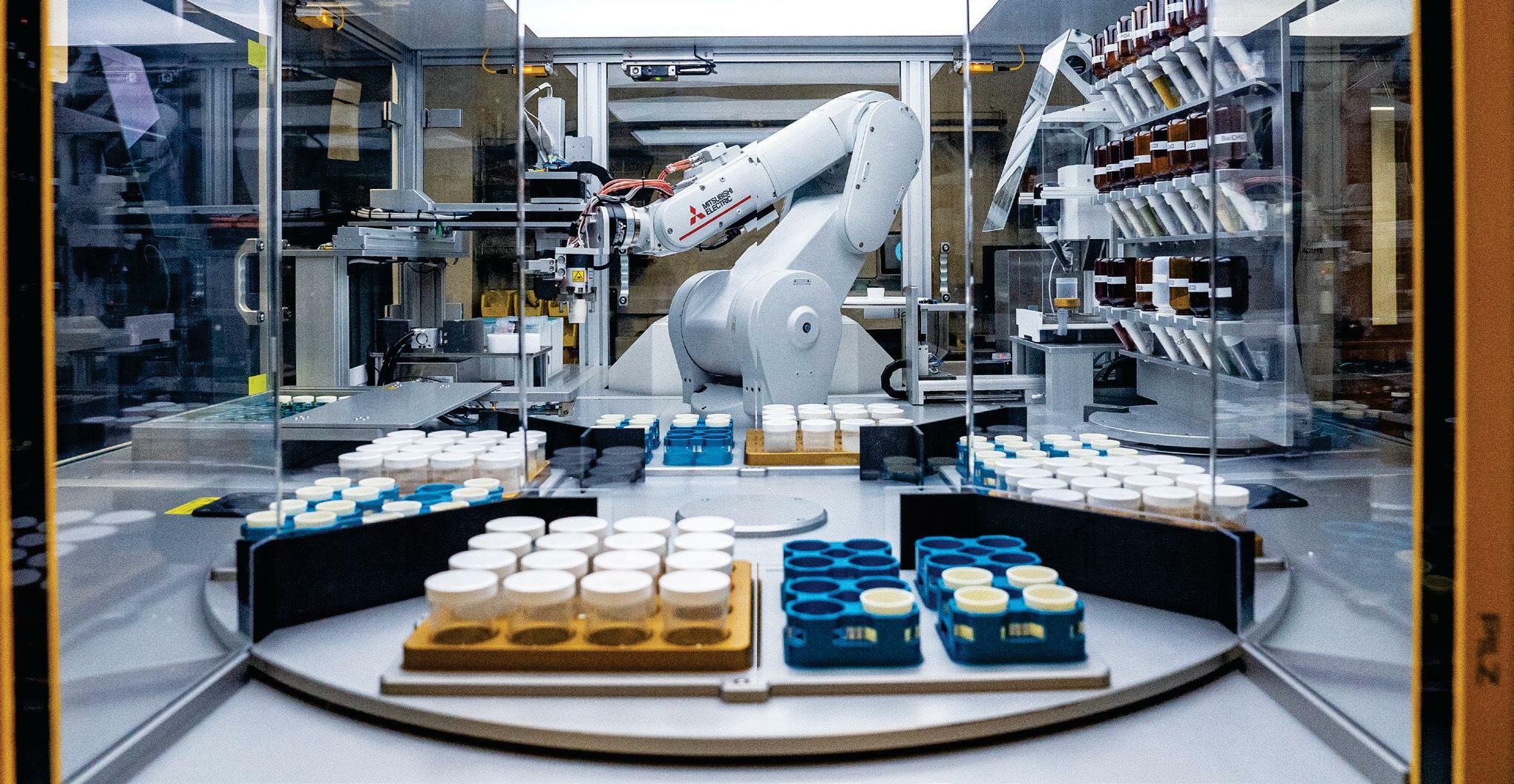
Lawrence Berkeley National Laboratory's A-Lab pairs robots and AI to run experiments at all hours, no humans required.
PAST MIDNIGHT IN THE HEARST MEMORIAL MINING BUILDING on the campus of the University of California, Berkeley, beyond a vaulted entrance and down a marble staircase, the experiments in the A-Lab are running without people. Powdered precursors and oxides twirl through the laboratory in crucibles shaped like sake cups, then are slurried and spun in centrifuges with zirconium beads, baked in industrial ovens, scanned using x-ray diffraction and, in battery tests, measured for ionic conductivity. Each result feeds the next experiment.
When something goes wrong-a jammed rack, a spilled sample, a precursor running out-the choreography halts. Minerva, Alfred, Prometheus, Jeeves, and a handful of other artificial intelligence-enabled robots that run the lab overnight can't always reset it themselves. A sleeping graduate student gets an e-mail and a Slack alert, then can log in from bed, check the lab's cameras and try to fix the problem.
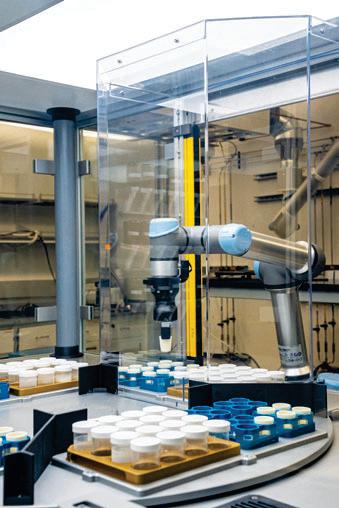 A robotic gripper moves cup-shaped containers among trays of prepared samples.

Den här artikeln är från utgåvan July/August 2026 av Scientific American.
Prenumerera på Magzter GOLD för att få tillgång till tusentals kurerade premiumartiklar samt 10 000+ tidskrifter och dagstidningar.
Redan prenumerant? Logga in
FLER ARTIKLAR FRÅN Scientific American
Scientific American
Let There Be Weapons
The Department of Energy’s new Genesis Mission promises AI-accelerated discovery. Seven of its first 26 challenges focus on nuclear weapons and national security

4 mins
July/August 2026

Scientific American
How to Fix Science
The federal funding system for scientific research in the U.S. needs reform
9 mins
July/August 2026

Scientific American
Robots Can Now Fold Your Laundry
Home-helper tasks are becoming easier for robotic assistants
4 mins
July/August 2026
Scientific American
50, 100 & 150 Years
NATURAL FISSION REACTOR
3 mins
July/August 2026

Scientific American
Anna Ho
Describing the characteristics of short-lived astrophysical events
1 mins
July/August 2026
Scientific American
THE SOLILOQUY OF SCHRÖDINGER'S CAT
A MEDITATION ON LIFE AND THE VON NEUMANN–WIGNER INTERPRETATION OF QUANTUM MECHANICS
1 min
July/August 2026

Scientific American
Mikhail Kolmogorov
Developing software to reveal large genetic changes that lead to cancer
1 mins
July/August 2026

Scientific American
Jaye Gardiner
Learning how the matrix around cells and tissues impacts cancers
1 mins
July/August 2026

Scientific American
Timnit Gebru
On safeguarding independent research in the age of big tech
3 mins
July/August 2026

Scientific American
A Youthful Illusion Sharpens Memory
By making people feel as if their face is a younger version of itself, researchers can bring childhood memories into sharper focus
4 mins
July/August 2026
Listen
Translate
Change font size