Prova GOLD - Gratis
Their Share of the Environment
TerraGreen
|June 2026
Environmental awareness grows when ecology connects to daily lives, livelihoods
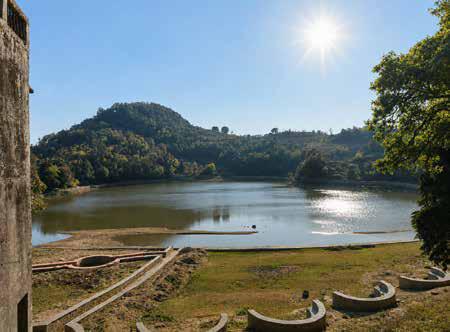
In this reflective and deeply grounded essay, Rajshekhar Pant examines the widening gap between academic environmental discourse and the lived realities of ordinary people in the Himalayan hill regions.
Moving beyond the rhetoric of climate change and global ecological debates, the essay explores how issues such as reckless hill-cutting, drying water sources, invasive species, excessive pesticide use, and unregulated tourism continue to reshape fragile mountain ecosystems. Through vivid local examples from Bhimtal, the piece argues that meaningful environmental awareness can emerge only when ecological concerns are connected to everyday lives and local livelihoods. June 5 comes and goes every year. A few articles appear in newspapers and magazines, panel discussions are held, and environmental concerns briefly find a place in the headlines. Then comes another day, another date—June 6—and an entirely new set of concerns. Before long, newspapers and television channels are once again stripped of the heavy rhetoric loaded with statistics and imposing terms such as ‘ozone depletion,’ ‘carbon footprints,’ and ‘global warming.’ The urgency fades almost as quickly as it arrives.
One often feels that the unnecessary ritualism surrounding such a sensitive issue, along with an excessive dependence on complex scientific terminology and intimidating data, has made the subject of the environment far more distant from ordinary people than it ought to be.
Within academic discussions on the environment, one often encounters the familiar slogan: Think Globally, Act Locally. The “globally” part of this phrase largely belongs to the academic world. It concerns those who engage with environmental issues as scholars, researchers, or commentators. Many among them are remarkably well informed about the latest ecological developments across the world.
The “act locally” part, however, belongs to ordinary people.


Den här artikeln är från utgåvan June 2026 av TerraGreen.
Prenumerera på Magzter GOLD för att få tillgång till tusentals kurerade premiumartiklar samt 10 000+ tidskrifter och dagstidningar.
Redan prenumerant? Logga in
FLER ARTIKLAR FRÅN TerraGreen

TerraGreen
World Environment Day 2026 A Renewed Call for Climate Action
Observed annually on June 5, World Environment Day (WED) has evolved into the world’s largest global platform for environmental awareness and action.

4 mins
June 2026

TerraGreen
New Solar Desalination Breakthrough Makes Fresh Water without Toxic Brine
According to the United Nations, 2.2 billion people still do not have access to safely managed drinking water.
1 min
June 2026

TerraGreen
Homes that Nurture Nature and Togetherness
Rethinking Homes through Conservation and Community
8 mins
June 2026
TerraGreen
Treethane in the Caulosphere
Unexplored Mechanisms and Climate Implication
5 mins
June 2026

TerraGreen
Rewriting the Plastic Story
For a Sustainable Climate Future
7 mins
June 2026
TerraGreen
India Launches First Wind Supply-Chain Platform
To strengthen the country's wind-energy ecosystem, the Ministry of New and Renewable Energy, Government of India, has launched WT-MARUT, India's first digital platform dedicated to wind-energy supply-chain management.
1 min
June 2026

TerraGreen
Nagpur Launches Major Lake Restoration Drive
The Nagpur Municipal Corporation intensified efforts to restore Ambazari Lake ahead of the monsoon, removing invasive water hyacinth and addressing untreated sewage inflows.
1 min
June 2026

TerraGreen
Electrification Emerges as Key Climate Strategy at Bonn Talks
Electrification became a central theme at the Bonn climate negotiations, where policymakers discussed replacing fossil fuels in transport, industry and buildings with clean electricity.
1 min
June 2026
TerraGreen
Rising Temperatures
Drivers, Implications, and the Way Forward
7 mins
June 2026
TerraGreen
Beneath Our Feet Lies a Fungal Superhighway Stretching 68 Quadrillion Miles
Beneath the ground, vast networks of fungi quietly support plant life and play an important role in regulating the planet's climate by helping move carbon into soils.
1 min
June 2026
Listen
Translate
Change font size