Prova GOLD - Gratis
Seeing the Invisible - How Atmospheric Models Help Us Understand Air Pollution
TerraGreen
|June 2026
This article by Himangi Tripathi explains how atmospheric models such as WRF-CMAQ help decode India's complex air pollution. By combining weather dynamics with chemical processes, these models simulate pollutant formation, transport, and transformation beyond limited monitoring data. They reveal seasonal patterns, long-range impacts, and policy scenarios, enabling more informed, science-based strategies for managing air quality and decision-making processes overall.
-
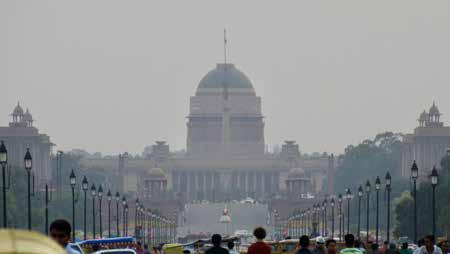
Every year, a grey haze settles over many Indian cities. Schools close, hospitals see a rise in respiratory cases, and public debate intensifies over who is responsible for the pollution.
Yet the air around us remains largely invisible, complex, and difficult to understand. Where exactly does the pollution come from? How far does it travel? Why does it suddenly worsen in winter and improve during other seasons? To answer these questions, scientists rely not only on monitoring stations but also on powerful atmospheric models.
Among the most important of these is the Weather Research and ForecastingCommunity Multiscale Air Quality (WRFCMAQ) modelling system, a scientific tool that helps researchers simulate how pollution forms, moves, and transforms in the atmosphere.
Monitoring stations tell us what the air quality is at a specific location. But they cannot tell the full story. It is impossible to install sensors in every village, highway, industrial cluster, or agricultural field across a country as vast as India. Nor can we measure air pollution at every height in the atmosphere. This is where models help scientists "see" what cannot be directly measured.
 At the foundation of this modelling system lies WRF, or the Weather Research and Forecasting model. Weather plays a crucial role in determining how pollution behaves. Wind can disperse pollutants across large distances, rainfall can wash them out of the air, and temperature inversions during winter can trap them close to the surface. WRF simulates these meteorological conditions by dividing the atmosphere into millions of small grids and calculating how wind, temperature, humidity, clouds, and atmospheric pressure change across space and time.
Understanding these weather dynamics is essential because air pollution does not behave randomly.


Den här artikeln är från utgåvan June 2026 av TerraGreen.
Prenumerera på Magzter GOLD för att få tillgång till tusentals kurerade premiumartiklar samt 10 000+ tidskrifter och dagstidningar.
Redan prenumerant? Logga in
FLER ARTIKLAR FRÅN TerraGreen

TerraGreen
World Environment Day 2026 A Renewed Call for Climate Action
Observed annually on June 5, World Environment Day (WED) has evolved into the world’s largest global platform for environmental awareness and action.

4 mins
June 2026

TerraGreen
New Solar Desalination Breakthrough Makes Fresh Water without Toxic Brine
According to the United Nations, 2.2 billion people still do not have access to safely managed drinking water.
1 min
June 2026

TerraGreen
Homes that Nurture Nature and Togetherness
Rethinking Homes through Conservation and Community
8 mins
June 2026

TerraGreen
Treethane in the Caulosphere
Unexplored Mechanisms and Climate Implication
5 mins
June 2026

TerraGreen
Rewriting the Plastic Story
For a Sustainable Climate Future
7 mins
June 2026
TerraGreen
India Launches First Wind Supply-Chain Platform
To strengthen the country's wind-energy ecosystem, the Ministry of New and Renewable Energy, Government of India, has launched WT-MARUT, India's first digital platform dedicated to wind-energy supply-chain management.
1 min
June 2026

TerraGreen
Nagpur Launches Major Lake Restoration Drive
The Nagpur Municipal Corporation intensified efforts to restore Ambazari Lake ahead of the monsoon, removing invasive water hyacinth and addressing untreated sewage inflows.
1 min
June 2026

TerraGreen
Electrification Emerges as Key Climate Strategy at Bonn Talks
Electrification became a central theme at the Bonn climate negotiations, where policymakers discussed replacing fossil fuels in transport, industry and buildings with clean electricity.
1 min
June 2026

TerraGreen
Rising Temperatures
Drivers, Implications, and the Way Forward
7 mins
June 2026

TerraGreen
Beneath Our Feet Lies a Fungal Superhighway Stretching 68 Quadrillion Miles
Beneath the ground, vast networks of fungi quietly support plant life and play an important role in regulating the planet's climate by helping move carbon into soils.
1 min
June 2026
Listen
Translate
Change font size