
Ga onbeperkt met Magzter GOLD
Krijg onbeperkte toegang tot meer dan 9000 tijdschriften, kranten en Premium-verhalen voor slechts
Poging GOUD - Vrij
AI-powered robotics and assistive technologies
PCQuest
|July 2025
Scalpels meet silicon. From Al-guided staplers to telesurgery with <100 ms latency, robots aren't just assisting, they're anticipating, adapting, and accelerating recovery. The future of surgery isn't coming. It's already scrubbing in
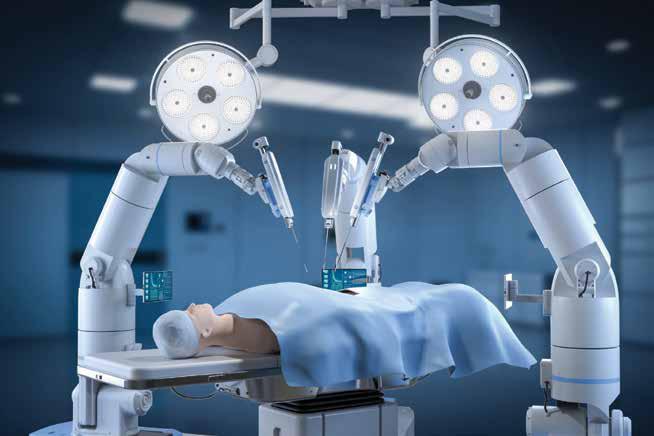
Al-powered robotics and assistive technologies: Transforming surgical precision and patient care.
In the last decade, the fusion of artificial intelligence (AI) with robotics has transformed surgical, rehabilitative, and remote care. What once seemed futuristic, robots assisting in performing complex surgeries or supporting rehabilitation, is now a part of modern medical practice. As clinicians, we are witnessing the dawn of a new paradigm: Al-powered assistive technologies that do not just support human capability but extend and amplify it.
The new frontier: AI in robotic surgery
AI-powered robotic platforms have significantly advanced the way complex surgeries are performed. Systems like the da Vinci Surgical System are now equipped with embedded machine learning algorithms that enhance motion scaling, tremor filtration, and image-guided navigation. With Al integration, the surgical console becomes more than a tool, it becomes an intelligent assistant that helps anticipate anatomical variations, track instrument movement, and identify potential issues in real time.
Al-driven robotics in surgical applications: Key advances include
- Automated margin detection during tumor resections, reducing positive cancer margins by 30%.
- Real-time force feedback systems preventing tissue damage during delicate procedures.
- Al-generated operative reports with 87.3% accuracy vs. surgeons' 72.8%.
Today, Al enables personalized surgical planning by analyzing thousands of prior cases. It suggests optimal approaches tailored to the patient’s unique anatomy and pathology, eliminating uncertainty and translating into better postoperative outcomes.



Dit verhaal komt uit de July 2025-editie van PCQuest.
Abonneer u op Magzter GOLD voor toegang tot duizenden zorgvuldig samengestelde premiumverhalen en meer dan 9000 tijdschriften en kranten.
Bent u al abonnee? Aanmelden
MEER VERHALEN VAN PCQuest

PCQuest
AI on the ground Practical use cases of AI in large enterprise operations
AI isn't a side project anymore, it's the quiet operator inside global giants. It reads invoices, senses machine fatigue, tailors every customer moment, flags risk in real time, and feeds leaders sharper instincts. Scale just got smarter

3 mins
March 2026

PCQuest
From AI experiments in 2025 to enterprise scale in 2026: Why data foundations will decide the winners
Everyone's betting big on Al, but most are burning cash instead of building value. The hidden culprit? Dirty data, clunky processes, and missing context. What if fixing your foundation, not your algorithms, was the real AI game-changer?
4 mins
March 2026

PCQuest
How automation at the periphery is accelerating digital transformation
Digital transformation is not tearing down the core anymore. It is happening at the edges. With AI and automation layered onto existing systems, companies are cutting costs, boosting productivity by up to 40%, and scaling smarter without risking operational chaos
2 mins
March 2026

PCQuest
When AI moves from chips to racks
AI performance is no longer just about faster chips. It is about how racks, power, networking, and orchestration work together. As agentic AI grows, infrastructure must become predictable, open, and built for scale from day one
4 mins
March 2026

PCQuest
Designing enterprise AI systems that stay fair
In 2026, bias is no longer treated as a communications issue or a public relations headache.
6 mins
March 2026

PCQuest
HALO smart sensor
What if bathrooms, locker rooms, and isolated spaces could become safer without adding cameras?
2 mins
March 2026

PCQuest
Building enterprise AI that doesn't discriminate
Bias in enterprise AI is not a side issue. It starts in data pipelines, training systems, product design, and engineering workflows. As AI scales, fairness, transparency, and accessibility are becoming core software requirements
4 mins
March 2026

PCQuest
Bias travels faster than code
Bias in enterprise AI is not a surface issue. It enters through data, features, model training, APIs, and UI logic, then spreads across the stack. The technical response is shifting from audits to architecture, observability, and deployment controls
6 mins
March 2026

PCQuest
How hospitals can use AI without risking patient data
With the fast pace of adoption of Artificial Intelligence (AI) and digital health systems in Indian hospitals, issues related to the security of patient data are also increasing at an equal rate.
2 mins
March 2026

PCQuest
DeFi in 2026: The rise of liquidity, privacy and decentralized exchanges
DeFi's teenage years are over. Liquidity now behaves like infrastructure, privacy is baked in with zero-knowledge math, and DEXS hum like borderless trading engines. What once felt scrappy now resembles parallel financial system-without gatekeepers
3 mins
March 2026
Listen
Translate
Change font size