
Ga onbeperkt met Magzter GOLD
Krijg onbeperkte toegang tot meer dan 9000 tijdschriften, kranten en Premium-verhalen voor slechts
Poging GOUD - Vrij
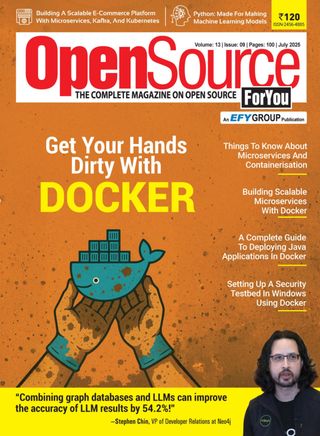
Python: Made for Making Machine Learning Models
Open Source For You
|July 2025
Discover how Python, a language most programmers love, is also turning into the language of choice for developing machine learning models.

As we all know, machine learning (ML) automates decision-making while Python is a simple language with a clean syntax and numerous libraries. What's interesting is that Python has evolved with the times and is now the language of choice for machine learning. Before we find out why this is so, let's get acquainted with the basic programming components of Python used for machine learning.
Central to everything in Python are data structures — the lists, dictionaries, tuples, sets, etc, used to hold data in different forms. Lists are for ordered collections of items that can be iterated over and for mapping keys to the values-dictionary, an important aspect of labelled datasets; tuples provide immutability, useful in contexts where data integrity is critical; and sets deal with unique features — for instance, removing duplicates from a dataset.
Control structures include loops and conditional statements, and they allow logical flows and iterations over data. For example, you may need to loop through a dataset to clean missing values or apply a custom transformation to each record. List comprehensions provide an elegant and direct Pythonic way to accomplish this, enhancing readability and reducing lines of code. Functions in Python allow forming the reusable logic encapsulated in them. For instance, whether we are talking about a function that normalises data or calculates accuracy, modular code with parameters and return values is what defines machine learning workflows. Also, higher-order functions in Python accept other functions as arguments, which is handy when filters or transformations are applied over datasets.

Dit verhaal komt uit de July 2025-editie van Open Source For You.
Abonneer u op Magzter GOLD voor toegang tot duizenden zorgvuldig samengestelde premiumverhalen en meer dan 9000 tijdschriften en kranten.
Bent u al abonnee? Aanmelden
MEER VERHALEN VAN Open Source For You

Open Source For You
Pixxel and Sarvam join forces to build India's first orbital AI data centre
Pixxel and Sarvam have announced a strategic partnership to develop India's first orbital data centre satellite, positioning the mission as a stepping stone towards sovereign and potentially open AI infrastructure.

1 mins
June 2026
Open Source For You
Niantic Spatial open sources SPZ 4
Niantic Spatial has released SPZ 4, the latest version of its open source file format for 3D Gaussian splats, positioning it as foundational infrastructure for scalable XR, robotics, web, and creative 3D workflows.
1 min
June 2026
Open Source For You
FSFE slams NHS England's reported move to privatise open source code
The Free Software Foundation Europe (FSFE) has warned that NHS England's reported plan to switch most public source-code repositories to 'private' threatens open source principles and weakens cybersecurity transparency.
1 min
June 2026
Open Source For You
Fine-tuning AI models for empathy may undermine accuracy, warn researchers
A study by the Oxford Internet Institute, published in Nature, has found that AI models fine-tuned for warmer, more empathetic responses are 60% more likely to generate incorrect answers than their base versions-raising fresh concerns for the open-weight ecosystem.
1 min
June 2026
Open Source For You
Claude Mythos effect forces Indian banks to employ continuous cybersecurity models
Indian banks are moving decisively from periodic compliance cycles to continuous cybersecurity models, with a sharp focus on real-time vulnerability detection, continuous remediation tracking, and exposure monitoring across ‘crown jewel’ systems.
1 min
June 2026
Open Source For You
Kaltura open sources machine-readable AI skills
Kaltura has open sourced a suite of AI agent skills-structured, production-tested knowledge modules designed for AI coding agents such as Claude Code, OpenAI Codex, GitHub Copilot, and Cursor.
1 min
June 2026

Open Source For You
Pinterest turns to open source AI to cut costs by 90%
Pinterest is positioning open source AI as a core driver of cost-efficient scalability, adopting a model-agnostic strategy that blends proprietary systems with closed models alongside open source models.
1 min
June 2026
Open Source For You
Tether backs local AI tools with new grants
Tether has launched a new grants initiative aimed at developers building open source wallets, payment, decentralised infrastructure, and local-first AI tools on its open technology stack.
1 min
June 2026
Open Source For You
Menlo open sources humanoid robotics development
Menlo Research has introduced the Asimov v1 humanoid robot as an open source humanoid platform designed for builders, researchers and robotics developers, positioning humanoid robotics away from closed proprietary systems and towards reproducible engineering platforms.
1 min
June 2026
Open Source For You
Google uncovers first AI-assisted zero-day exploit
Google has warned that cybercriminals and state-backed threat actors are rapidly operationalising generative AI to develop exploits, automate malware campaigns, and scale cyberattacks targeting open source infrastructure and AI ecosystems.
1 min
June 2026
Listen
Translate
Change font size