Poging GOUD - Vrij
PHYSICAL AI: The Missing Layer In Robotics
Electronics For You
|July 2026
What happens when AI leaves the screen and enters the real world? From humanoid robots to autonomous machines, physical AI is turning intelligence into action.
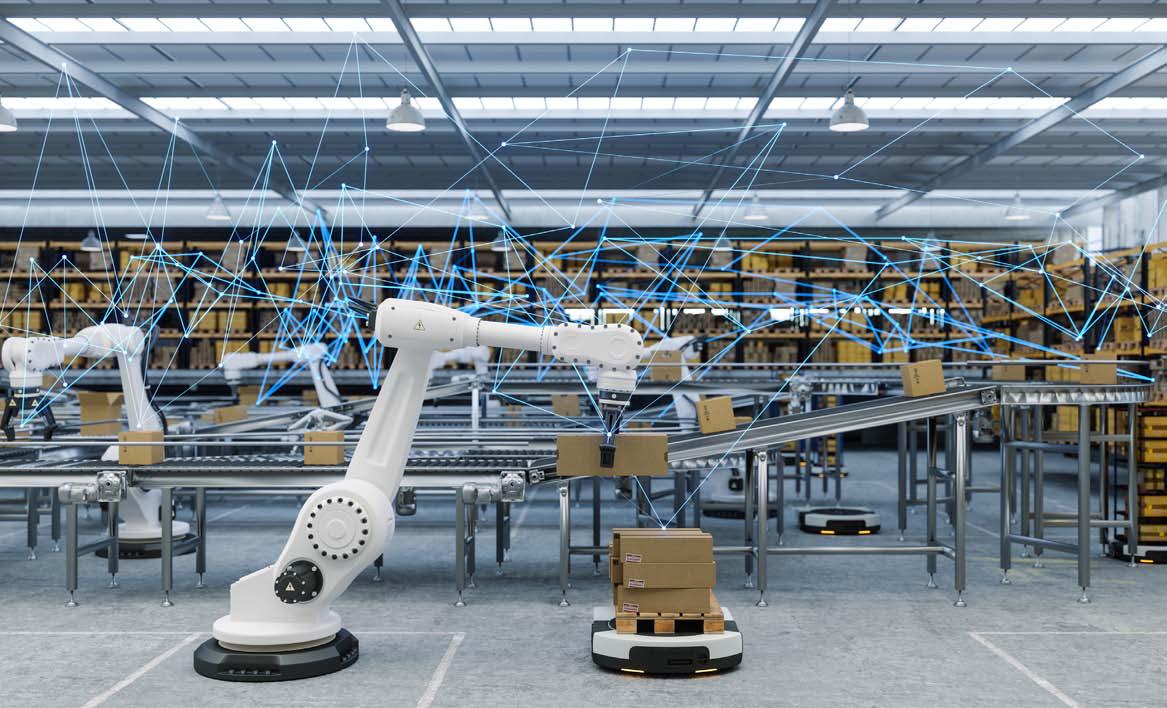
The simplest way to explain physical AI is as a combination of software (the mind) and hardware (the body). In this case, the hardware is a robot, and the software is a form of artificial intelligence (AI). When a robot and AI are combined, the result is what is known as Embodied AI, which enables intelligence to operate in a physical form and interact with the world.
Most AI systems focus on digital environments, meaning they can process and manipulate information, including text, images, videos, and large volumes of data. They help people by providing information, automating processes, and assisting with decision-making.
On the other hand, physical AI is more of a combination of robotics and artificial intelligence; it can also be developed and tested in digital environments known as simulations. These simulations allow robots to be trained and evaluated safely and efficiently before deployment in the real world.
Why now?
With the emergence of foundation models, the ability to perform physical tasks became significantly more flexible, similar to how large language models (LLMs) such as ChatGPT and Gemini expanded the capabilities of language-based AI.
Within a few years, this adaptable intelligence had begun making AI physical in practical ways. Today, vision-language models (VLMs), vision-language-action (VLA) models, and world models enable robots to perceive their surroundings, understand instructions, and act autonomously in real-world environments.
The emergence of adaptable intelligence has made physical AI a significant new frontier. Until recently, many robotics companies remained in research and prototyping phases for nearly two decades, as the technology required for widespread commercial deployment and large-scale adaptability simply did not exist.
AI has effectively become the missing layer that transforms robotics from rigid automation into scalable, intelligent systems.


Dit verhaal komt uit de July 2026-editie van Electronics For You.
Abonneer u op Magzter GOLD voor toegang tot duizenden zorgvuldig samengestelde premiumverhalen en meer dan 9000 tijdschriften en kranten.
Bent u al abonnee? Aanmelden
MEER VERHALEN VAN Electronics For You

Electronics For You
FM RADIO RECEIVER Using TDA7000
This FM radio receiver demonstrates the practical application of RF engineering and analogue signal-processing techniques.

4 mins
July 2026

Electronics For You
Latest 3D chip stacking method could extend Moore's Law
Engineered by a team at the University of Illinois Grainger College of Engineering in Urbana-Champaign, the process uses ultrathin single-crystalline silicon nanomembranes transferred at temperatures below 200°C, avoiding heat damage to underlying circuits.
1 min
July 2026

Electronics For You
Stretchable patch detects heart failure risks
Researchers at the University of Chicago's Pritzker School of Molecular Engineering in Chicago have developed an AI-powered stretchable computing patch capable of processing health data directly on the body in milliseconds, eliminating the need for external servers or wireless connections.
1 min
July 2026

Electronics For You
Simple 12V To 24V VOLTAGE DOUBLER
Many electronic circuits require a voltage higher than that available from the power supply.
3 mins
July 2026
Electronics For You
Crystal stress method reshapes nanochip manufacturing techniques
Research conducted at Rice University in Houston, Texas, demonstrated that alpha-molybdenum trioxide crystals can deform under an electron beam, generating highly ordered nanoscale wrinkles that function as optical gratings for guiding and manipulating light on chips.
1 min
July 2026

Electronics For You
Hidden Costs In IoT PRODUCT DEVELOPMENT
Hardware mistakes do not show up early in development. The most expensive hardware mistakes are rarely the obvious ones. Decisions made during design, testing, and architecture shape costs for years.
7 mins
July 2026

Electronics For You
Temperature-Based DUAL SAFETY SYSTEM For Smart Homes
A temperature-based dual safety system addresses common household risks through intelligent control.
4 mins
July 2026

Electronics For You
Smart material developed to fight counterfeiting
Engineered by a team at the Indian Institute of Technology Guwahati, the technology uses perovskite nanocrystals with a double-layer protective coating that improves resistance to heat and chemicals while maintaining optical performance.
1 min
July 2026

Electronics For You
President Murmu inaugurates semiconductor training fab at IISc
On June 3, 2026, President Droupadi Murmu inaugurated IISc Bengaluru’s Semiconductor Training Fab at CeNSE, established with support from the Ministry of Tribal Affairs.
4 mins
July 2026

Electronics For You
Quantum Li-Fi secures networks
Research conducted in Germany by a consortium led by KEEQuant and supported by Fraunhofer IPMS highlights a pathway toward flexible, high-security next-generation wireless networks.
1 min
July 2026
Listen
Translate
Change font size