Poging GOUD - Vrij
Why can't it always be summer?
The Week Junior Science+Nature UK
|July 2025
There's a reason why Earth has seasons — and it's about being totally tilted.
-
With its long days just itching to be spent by water doing nothing, summer really can be an enchanting season. Sadly, all good things must come to an end — summer cannot last for ever. Why not? Well, there's both a simple reason and a more complicated one.
The simple reason is that it can’t always be summer because the planet is tilted. The more complicated answer requires some geometry.
Earth's orbit and the seasons
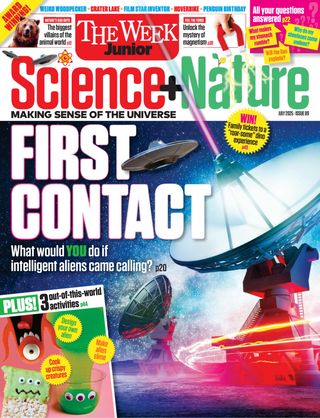
First, you need to know that Earth is a sphere. Technically, it has an oblate spheroid shape. That means that the planet is shaped like a satsuma — a little bit wider than itis tall. Earth travels through space in an orbit around the Sun. Its orbit is an ellipse — which is more like an oval than a circle —so there are times when Earth is closer to the Sun and times when it's further away. A lot of people assume this distance is why we have seasons, but they are not right. In the UK, the Earth is three million miles closer to the Sun during winter than in the summer.
Spinning like a top

Dit verhaal komt uit de July 2025-editie van The Week Junior Science+Nature UK.
Abonneer u op Magzter GOLD voor toegang tot duizenden zorgvuldig samengestelde premiumverhalen en meer dan 9000 tijdschriften en kranten.
Bent u al abonnee? Aanmelden
MEER VERHALEN VAN The Week Junior Science+Nature UK

The Week Junior Science+Nature UK
Do fairies exist?
Is there real magic in this world or is the fairy realm history's longest-running hoax?

2 mins
July 2026

The Week Junior Science+Nature UK
Scientists finally solve an age-old T. rex teaser
The reason why the big dino had such tiny arms is a prehistoric puzzler.
2 mins
July 2026

The Week Junior Science+Nature UK
Will humans and aliens ever meet?
If aliens exist somewhere out there, will we ever get a chance to say hello?
1 min
July 2026
The Week Junior Science+Nature UK
Carlee Jackson
Meet the shark scientist who wants to inspire others to love these predators.
2 mins
July 2026
The Week Junior Science+Nature UK
Wildlife watch
Go on a wildlife spotting trip this summer with Jenny Ackland.
1 min
July 2026
The Week Junior Science+Nature UK
Welcome to the jungle
Visit the project turning an abandoned space into a wildlife haven.
1 mins
July 2026
The Week Junior Science+Nature UK
New launch puts a Smile in space
On 19 May, the Smile spacecraft took off on a mission to understand how Earth uses its invisible shield as protection from deadly particles released by the Sun.
1 min
July 2026

The Week Junior Science+Nature UK
Heavy metal scorpions
Scorpions are nature's ultimate they have powerful claws (pincers) and a venom-tipped stinger. Scientists have shown that these formidable critters can make their weapons stronger using metals.
1 min
July 2026
The Week Junior Science+Nature UK
Wing it!
Reach for the skies with Tom Jackson as he reveals the secrets of flight.
6 mins
July 2026

The Week Junior Science+Nature UK
Can you survive inside a tornado?
Read the story of the scientist who got stuck inside a twister.
3 mins
July 2026
Listen
Translate
Change font size