Poging GOUD - Vrij
YOUR PERSONALIZED CANCER VACCINE
Scientific American
|December 2025
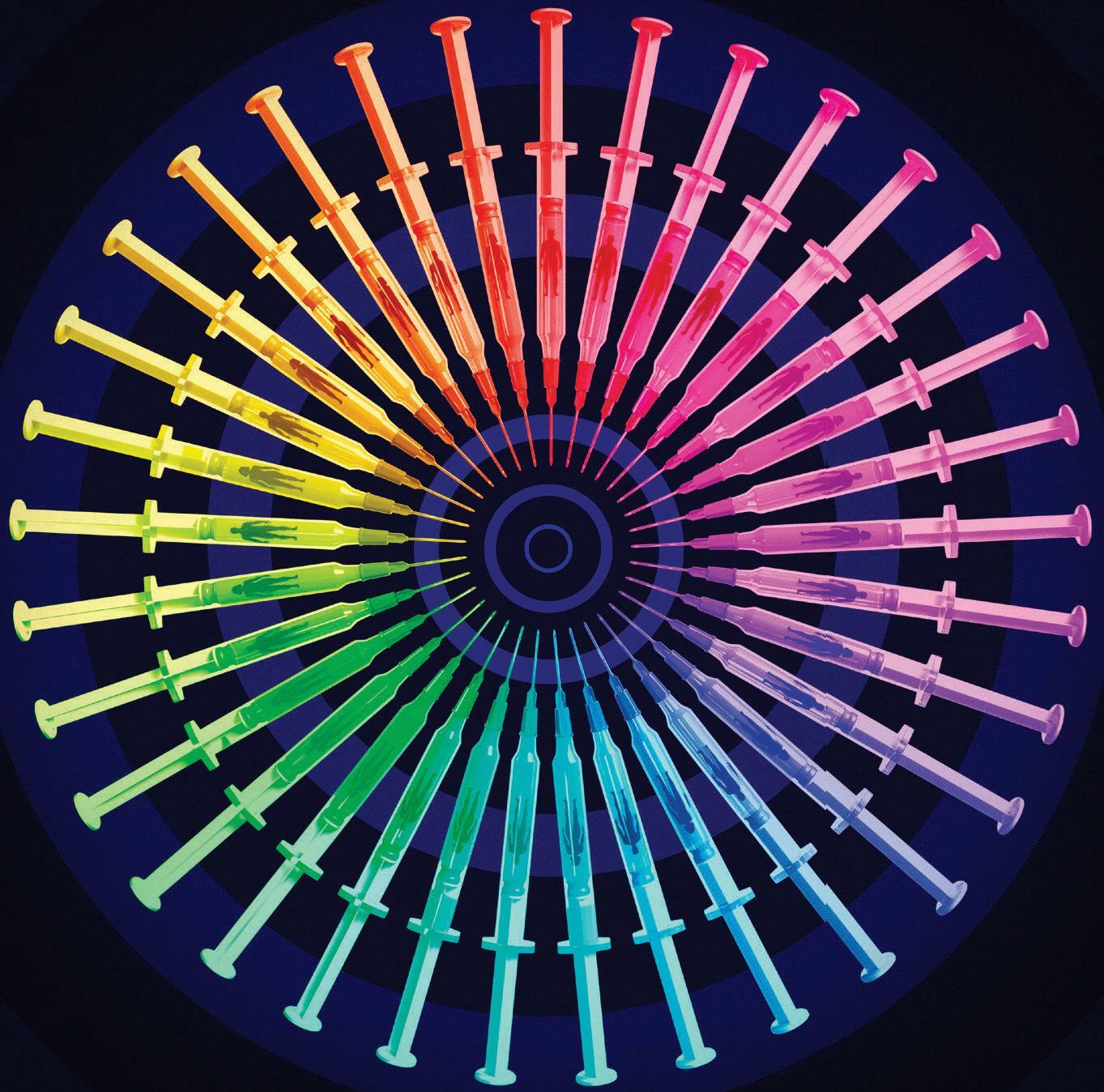
Vaccines based on mRNA can be tailored to target a cancer patient's unique tumor mutations. But crumbling support for cancer and mRNA vaccine research has endangered this promising therapy
AS SOON AS BARBARA BRIGHAM'S CANCEROUS PANCREATIC TUMOR was removed from her body in the fall of 2020, the buzz of a pager summoned a researcher to the pathology department in Memorial Sloan Kettering's main hospital in New York City, one floor below. Brigham, now 79, was recovering there until she felt well enough to go home to Shelter Island, near the eastern tip of Long Island. Her tumor and parts of her pancreas, meanwhile, were sent on an elaborate 24-hour course through the laboratory. Hospital staff assigned the organ sample a number and a unique bar code, then extracted a nickel-size piece of tissue to be frozen at -80 degrees Celsius. They soaked it in formalin to prevent degradation, then set it in a machine that gradually replaced the water in each cell with alcohol.
Next, lab staff pinned the pancreas to a foam block, took high-resolution images with a camera fixed overhead and used a scalpel to remove a series of sections of tumor tissue. These sections were embedded in hot paraffin and cut into slices a fraction of the thickness of a human hair, which were prepped, stained and mounted on glass slides to be photographed again. By the time a pathologist looked at Brigham's tumor under a microscope the next day, more than 50 people had helped steer it through the lab. Still, this work was all a prelude.
The real action came some two months later, when Brigham returned to the hospital to receive a vaccine tailored to the mutations that differentiated her tumor from the rest of her pancreas. Made of messenger RNA (mRNA) suspended in tiny fat particles, the vaccine was essentially a set of genetic instructions to help Brigham's immune system go after the mutant proteins unique to her tumor cells. It was, in other words, her very own shot.

Dit verhaal komt uit de December 2025-editie van Scientific American.
Abonneer u op Magzter GOLD voor toegang tot duizenden zorgvuldig samengestelde premiumverhalen en meer dan 9000 tijdschriften en kranten.
Bent u al abonnee? Aanmelden
MEER VERHALEN VAN Scientific American

Scientific American
The Quiet Math Problem That Runs the Planet
How Diffie-Hellman key exchange secures everything from your text messages to government secrets

7 mins
May 2026

Scientific American
The Fog of Science
Did an adversary just invent a world-changing weapon, or are they making it up? DARPA is building an AI to instantly call their bluff
4 mins
May 2026
Scientific American
The Hubble Space Telescope Is Still Awesome
Hubble is going strong despite its decades in space and next-generation successors
4 mins
May 2026

Scientific American
Meet America's Native Bees
Scientists estimate there are about 4,000 species of native bees in the U.S.
5 mins
May 2026

Scientific American
The Chemistry of Desire
Inside the secretive laboratories where scientists build novel molecules to make luxury fragrance feel like pure emotion
5 mins
May 2026

Scientific American
Scanning the Stone
As ore gets harder to find, the mining industry is turning to subatomic-particle sensors to push deep underground
8 mins
May 2026

Scientific American
YOUR HEART IN FLAMES
Inflammation may be the true cause of cardiovascular diseaseand there's a drug to treat it
13 mins
May 2026

Scientific American
Ancient Lexicon
Stone Age art may reveal a 40,000-year-old precursor to writing
2 mins
May 2026

Scientific American
Thermal Breakthrough
A new super heat conductor challenges fundamental physics
2 mins
May 2026

Scientific American
How to Vacation in Space
Planned orbital hotels promise luxury, but can they deliver?
4 mins
May 2026
Listen
Translate
Change font size