Poging GOUD - Vrij
Echolocation Touch
Scientific American
|October 2025
Dolphins' echolocation may be more like feeling than like seeing

IT'S MIDNIGHT in a pitch-dark parking lot. Trying to unlock your car, you fumble and drop the keys. You squat down and run your hand across the invisible pavement. To the left you feel a firm, rubbery tire. Reversing course, you pass over jagged pebbles and papery leaves. Finally your fingers discover—and instantly close around—a notched piece of metal. This kind of tactile exploration may be the closest we can get to imagining the experience of dolphin echolocation, say the authors of a study on dolphin brains that was recently published in PLOS One.
People often imagine echolocation as "seeing" with sound-experiencing auditory signals as a world of images like the ones our brains typically create from light perceived by our eyes. Like sonar devices, which turn sonic waves into visual representations, echolocators emit sounds and then decode spatial and textural information in the echoes that bounce back. And when Russian scientists inserted electrodes into the heads of dolphins and porpoises in the 1970s and 1980s, they reported detecting brain activity in the visual cortex while the animals heard sounds.
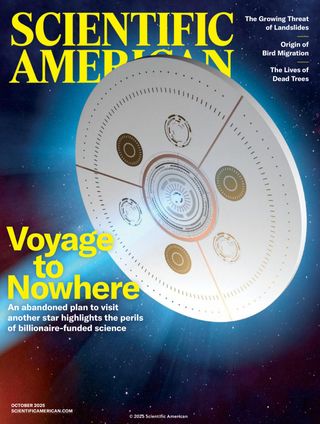

Dit verhaal komt uit de October 2025-editie van Scientific American.
Abonneer u op Magzter GOLD voor toegang tot duizenden zorgvuldig samengestelde premiumverhalen en meer dan 9000 tijdschriften en kranten.
Bent u al abonnee? Aanmelden
MEER VERHALEN VAN Scientific American

Scientific American
Sailing the Sun
By designing vertical panels that move in a gale, two Swedish inventors are unlocking a solar future for the windswept north

9 mins
March 2026
Scientific American
Covered in Bees
Ancient bees burrowed deep into discarded mammal jawbones
2 mins
March 2026
Scientific American
Fire Starters
Ancient humans were making fire 350,000 years earlier than thought
3 mins
March 2026
Scientific American
Relativity Revealed
Physicists have observed a bizarre prediction of special relativity for the first time
8 mins
March 2026

Scientific American
Everything You Wanted to Know about Polyamory (but Were Afraid to Ask
The practice is not a faddish excuse to sleep around, research shows. And it has deep roots in American culture
14 mins
March 2026

Scientific American
Let the Rivers Run
An investigation into the rights of nature
4 mins
March 2026

Scientific American
Hidden Proof
\"Effective zero knowledge\" beats long-standing cryptographic impossibilities
2 mins
March 2026
Scientific American
The Universe's Weirdest Optical Illusions
Sometimes the farther away an object is, the bigger it seems to be
4 mins
March 2026
Scientific American
Earthquake Life
Yellowstone quakes spark bursts of microbial growth underground
2 mins
March 2026

Scientific American
Living in the COPILOT SOCIETY
The promise and peril of artificial intelligence everywhere
2 mins
March 2026
Listen
Translate
Change font size