
Ga onbeperkt met Magzter GOLD
Krijg onbeperkte toegang tot meer dan 9000 tijdschriften, kranten en Premium-verhalen voor slechts
Poging GOUD - Vrij
Copyright Laws Can Stop Deepfakes
Scientific American
|December 2025
The U.S. should give its residents rights to their own face and voice
-
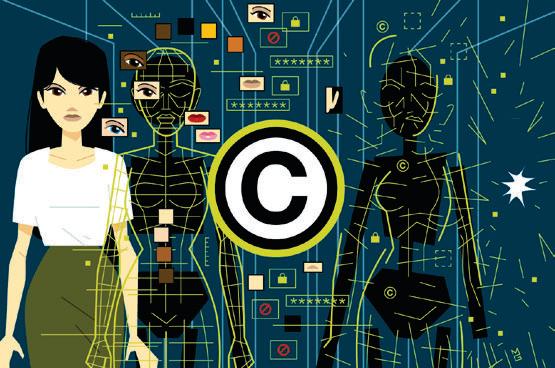
GENERATIVE ARTIFICIAL intelligence can now counterfeit reality at an industrial scale. Deepfakes—photographs, videos and audio tracks that use AI to create convincing but entirely fabricated representations of people or events—aren’t just an Internet content problem; they are a social-order problem. The power of AI to create words and images that seem real but aren't threatens society, critical thinking and civilizational stability. A society that doesn’t know what is real cannot self-govern.
We need laws that prioritize human dignity and protect democracy. Denmark is setting the example. In June the Danish government proposed an amendment to its copyright law that would give people rights to their own face and voice. It would prohibit the creation of deepfakes of a person without their consent, and it would impose consequences on those who violate this rule. It would legally enshrine the principle that you own you.
What makes Denmark’s approach powerful is the corporate fear of copyright-infringement legalities. In a study uploaded to preprint server arXiv.org in 2024, researchers posted 50 nude deepfakes on X and reported them to the platform in two ways: 25 as copyright complaints and 25 as nonconsensual nudity under X’s policies. X quickly removed the copyright claims but took down none of the intimate-privacy violations. Legal rights got action; privacy didn't.


Dit verhaal komt uit de December 2025-editie van Scientific American.
Abonneer u op Magzter GOLD voor toegang tot duizenden zorgvuldig samengestelde premiumverhalen en meer dan 9000 tijdschriften en kranten.
Bent u al abonnee? Aanmelden
MEER VERHALEN VAN Scientific American

Scientific American
The Quiet Math Problem That Runs the Planet
How Diffie-Hellman key exchange secures everything from your text messages to government secrets

7 mins
May 2026

Scientific American
The Fog of Science
Did an adversary just invent a world-changing weapon, or are they making it up? DARPA is building an AI to instantly call their bluff
4 mins
May 2026

Scientific American
The Hubble Space Telescope Is Still Awesome
Hubble is going strong despite its decades in space and next-generation successors
4 mins
May 2026

Scientific American
Meet America's Native Bees
Scientists estimate there are about 4,000 species of native bees in the U.S.
5 mins
May 2026

Scientific American
The Chemistry of Desire
Inside the secretive laboratories where scientists build novel molecules to make luxury fragrance feel like pure emotion
5 mins
May 2026

Scientific American
Scanning the Stone
As ore gets harder to find, the mining industry is turning to subatomic-particle sensors to push deep underground
8 mins
May 2026

Scientific American
YOUR HEART IN FLAMES
Inflammation may be the true cause of cardiovascular diseaseand there's a drug to treat it
13 mins
May 2026

Scientific American
Ancient Lexicon
Stone Age art may reveal a 40,000-year-old precursor to writing
2 mins
May 2026

Scientific American
Thermal Breakthrough
A new super heat conductor challenges fundamental physics
2 mins
May 2026

Scientific American
How to Vacation in Space
Planned orbital hotels promise luxury, but can they deliver?
4 mins
May 2026
Listen
Translate
Change font size