
Ga onbeperkt met Magzter GOLD
Krijg onbeperkte toegang tot meer dan 9000 tijdschriften, kranten en Premium-verhalen voor slechts
Poging GOUD - Vrij
Colorful Diagnosis
Scientific American
|November 2025
AI-powered tongue analysis borrows from traditional Chinese medicine
FOR THOUSANDS OF YEARS traditional Chinese medicine (TCM) practitioners have checked patients’ tongues as part of a full examination, carefully scrutinizing their color, shape and coating in an attempt to detect illness. TCM considers a tongue’s color especially telling—and now some researchers, encouraged by recent studies pointing toward a measurable association with health factors, are working to adapt this ancient diagnostic approach to today’s AI-based technology.
TCM remains a controversial topic in the global scientific community. The World Health Organization officially added TCM diagnoses to the 11th revision of the International Classification of Diseases, the global standard for health-information classification, in 2022. But most high-profile studies have treated the topic warily. “Despite the expanding TCM usage and the recognition of its therapeutic benefits worldwide, the lack of robust evidence from the EBM [evidence-based medicine] perspective is hindering acceptance of TCM by the Western medicine community and its integration into mainstream healthcare,” wrote the authors of a 2015 review article on TCM’s prospects. Still, pockets of strong academic interest persist.
In TCM, tongue color “is closely linked to the condition of the blood and qi [a Chinese term often translated into English as ‘vital energy’], making it a primary indicator for TCM practitioners in assessing a patient’s overall health,” says Dong Xu, whose research at the University of Missouri focuses on computational biology and bioinformatics and who coauthored a 2022 study on analyzing digital tongue images. But tongue examination can be highly subjective: it relies entirely on an individual practitioner’s color perception and analysis.
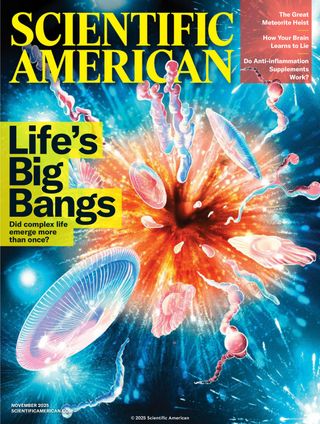

Dit verhaal komt uit de November 2025-editie van Scientific American.
Abonneer u op Magzter GOLD voor toegang tot duizenden zorgvuldig samengestelde premiumverhalen en meer dan 9000 tijdschriften en kranten.
Bent u al abonnee? Aanmelden
MEER VERHALEN VAN Scientific American

Scientific American
Earthquake Life
Yellowstone quakes spark bursts of microbial growth underground

2 mins
March 2026

Scientific American
Sailing the Sun
By designing vertical panels that move in a gale, two Swedish inventors are unlocking a solar future for the windswept north
9 mins
March 2026
Scientific American
Covered in Bees
Ancient bees burrowed deep into discarded mammal jawbones
2 mins
March 2026
Scientific American
Fire Starters
Ancient humans were making fire 350,000 years earlier than thought
3 mins
March 2026
Scientific American
Relativity Revealed
Physicists have observed a bizarre prediction of special relativity for the first time
8 mins
March 2026

Scientific American
Everything You Wanted to Know about Polyamory (but Were Afraid to Ask
The practice is not a faddish excuse to sleep around, research shows. And it has deep roots in American culture
14 mins
March 2026

Scientific American
Let the Rivers Run
An investigation into the rights of nature
4 mins
March 2026

Scientific American
Hidden Proof
\"Effective zero knowledge\" beats long-standing cryptographic impossibilities
2 mins
March 2026

Scientific American
The Universe's Weirdest Optical Illusions
Sometimes the farther away an object is, the bigger it seems to be
4 mins
March 2026

Scientific American
Living in the COPILOT SOCIETY
The promise and peril of artificial intelligence everywhere
2 mins
March 2026
Listen
Translate
Change font size