Poging GOUD - Vrij
HOW PARACHUTES WORK
How It Works UK
|Issue 204
There's much more to this essential piece of flight safety equipment than a simple tug on a rip cord
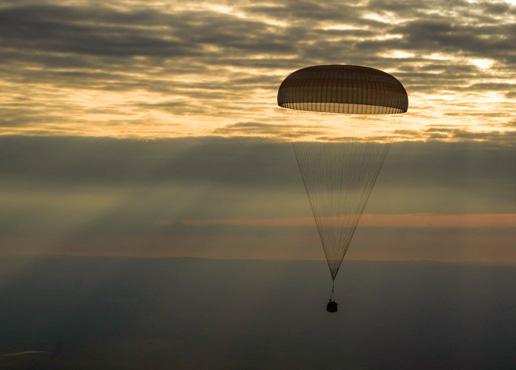
Whether they're being used for recreational skydiving, emergency escapes from aircraft or military supplies and troop deployment, parachutes are engineered to serve the same role: to safely lower people or objects from the skies to the ground. Parachutes work by counteracting the force of gravity pulling objects through the air to the ground by increasing air resistance. These apparatus consist of large, strong and light canopies that, when deployed, catch air as a skydiver falls to slow their descent. The faster the parachute is falling, the more drag it creates, which resists the downward movement and pushes the parachute up. As a result, the person attached to the parachute can gently float the remaining distance that separates their feet from the earth.
Without a parachute, a free-falling person will gain speed as they move towards the ground by around ten metres per second. After around 12 seconds, this speed steadies and remains consistent. This is called terminal velocity. Skydivers generally deploy their parachutes between 900 and 1,500 metres from the ground. As a result, using a parachute reduces a person's terminal velocity by 90 per cent, transporting them to the ground in a controlled way that means they can land safely on their feet.


Dit verhaal komt uit de Issue 204-editie van How It Works UK.
Abonneer u op Magzter GOLD voor toegang tot duizenden zorgvuldig samengestelde premiumverhalen en meer dan 9000 tijdschriften en kranten.
Bent u al abonnee? Aanmelden
MEER VERHALEN VAN How It Works UK

How It Works UK
20 WEARABLE HEALTH TRACKERS
Whether you strap a wellness coach to your wrist or weave subtle sensors into your clothes, these devices are revolutionising how we track our health

9 mins
Issue 210
How It Works UK
SUPERPOWERED PLANTS
The world of plants is vibrant and diverse, just like this book.
1 min
Issue 210
How It Works UK
SECRET STORIES OF LOST BEASTS
We're all aware of the mighty dinosaurs that once roamed Earth, but there are so many weird and wonderful species that have been lost to time.
1 min
Issue 210

How It Works UK
ALL ABOUT BLIMPS
Is it a bird? Is it a spaceship? No... it's a non-rigid airship
2 mins
Issue 210
How It Works UK
SUPER QUESTERS MISSION: RAINFOREST MAGIC
Join adventurers Leo, Lilli and Bea as they transform into superheroes and journey to the rainforest in the pursuit of knowledge.
1 min
Issue 210
How It Works UK
HOW THE MIGHTY MAMMOTH RULED THE ICE AGE
Meet the prehistoric giants that roamed the Arctic Circle thousands of years ago
4 mins
Issue 210
How It Works UK
Have they found LIFE ON MARS?
Although it's by no means certain, scientists are slowly accumulating evidence that life once existed on the Red Planet
2 mins
Issue 210

How It Works UK
HOW FAST DO GLACIERS MOVE?
The speed at which a glacier flows depends on its mass, the depth and slope of the underlying rock bed and friction.
1 min
Issue 210

How It Works UK
HOW IN-FLIGHT WI-FI WORKS
This technology allows you to scroll to your heart's content while killing time at cruise altitude
3 mins
Issue 210

How It Works UK
HOW WIGWAMS WERE BUILT
Discover the construction and living conditions inside these traditional domed dwellings
1 mins
Issue 210
Listen
Translate
Change font size