Essayer OR - Gratuit
HOW PARACHUTES WORK
How It Works UK
|Issue 204
There's much more to this essential piece of flight safety equipment than a simple tug on a rip cord
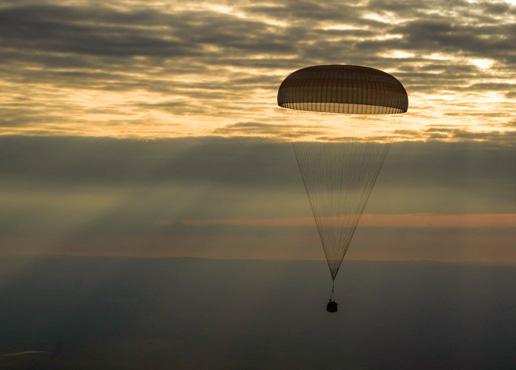
Whether they're being used for recreational skydiving, emergency escapes from aircraft or military supplies and troop deployment, parachutes are engineered to serve the same role: to safely lower people or objects from the skies to the ground. Parachutes work by counteracting the force of gravity pulling objects through the air to the ground by increasing air resistance. These apparatus consist of large, strong and light canopies that, when deployed, catch air as a skydiver falls to slow their descent. The faster the parachute is falling, the more drag it creates, which resists the downward movement and pushes the parachute up. As a result, the person attached to the parachute can gently float the remaining distance that separates their feet from the earth.
Without a parachute, a free-falling person will gain speed as they move towards the ground by around ten metres per second. After around 12 seconds, this speed steadies and remains consistent. This is called terminal velocity. Skydivers generally deploy their parachutes between 900 and 1,500 metres from the ground. As a result, using a parachute reduces a person's terminal velocity by 90 per cent, transporting them to the ground in a controlled way that means they can land safely on their feet.


Cette histoire est tirée de l'édition Issue 204 de How It Works UK.
Abonnez-vous à Magzter GOLD pour accéder à des milliers d'histoires premium sélectionnées et à plus de 9 000 magazines et journaux.
Déjà abonné ? Se connecter
PLUS D'HISTOIRES DE How It Works UK

How It Works UK
FORMULA FAST
YOUR ULTIMATE GUIDE TO FORMULA ONE RACING

1 mins
Issue 212

How It Works UK
MY LIFE AS AN ASTHMANAUT
A CHILDREN'S BOOK ABOUT ASTHMA
1 min
Issue 212

How It Works UK
LYDIA LOVES BUGS
A SHORT AND SWEET STORY OF AN ENTHUSIASTIC ENTOMOLOGIST
1 min
Issue 212

How It Works UK
INSIDE A DRONE
Drones aren't just for the military any more. These flying marvels are now taking over our lives
3 mins
Issue 212
How It Works UK
WE CAN HEAR WITHOUT EARS
AND OTHER THINGS YOU DIDN'T KNOW WE PLANTS COULD DO
1 min
Issue 212

How It Works UK
DO GEESE GET GOOSEBUMPS?
Many animals experience a similar reaction when they feel cold or scared
2 mins
Issue 212
How It Works UK
SUBMARINES WITHOUT SAILORS
Dive into the world of autonomous submarines and discover the mission that will see one sail around the world
4 mins
Issue 212
How It Works UK
WHAT HAPPENS INSIDE A COCOON?
How certain species of insects transform from crawling caterpillars to flying moths and butterflies
3 mins
Issue 212

How It Works UK
HOW THE ROSE LOST ITS SCENT
From floral to fragranceless, there's a biological reason behind a rose's missing odour today
3 mins
Issue 212

How It Works UK
How many insects have been discovered so far?
The total number of named species is around a million.
7 mins
Issue 212
Listen
Translate
Change font size