
Ga onbeperkt met Magzter GOLD
Krijg onbeperkte toegang tot meer dan 9000 tijdschriften, kranten en Premium-verhalen voor slechts
Poging GOUD - Vrij
GOOD BAD HABIT
How It Works UK
|Issue 212
Why our brains are hardwired for both healthy and unhealthy routines

Every habit begins as a choice, but not every habit remains one. In fact, a 2025 study by Psychology and Health found that two-thirds of your daily actions are dictated by habits and a minority of your behaviours are chosen. However, these conscious decisions use up the most mental energy. From the moment your alarm goes off, you may immediately rise and head to the bathroom to begin getting ready for the day. If every day started with your brain processing why you had to brush your teeth and considering each step taken to do so, your energy would already have depleted significantly by the early hours. Essentially, a habit is a behaviour loop the brain has learned to depend on.
By repeating actions, the brain learns that a certain action is safe and necessary. It then shifts the corresponding learned neural signals from conscious control to automatic habit circuits. Deeper in the brain, actions become habits by bypassing higher level decision making. Habit formation can be both useful and detrimental. Those we consider to be good habits can increase your productivity, develop new skills, improve health and wellness, and break bigger goals into smaller actions. Yet mixed in with the good are some less desirable learned behaviours. It may seem unfair, but a good habit doesn’t come about as easily as a bad one. This isn't the body setting you up for failure, but instead is caused by good habits having delayed longer term benefits. By contrast, a bad habit usually offers an immediate reward that the brain can more easily become addicted to. These rewards are in the form of pleasure or stress relief, flooding the brain with feelgood chemicals such as dopamine.

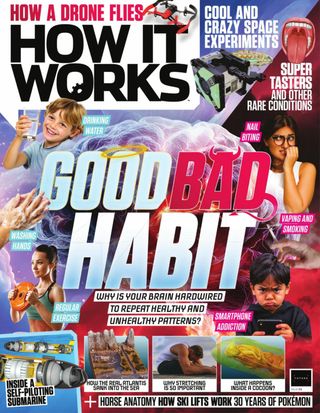

Dit verhaal komt uit de Issue 212-editie van How It Works UK.
Abonneer u op Magzter GOLD voor toegang tot duizenden zorgvuldig samengestelde premiumverhalen en meer dan 9000 tijdschriften en kranten.
Bent u al abonnee? Aanmelden
MEER VERHALEN VAN How It Works UK

How It Works UK
FORMULA FAST
YOUR ULTIMATE GUIDE TO FORMULA ONE RACING

1 mins
Issue 212

How It Works UK
MY LIFE AS AN ASTHMANAUT
A CHILDREN'S BOOK ABOUT ASTHMA
1 min
Issue 212

How It Works UK
LYDIA LOVES BUGS
A SHORT AND SWEET STORY OF AN ENTHUSIASTIC ENTOMOLOGIST
1 min
Issue 212

How It Works UK
INSIDE A DRONE
Drones aren't just for the military any more. These flying marvels are now taking over our lives
3 mins
Issue 212
How It Works UK
WE CAN HEAR WITHOUT EARS
AND OTHER THINGS YOU DIDN'T KNOW WE PLANTS COULD DO
1 min
Issue 212
How It Works UK
DO GEESE GET GOOSEBUMPS?
Many animals experience a similar reaction when they feel cold or scared
2 mins
Issue 212

How It Works UK
SUBMARINES WITHOUT SAILORS
Dive into the world of autonomous submarines and discover the mission that will see one sail around the world
4 mins
Issue 212
How It Works UK
WHAT HAPPENS INSIDE A COCOON?
How certain species of insects transform from crawling caterpillars to flying moths and butterflies
3 mins
Issue 212

How It Works UK
HOW THE ROSE LOST ITS SCENT
From floral to fragranceless, there's a biological reason behind a rose's missing odour today
3 mins
Issue 212
How It Works UK
How many insects have been discovered so far?
The total number of named species is around a million.
7 mins
Issue 212
Listen
Translate
Change font size