Poging GOUD - Vrij
India's cooling paradox
Down To Earth
|May 01, 2025
Aerosols responsible for toxic air pollution could explain India's slower warming—but scientists warn there are no easy solutions
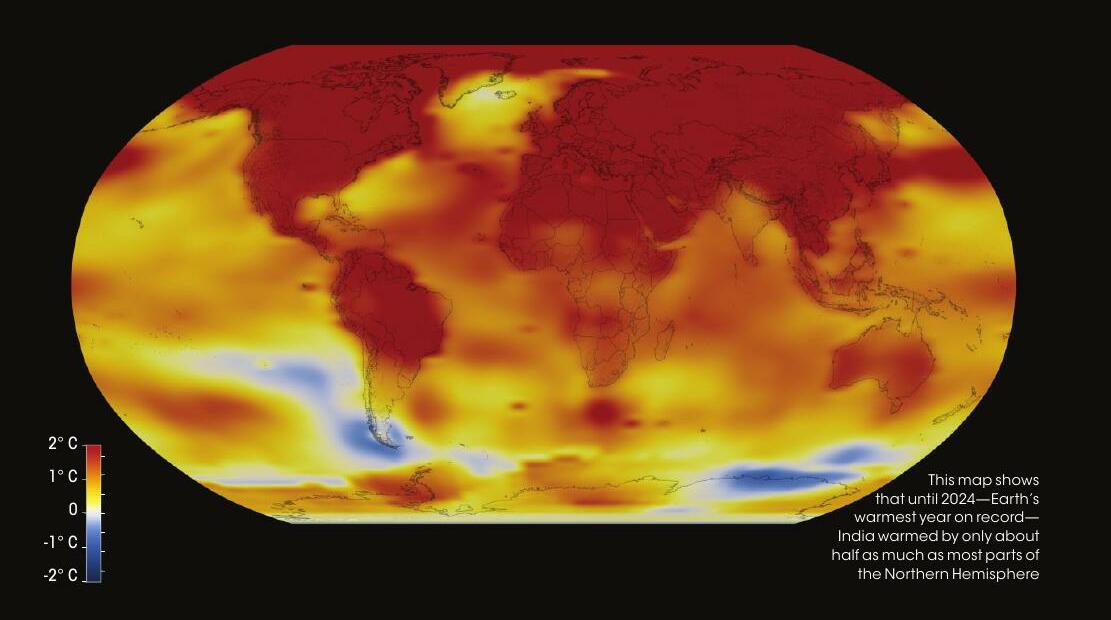
INDIA HAS warmed significantly over the past several decades—but not as much as the rest of the Northern Hemisphere. Satellite data from the US National Aeronautics and Space Administration (NASA), released on January 10, shows that since the 1950s, the country has warmed about 0.6°C, which is only about half the warming seen in other regions of the hemisphere. At first glance, this might seem like a potential silver lining in the climate crisis. But scientists say it could be a warning sign rather than a cause for comfort.
One possible explanation for this unusual trend lies in the thick blanket of aerosols—fine particulate matter that remain suspended in the air—lingering over large parts of the country, especially the Indo-Gangetic plains.
Aerosols, largely released through fossil fuel combustion, crop burning and industrial activities, act like a massive sunshade. “They reflect sunlight back into space like tiny mirrors or absorb it in the upper atmosphere. Either way, they reduce the amount of solar radiation reaching the surface,” says Loretta J Mickley, senior research fellow and co-lead, Atmospheric Chemistry Modeling Group, Harvard University, US. The result is a net cooling effect at the ground level—even as greenhouse gases continue to accumulate.
However, Mickley says, little has been studied to understand what governs the temperature patterns in India and the role of aerosols in suppressing warming. “In the eastern US, we have historically dealt mostly with reflective sulphate aerosols,” says Mickley. “But India also has a significant presence of black carbon—emitted from industries and crop burning—which makes the aerosol mix much more absorbing,” she adds.

Dit verhaal komt uit de May 01, 2025-editie van Down To Earth.
Abonneer u op Magzter GOLD voor toegang tot duizenden zorgvuldig samengestelde premiumverhalen en meer dan 9000 tijdschriften en kranten.
Bent u al abonnee? Aanmelden
MEER VERHALEN VAN Down To Earth

Down To Earth
BEYOND COLLATERAL DAMAGE
Recent geopolitical conflicts are urging a reconsideration of what constitutes environmental harm in war and the limits of existing legal frameworks

3 mins
April 01, 2026

Down To Earth
Masterstroke
Residents of a small Kerala town reject an inadequate state-led development blueprint and create their own master plan that prioritises protection of historic water systems and urban commons
4 mins
April 01, 2026

Down To Earth
Rethinking E20
It is pertinent to explore potential of ethanol as high-value industrial feedstock
4 mins
April 01, 2026
Down To Earth
Food in the age of climate change
WHEN WE eat, we contribute to climate change. But food is also about livelihoods, about nutrition and about nature.
3 mins
April 01, 2026

Down To Earth
FADING WINTER
India's winters are warming, becoming shorter, shifting and spilling beyond their traditional bounds. The consequences are already evident in meltwater availability, forest-fire intensity and changes in flowering cycles and insect behaviour.
20 mins
April 01, 2026
Down To Earth
War on Iran strikes India's pharmaceuticals sector
Shortages of critical raw materials and rising input costs for the drug industry will have global consequences
4 mins
April 01, 2026

Down To Earth
POWER IN AN AGE OF INSECURITY
Energy transition is no longer solely about emission reduction but also about energy security
3 mins
April 01, 2026
Down To Earth
Re-discovery of fuelwood
THE WEST Asia conflict has made visible a multi-billion dollar energy market in India.
2 mins
April 01, 2026

Down To Earth
A CASE THAT RESHAPED INDIA'S ENVIRONMENT
The case of MC Mehta v Union of India stands as proof that a proactive judiciary can accelerate action even when the executive drags its feet
4 mins
April 01, 2026
Down To Earth
FOREVER DEPENDENT
India depends on global fertiliser supply chains for 70 per cent of its needs, leaving its food security exposed to geopolitical disruptions
6 mins
April 01, 2026
Listen
Translate
Change font size