Poging GOUD - Vrij
Dry beginning
Down To Earth
|August 01, 2022
June is becoming drier and this is delaying the sowing of the kharif season

THE SOUTHWEST monsoon arrived three days ahead of its schedule on May 29 this year. Still, almost a month later, Ajit Pratap was eagerly waiting for the rains to reach his farm in the Jalaun district of Uttar Pradesh. "I have not been able to sow basmati on my 10-hectare (ha) and the forecast suggests the monsoon rains are not coming to my district before July," he says. By this time last year, the village had not only finished sowing but had also started transplanting paddy from the nursery to the farms.
Some 650 km away, Gulab Kapse of Madhya Pradesh's Betul district was forced to sow his soybean crop twice after 60 per cent of the seeds he had sown between June 9 and 10 failed to germinate. Agriculture in Temni village is totally rain-dependent. "Usually it rains in June, but this time the proper rains started almost a month later, after July 14," he says.
In Maharashtra's Nashik district, Bharat Dighole says farmers could not carry out sowing in his village, Jaygaon, in June. "For the last six-seven years that June is going to waste. We are just starting to sow. By now, nursery preparation should have been completed," he says. Dighole cultivates soybean, maize, cabbage and onion. In eastern India, Chhattisgarh, Odisha, Bihar, and Jharkhand have also reported delays in sowing this year because of a patchy monsoon.
June and July are the two most important kharif months, particularly for the 61 per cent of farmers who practice rainfed agriculture, as per National Rainfed Area Authority. A dry June means the ground moisture levels are not conducive for sowing, and the delay can cripple food production.
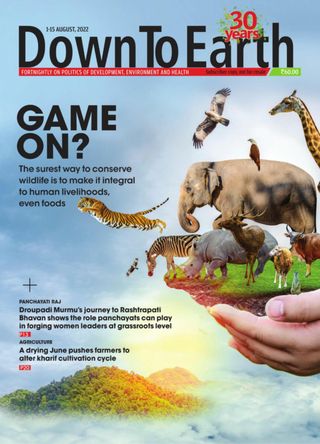

Dit verhaal komt uit de August 01, 2022-editie van Down To Earth.
Abonneer u op Magzter GOLD voor toegang tot duizenden zorgvuldig samengestelde premiumverhalen en meer dan 9000 tijdschriften en kranten.
Bent u al abonnee? Aanmelden
MEER VERHALEN VAN Down To Earth

Down To Earth
THE GREAT PIVOT
China's moves to transition to clean energy offer critical lessons to India

4 mins
March 01, 2026

Down To Earth
COAL V CORRIDOR
A proposal to mine coal along a corridor that links two tiger reserves in central India is a step away from getting final clearance. The move could affect movement and genetic diversity of tiger populations in the region
8 mins
March 01, 2026

Down To Earth
India's challenging AI predicament
Hobbled by lack of innovation and AI skills in its crucial technology sector, India is focusing on a ruinous plan to host data centres
4 mins
March 01, 2026
Down To Earth
China to implement zero tariffs across Africa
CHINA ON February 14 announced that it will implement zero tariffs for imports from all the 53 African nations it has diplomatic relations with, starting from May 1.
1 min
March 01, 2026
Down To Earth
Poverty, sans the threshold
MEASUREMENT OF poverty is a fundamental exercise, needed to direct development programmes.
2 mins
March 01, 2026
Down To Earth
A bridge across forever
For two decades, a Chhattisgarh village remains stuck in a loop of building temporary river crossings to access markets and sell forest produce
4 mins
March 01, 2026
Down To Earth
Liveable cities need a new model
CRY FOR my Delhi. This is my city—my family records many generations who have lived here.
3 mins
March 01, 2026
Down To Earth
Real impacts of the changing seasons
This refers to the article \"1,500 days, and an alarm for new climate\" (1-15 December, 2025).
1 mins
March 01, 2026

Down To Earth
‘It’s a systematic effort by US to dismantle climate policy’
The US, the world's largest historical emitter of greenhouse gases, has overturned its “endangerment finding”, the legal foundation for regulating emissions under the Clean Air Act since 2009.
4 mins
March 01, 2026
Down To Earth
Amazon turned carbon source in 2023 drought
EXTREME DROUGHT and a prolonged heatwave in 2023 pushed parts of the Amazon rainforest from acting as a carbon sink to becoming a carbon source for three months, according to a February 13 study published in the journal AGU Advances of the American Geophysical Union.
1 min
March 01, 2026
Translate
Change font size