
Ga onbeperkt met Magzter GOLD
Krijg onbeperkte toegang tot meer dan 9000 tijdschriften, kranten en Premium-verhalen voor slechts
Is the Universe uniform?
BBC Sky at Night Magazine
|November 2025
One of astronomy's most fundamental assumptions may be wrong. Colin Stuart investigates whether our belief that the Universe looks the same everywhere holds up to scrutiny

Imagine you're in a woodland, with sunlight filtering through the endless green canopy overhead. There's uniqueness everywhere. Some trees grow bolt upright, but others are wizened and twisted. Here the ground is clear, but over there it's riddled with brambles and thorns.
Yet this individuality fades if you can climb a ridge and lift yourself above the canopy. Now your view is a constant sea of green for as far as the eye can see. The forest is both regular and directionless.
Most cosmologists believe that the Universe works in the same way. At small scales, there are individual quirks such as stars, planets and different types of galaxies. But zoom out far enough, to scales of hundreds of millions of lightyears, and it's like climbing that ridge: the Universe becomes uniform.
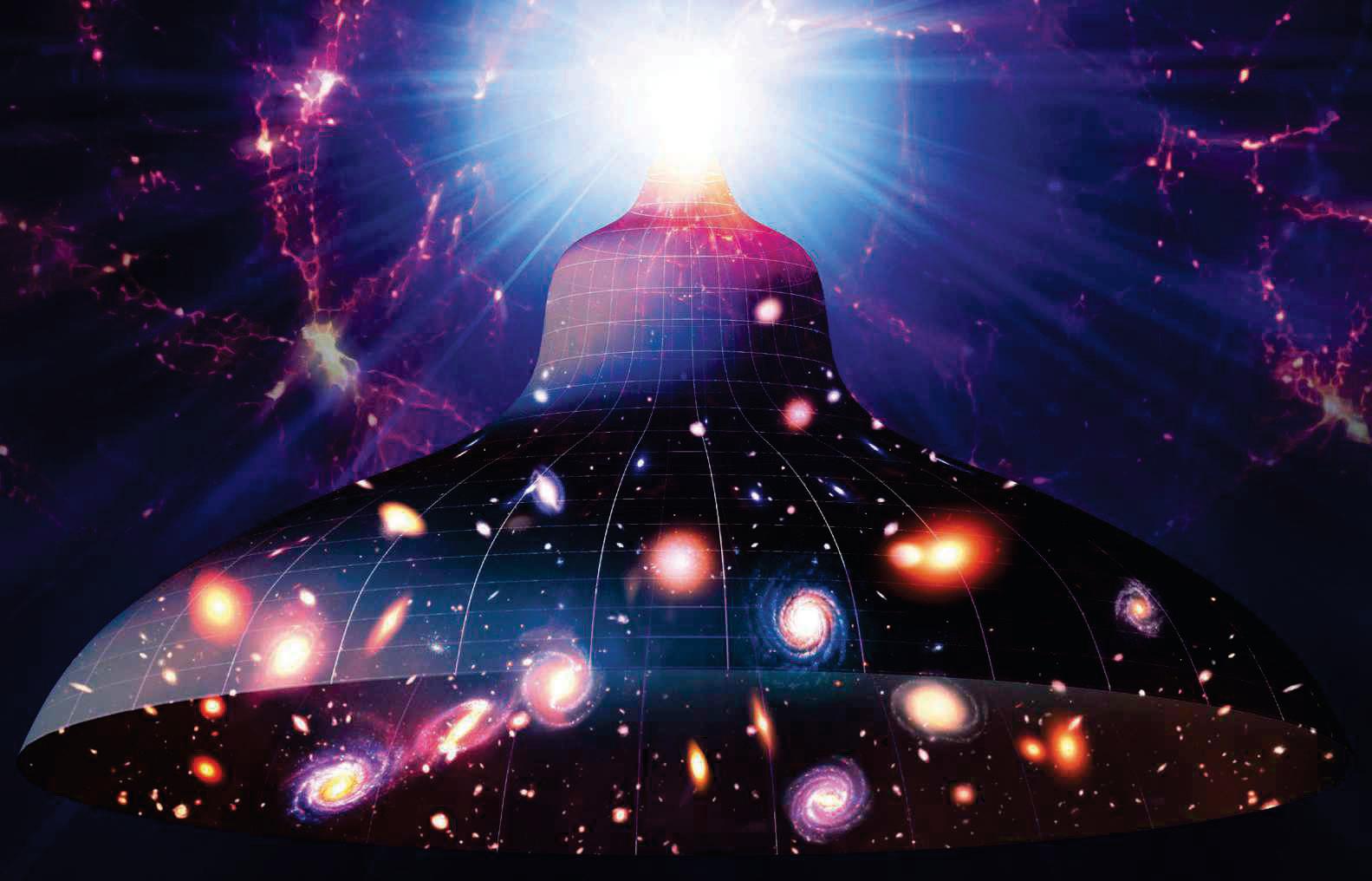 Astronomers say that, on large scales, the Universe is both homogeneous and isotropic. Homogeneous means the Universe is the same everywhere - drop into any sufficiently large patch of space and, on average, you'd see the same spread of galaxies. Isotropic means the Universe looks the same in every direction - no matter whether you look north, south, east or west, the broad brushstrokes of the cosmic picture repeat.
Together, these ideas underpin an almost sacrosanct astronomical assumption that's known as the cosmological principle, which says that we do not occupy a special place in the Universe.
"Homogeneity and isotropy are absolutely central to modern cosmology," says Blake Sherwin, a professor of cosmology at the University of Cambridge. "If we ever robustly confirmed a departure from them, it would force us to reexamine the foundations of the field."

Dit verhaal komt uit de November 2025-editie van BBC Sky at Night Magazine.
Abonneer u op Magzter GOLD voor toegang tot duizenden zorgvuldig samengestelde premiumverhalen en meer dan 9000 tijdschriften en kranten.
Bent u al abonnee? Aanmelden
MEER VERHALEN VAN BBC Sky at Night Magazine

BBC Sky at Night Magazine
MOONWATCH
January's top lunar feature to observe

2 mins
January 2026
BBC Sky at Night Magazine
Speed up your processing workflow
How to use Photoshop's Actions tool to drastically cut your processing time
3 mins
January 2026
BBC Sky at Night Magazine
Chasing Canada's polar lights
With solar maximum peaking and a new Moon promising dark skies, Jamie Carter travels to Churchill, Manitoba to hunt the Northern Lights - and dodge polar bears – in Canada's far north
7 mins
January 2026
BBC Sky at Night Magazine
Beyond Pluto: The search for the hidden planets
Could one – or even two - undiscovered planets lurk at the edges of our Solar System? Nicky Jenner explores how close we are to finding the elusive 'Planet 9'
6 mins
January 2026
BBC Sky at Night Magazine
Jupiter moon events
Jupiter is a magnificent planet to observe.
2 mins
January 2026

BBC Sky at Night Magazine
What samples from space have taught us
Alastair Gunn explains what scientists have learnt in the 20 years since the first unmanned mission brought materials back from alien worlds
3 mins
January 2026
BBC Sky at Night Magazine
The Milky Way as you've never seen it before
This is the largest low-frequency radio colour image of our Galaxy ever assembled
1 min
January 2026

BBC Sky at Night Magazine
Merger of ‘impossibly' massive black holes explained
Scientists discover how enormous, fast-spinning black holes can exist after all
1 mins
January 2026
BBC Sky at Night Magazine
Lunar occultation of the Pleiades
BEST TIME TO SEE: 27 January from 20:30 UT
1 min
January 2026
BBC Sky at Night Magazine
The Universe's expansion may be slowing down
New study suggests current theories of dark energy could be wrong
1 mins
January 2026
Listen
Translate
Change font size